The phrase “What Kind of Vs What Kinds of” shows the difference between asking about one type and asking about many types. “What kind of” is used with singular nouns. “What kinds of” is used with plural nouns. This is an easy grammar rule about singular vs plural forms.
Have you ever wondered if you should say what kind of or what kinds of? Many people get confused. Even native speakers sometimes mix them up. Learning the correct usage can make your English sound clear and confident.
The choice depends on the noun and the context. “What kind of” works for one category or uncountable nouns. “What kinds of” is for different groups or many categories. Knowing this difference helps in speaking, writing, and asking clear questions.
Understanding the Basics: Singular vs. Plural
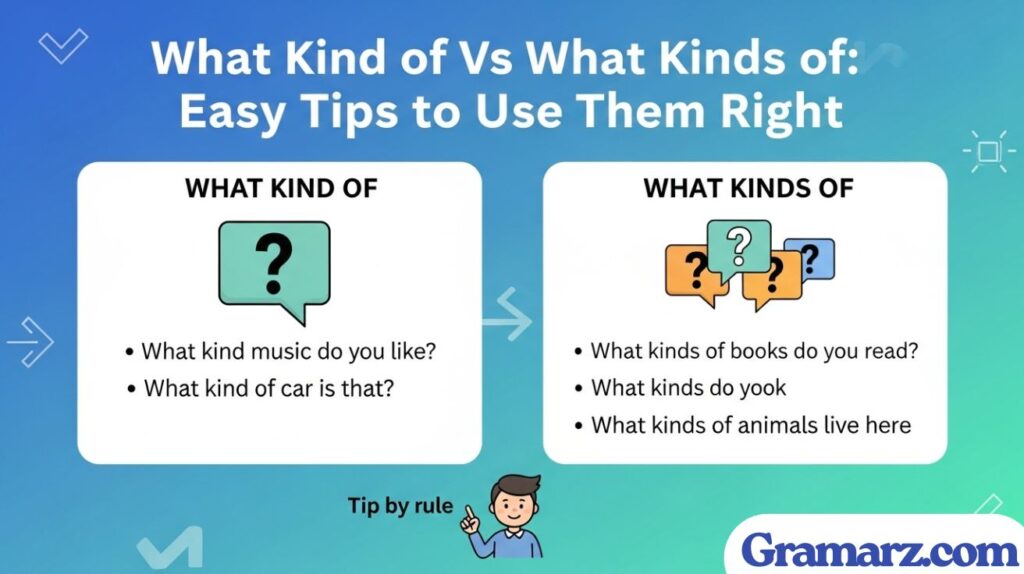
At the heart of this discussion lies the rule of grammar rules singular vs plural. The phrase “What kind of” is always connected to a singular noun, while “What kinds of” is followed by a plural noun. This is the foundation of the what kind of grammar rule and the what kinds of grammar rule.
To make this clearer, consider the following table:
| Phrase | Follows | Example | Meaning |
| What kind of | Singular noun / Uncountable noun | What kind of fruit do you like? | Asking about one type or category |
| What kinds of | Plural noun | What kinds of fruits are in the basket? | Asking about multiple types or categories |
This distinction may look small, but it changes the meaning of the question. In other words, asking about types in English depends on whether you want one answer or many.
“What Kind of”: The Singular Inquiry
The phrase what kind of is used when you want to know about a single category, type, or instance. It aligns with singular vs plural nouns, and here, we always pair it with a singular word or with uncountable nouns examples.
For instance, you might ask, What kind of music do you enjoy? The answer could be “jazz,” “rock,” or “classical.” Notice that music is uncountable, but we still use what kind of. Similarly, asking What kind of car do you drive? expects a single reply, such as “Toyota” or “Ford.”
This correct usage of what kind of works best when you want a specific and limited answer. It helps you narrow down the conversation to one choice.
“What Kinds of”: The Plural Exploration
On the other hand, what kinds of is used when the question is about multiple categories or varieties. This is the basis of the what kinds of grammar rule. The noun that follows must be plural, such as cars, foods, or activities.
For example, What kinds of books do you enjoy? invites a broader answer like “mystery novels, biographies, and science fiction.” Or, What kinds of pets are good for children? could lead to a list including “dogs, cats, and hamsters.”
This phrase helps in situations where the answer is expected to include more than one possibility. Understanding this rule will help you avoid common grammar mistakes and make your English sound more natural.
Contextual Usage: When to Use What Kind of Vs What Kinds of
Knowing the difference between what kind of and what kinds of is important, but even more important is understanding the context. Language is flexible, and how you ask depends on whether you expect one answer or many.
Specific Inquiries
When you are asking for one exact answer, you use what kind of. These are English grammar questions examples where the speaker is looking for something specific. If you ask, What kind of phone do you use? the listener might say, “iPhone.” Similarly, What kind of pet would you like to adopt? usually expects “a dog” or “a cat.”
Broad Explorations
If the question allows for many answers, you should use what kinds of. For example, What kinds of phones are popular in the USA? can bring answers like “Samsung, Apple, and Google Pixel.” Or, What kinds of activities do children enjoy in summer? could include “swimming, biking, and camping.”
In short, when to use what kind of is when you want one answer, and when to use what kinds of is when you want many.
Common Mistakes and How to Avoid Them
Even native speakers sometimes confuse the rules. Let’s examine the common ESL mistakes related to this topic.
Mismatching Singular and Plural
A common error is mixing the rule with the wrong noun. Saying, What kind of books do you like? is incorrect, because “books” is plural. The correct form is What kinds of books do you like? Conversely, saying What kinds of car is that? is wrong. The correct phrase is What kind of car is that?
Confusion with Collective Nouns
Another mistake happens with collective nouns in English, which are grammatically singular but represent groups. For instance, What kind of team do you support? is correct because “team” is treated as singular. But saying What kinds of family do you come from? is incorrect. It should be What kind of family do you come from?
Overlooking Context
Sometimes people ignore context. What kind of fruit do you like? asks for one favorite type of fruit. What kinds of fruits are in this salad? asks for a list of different fruits. Knowing how context shapes your choice is key to improve English communication skills.
Practical Examples in Various Contexts
The use of these phrases becomes easier when we see them applied in real-world settings.
In Educational Settings
In school or university, you may ask, What kind of degree are you pursuing? expecting “bachelor’s” or “master’s.” On the other hand, What kinds of courses are offered in this program? would include several classes like “mathematics, history, and economics.” This is important for grammar in academic writing because clear phrasing avoids confusion.
In Professional Environments
At work, grammar for professional communication is critical. For example, What kind of experience do you have in marketing? expects a focused answer, like “digital marketing.” Meanwhile, What kinds of skills are needed for this job? invites multiple replies, such as “communication, leadership, and technical expertise.”
In Everyday Conversations
In casual talks, grammar for everyday conversation is just as important. If someone asks, What kind of movie do you want to watch tonight? they want a specific answer like “action.” But What kinds of movies do you usually enjoy? could include “comedy, horror, and drama.” These are different kinds of examples that show how naturally the rule applies in daily life.
Enhancing Your Language Skills
Using these phrases correctly shows a good command of English. The more you practice, the fewer common grammar mistakes you will make. It also helps you speak with confidence, whether you are studying, working, or chatting with friends. Remember, the purpose is not just grammar but clarity. When you choose the right phrase, you guide the listener toward the right kind of response.
Advanced Uses and Exceptions
While the main rule is simple, English has many exceptions. Sometimes, the distinction is not only grammatical but also conceptual.
Uncountable Nouns
With uncountable nouns examples like “water,” “music,” or “information,” we always use what kind of. You might ask, What kind of music do you like? or What kind of information are you looking for? Even if there are many types of music, the noun “music” cannot be made plural.
Collective Nouns Revisited
As mentioned earlier, collective nouns in English can be tricky. If you ask, What kind of team are you building? you are treating the team as one unit. But if you ask, What kinds of players are on this team? you are talking about the members.
Abstract Concepts
Abstract nouns, like love, courage, or happiness, also follow this rule. What kind of love do you believe in? looks at love as one concept. But What kinds of love exist in human relationships? explores multiple forms, such as romantic love, family love, or friendship. This is a case where abstract nouns grammar affects meaning.
Contextual Nuances
When learning what kind of vs what kinds of, it is important to look beyond the basic grammar rules singular vs plural. While “kind” usually introduces a singular noun and “kinds” introduces a plural noun, there are situations where context changes the choice. For example, What kind of music do you like? treats music as one broad category, while What kinds of music do you like? expects several different genres as answers. Both are correct, but the context shapes whether you want one type or many.
Understanding when to use what kind of and when to use what kinds of depends on whether you want to focus on a single answer or explore multiple possibilities. Context also affects tone. A teacher may ask, What kind of help do you need? focusing on one form of assistance. A counselor might ask, What kinds of problems are students facing this year? which invites a list of issues. These small changes in phrasing make a big difference in communication.
Cultural and Regional Variations
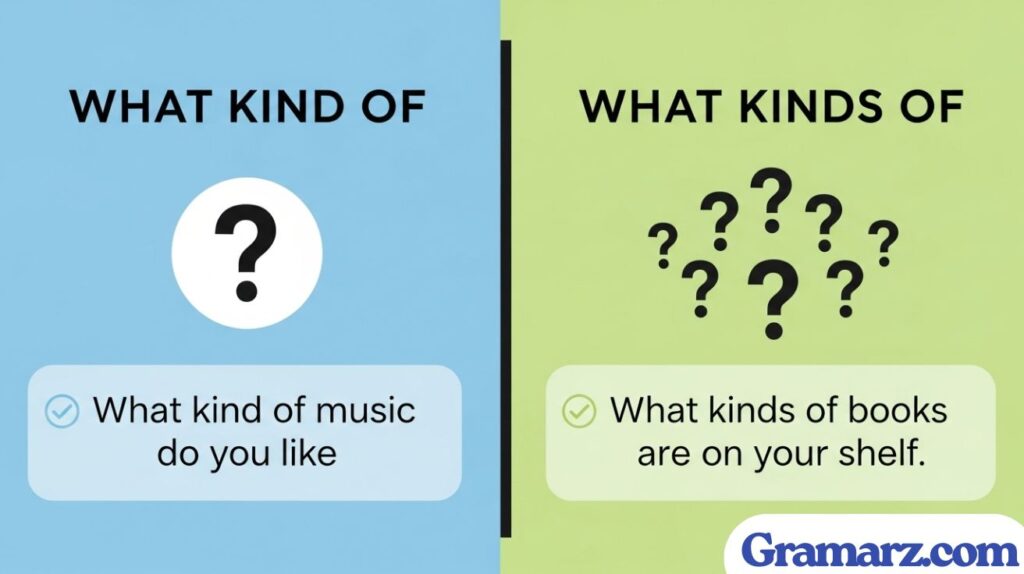
While the correct usage of what kind of and correct usage of what kinds of follows the same rules worldwide, regional preferences sometimes affect word choice. In American English, “kind” and “kinds” are most common, while in British English, people often use what sort of vs what kind of in the same way. For example, a British speaker may say, What sort of food do you like? while an American might prefer, What kind of food do you like?
Similarly, what type of vs what types of and what variety of vs what varieties of are often used as alternatives. For instance, you might ask, What type of job are you applying for? or What types of jobs are available in this field? These are essentially parallel to what kind of vs what kinds examples. In the United States, people also use kinds of vs types of interchangeably, though “types” sometimes sounds more formal.
This shows that while the rule of singular vs plural nouns is fixed, the actual phrases used may vary depending on culture, tone, and even region.
Practical Applications in Writing and Speaking
The best way to learn the difference between what kind of and what kinds of is to see how they appear in professional and real-world settings.
Academic Writing
In grammar in academic writing, accuracy is very important. For example, a research paper might ask, What kind of impact does social media have on adolescent mental health? Here, the focus is on one specific kind of effect, perhaps positive or negative. Another study might ask, What kinds of interventions are effective in supporting students? which seeks multiple strategies such as counseling, peer mentoring, and workshops.
Academic writing often requires careful use of what kind of grammar rule and what kinds of grammar rule to ensure the research question is precise.
Business Communication
In professional settings, grammar for professional communication demands clarity. If a manager asks, What kind of budget are we working with? the expectation is a single total number. But when they ask, What kinds of expenses should we anticipate? the answer might include marketing costs, travel, and staff salaries.
Misusing these phrases in business can lead to confusion, making this distinction critical for contracts, reports, and presentations.
Journalistic Writing
In journalism, where every question must be sharp, the difference between what kind of and what kinds of becomes even clearer. A journalist might ask, What kind of statement will the company release? expecting one official answer. Another might ask, What kinds of reactions have you received from the public? which invites a variety of opinions such as supportive, critical, or neutral.
Good journalists avoid common ESL mistakes by always keeping the context in mind.
Enhancing Your Questions
Knowing the correct usage of what kind of and correct usage of what kinds of is not just about grammar; it is about asking smarter questions. For example, instead of asking, What kind of food do you like? you could ask, What kind of cuisine do you prefer when celebrating a special occasion? This makes the question more specific and meaningful.
Adding follow-ups also helps. After asking, What kinds of books do you enjoy reading? you might continue with, What kind of influence has your favorite book had on your life? Combining both forms can create a deeper and more engaging conversation.
These techniques go beyond English grammar tips and show how grammar supports better communication in all areas of life.
Read Also : Goomar Its Meaning, Origin and Usage
Common Related Phrases
The rules for what kind of vs what kinds of also apply to other phrases. For example, what type of vs what types of, what sort of vs what sorts of, and what variety of vs what varieties of follow the same grammar rules singular vs plural pattern.
The table below shows this clearly:
| Singular Form | Plural Form | Example |
| What kind of | What kinds of | What kind of movie do you like? / What kinds of movies do you like? |
| What type of | What types of | What type of car do you own? / What types of cars are popular? |
| What sort of | What sorts of | What sort of questions are on the exam? / What sorts of questions are included? |
| What variety of | What varieties of | What variety of coffee is this? / What varieties of coffee are served here? |
These alternatives enrich your vocabulary and reduce repetition in both grammar for academic writing and grammar for everyday conversation.
Practicing Your Skills
Practice is essential to avoid common ESL mistakes. One way to practice is to create your own different kinds of examples. For instance, try writing five sentences with what kind of and five with what kinds of, then check if the nouns that follow are singular or plural. Another way is to listen to native speakers and notice how they use these questions in daily life.
You can also create short case studies. For example, imagine you are preparing for a job interview. Write possible interview questions such as What kind of work environment do you prefer? and What kinds of tasks do you enjoy the most? This kind of practice combines real-life usefulness with grammar accuracy.
The Importance of Context
The rule of what kind of vs what kinds of always comes back to context. If a teacher asks, What kind of solution are you proposing? the answer is expected to be one strong suggestion. But if the question is, What kinds of solutions are possible? then several options are expected.
These subtle changes can guide entire conversations. Being aware of context also prevents common grammar mistakes that confuse the listener. This is why every serious learner must understand not just the rule but also its use in real situations.
The Role of Tone and Formality
Tone also plays a role in how we use these phrases. In formal writing, such as academic papers or professional reports, it is important to stick closely to the what kind of grammar rule and what kinds of grammar rule. But in casual conversation, especially in grammar for everyday conversation, native speakers sometimes blur the distinction, especially with uncountable nouns examples like “music” or “information.”
Still, learners should follow the rules carefully until they are confident enough to recognize when informal exceptions are acceptable. This habit not only prevents common ESL mistakes but also strengthens overall fluency.
Beyond English: A Universal Concept
The idea behind what kind of vs what kinds of is not unique to English. Many languages make a similar distinction between singular and plural. For example, in Spanish we say qué tipo de for singular and qué tipos de for plural. In French, it becomes quel genre de and quels genres de.
This shows that the difference between what kind of and what kinds of is a universal concept tied to how humans classify and group things. Even when dealing with collective nouns in English, uncountable nouns examples, and abstract nouns grammar, the logic of singular versus plural applies across languages.
Understanding the Core of “What Kind of”
The phrase “what kind of” is used when we want to ask about a single category, type, or classification. It usually works with singular nouns, such as What kind of car do you drive? The answer is expected to focus on one example, like “a sedan” or “an SUV.” This is the essence of the what kind of grammar rule.
In English, what kind of also works naturally with uncountable nouns examples, like What kind of music do you enjoy? Since “music” is treated as one big category, “kind” stays singular. This form is helpful in grammar for everyday conversation where one answer or one general type is expected, making it simple but effective in communication.
Exploring the Plural Nature of “What Kinds of”
The phrase “what kinds of” is plural and expects multiple categories or answers. For instance, What kinds of books do you read? might result in “novels, biographies, and poetry.” Here, the what kinds of grammar rule is tied to plural nouns, allowing the speaker to discuss more than one category in detail.
This plural construction works well when asking about types in English where variety is expected. In professional or academic contexts, you might see it in questions like What kinds of challenges affect small businesses? which invites a range of answers. It fits well when exploring different kinds of examples across broad subjects.
FAQ,s
Which kind or what kind is correct?
“What kind” is the correct form. Use “which kind” only when the choices are already limited or specific.
Does is what kind of tense?
The word “does” belongs to the simple present tense, mainly used in questions or negative sentences.
How to use the word kind of?
Use “kind of” to ask about a type or category, such as What kind of book do you like? It can also mean “somewhat” in casual speech, like I kind of agree.
What kind of questions or what kinds of questions?
Use “what kind of questions” when asking about one category. Use “what kinds of questions” when asking about multiple categories or types.
Final Thoughts
The what kind of vs what kinds of debate is not just about grammar. It is about clarity in communication. Whether you are learning English, teaching it, or using it professionally, knowing the difference between what kind of and what kinds of helps you avoid mistakes and express yourself better.
Think of it this way: Use “kind” for one, and “kinds” for many. That simple rule can guide you in all situations. By practicing with English grammar questions examples, observing how native speakers use them, and paying attention to common ESL mistakes, you will strengthen your grammar and improve your overall communication skills.