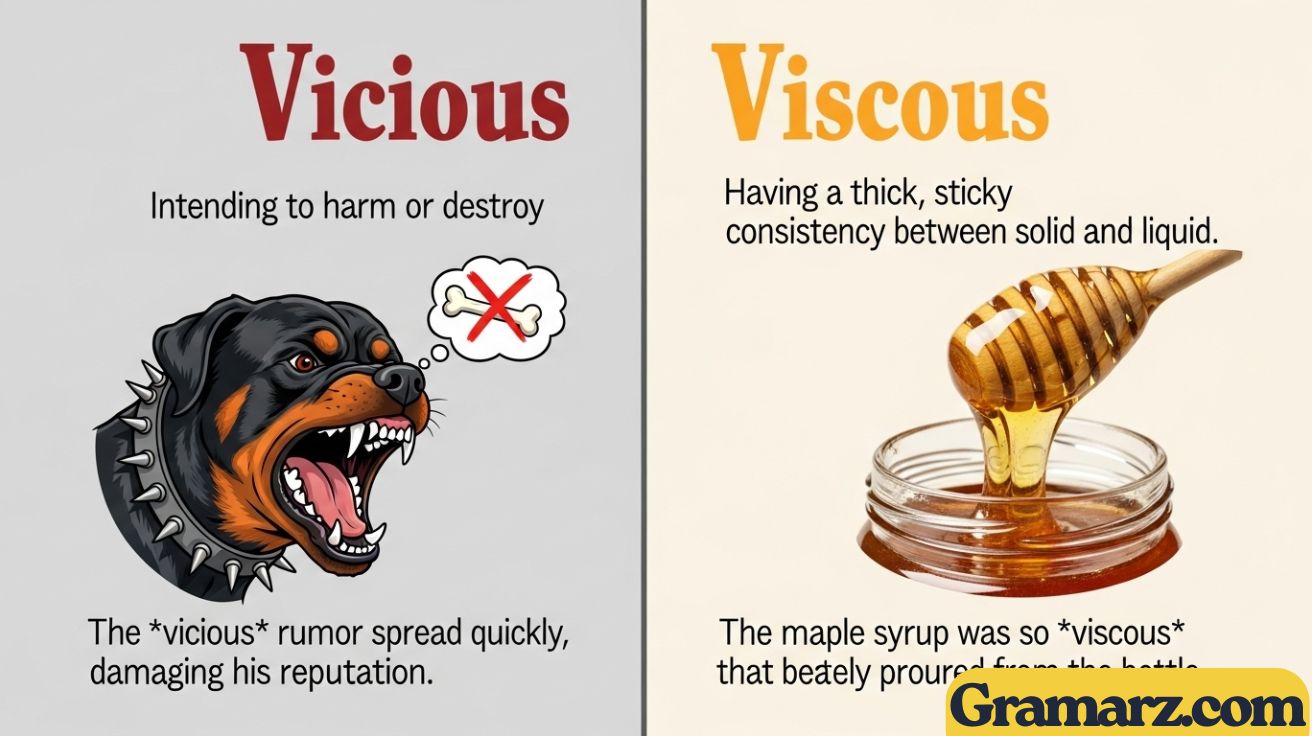
The words vicious vs viscous sound almost the same but have very different meanings. Vicious means cruel, violent, or evil, while viscous means thick, sticky, or slow-flowing. Knowing their difference helps you write and speak correctly.
It’s easy to mix up vicious vs viscous because they look and sound alike. One belongs to emotion and behavior, the other to science and texture. A single wrong word can completely change your meaning.
Understanding vicious vs viscous makes your English more clear and confident. You’ll learn how to use “vicious” to describe cruelty and “viscous” to describe sticky liquids. These small details make a big difference in writing.
The Sticky Situation of Similar-Sounding Words
English is filled with words that sound almost identical but carry completely different meanings. These are not always true homophones, but they cause homophones confusion because of their pronunciation similarities. The pair vicious and viscous is a perfect example. Many writers accidentally use one instead of the other, which can make sentences sound odd or even change the meaning entirely. For instance, saying “a vicious liquid” sounds strange because liquids cannot be cruel, while “a viscous liquid” correctly describes thick and sticky liquids like honey or syrup.
The problem arises because these words are pronounced similarly, and both begin with “vi-” and end with an “-ous.” When we rely on sound instead of meaning, mistakes happen. This highlights the importance of careful spelling and context awareness in proper word choice in writing.
The Power of Precision in Language
The power of precision in language cannot be overstated. Using the right word at the right time is what separates clear communication from confusion. Choosing between vicious and viscous might seem small, but it can change the tone and intent of your writing completely. A scientist writing about a scientific term for stickiness must know what does viscous mean in chemistry, while a journalist describing cruel or violent behavior must use vicious. Precision in writing ensures that your readers understand exactly what you mean without misinterpretation.
In everyday communication, incorrect word use can make someone question your credibility. In professional writing, it can make an article misleading. Therefore, understanding the meaning of vicious and viscous helps maintain clarity and professionalism in every sentence you write.
Why “Vicious” and “Viscous” Trip Us Up
The confusion between these two words comes from their pronunciation difference between vicious and viscous being subtle. The first is pronounced “VISH-us,” while the second is “VIS-kus.” For non-native speakers and even fluent English users, the “sh” and “sk” sounds can blur together, leading to mistakes. Another reason is that “vicious” is used more often in daily speech, while “viscous” appears mostly in scientific or technical writing.
People often guess based on what sounds familiar. Because viscous isn’t used as frequently, it’s easy to pick the wrong one. This confusion is a classic example of how English vocabulary mistakes arise from sound-based assumptions rather than understanding meaning.
The Role of Homophones in Language Confusion
While vicious and viscous are not exact homophones, they cause the same kind of homophones confusion that words like “affect” and “effect” or “to,” “too,” and “two” do. English has many similar-sounding English words that challenge even advanced learners. These near-homophones remind us why attention to spelling, meaning, and context is so important. Understanding how pronunciation and meaning connect allows writers to avoid falling into the trap of commonly misused words.
Vicious: When Words Bite Back

The word vicious has a sharp edge—it describes something harsh, cruel, or dangerously aggressive. The Latin origin of vicious is “vitiosus,” meaning “faulty” or “corrupt.” Over time, it evolved to mean cruel or violent behavior, which we use today in many emotional, moral, or social contexts.
Definition and Core Meaning
Vicious means intentionally harmful, aggressive, or full of evil intent. It is used to describe people, animals, storms, or even words that cause pain. Here is a short vicious definition and examples:
| Context | Example Sentence |
| Behavior | The man made a vicious attack on his opponent. |
| Speech | She spread a vicious rumor about her coworker. |
| Animals | The vicious dog barked fiercely at strangers. |
| Weather | A vicious storm destroyed homes across the coast. |
| Society | The vicious circle meaning of poverty repeats itself. |
Learning how to use vicious in a sentence correctly can add emotional power and clarity to your writing.
Psychological and Sociological Contexts
In psychology and sociology, the word vicious is often used in phrases like “a vicious cycle.” This describes harmful patterns that repeat themselves, such as addiction or poverty. The phrase vicious circle meaning represents self-destructive behavior that feeds on itself, worsening over time. Using this term accurately in discussions shows an understanding of social systems and cause-and-effect relationships.
The Impact of Vicious Language
Language shapes perception. Describing something as vicious gives it emotional intensity—it sounds dangerous and negative. Writers and speakers use it to show severity, but overuse can make it lose impact. In professional writing, it’s best to reserve vicious for situations where cruelty, violence, or harm are clearly present.
Viscous: The Science of Stickiness
While vicious relates to aggression, viscous describes thick and sticky liquids that flow slowly. The Latin origin of viscous is “viscosus,” meaning “sticky.” It is commonly used in scientific writing and discussions about fluid properties and viscosity meaning and examples. Understanding viscous meaning in science helps avoid mixing it up with emotional or moral terms.
Definition and Physical Properties
Viscous means having a thick, slow-moving consistency. Substances like honey, syrup, oil, and molasses are perfect viscous substances like honey. In simple words, viscosity is how resistant a fluid is to flowing. Scientists define it as a measure of internal friction within a liquid.
Applications in Various Fields
What does viscous mean in chemistry? It refers to a liquid’s resistance to flow. Chemists study viscous fluid properties to understand how different materials behave under temperature or pressure. In biology, viscosity affects blood flow and digestion. Engineers design lubricants with specific viscosity levels to protect machines. Geologists use the term to describe magma or glacier movement. Thus, viscous has importance across multiple disciplines, showing how it connects language and science.
Everyday Examples of Viscosity
In daily life, how to use viscous correctly is simple. When describing something that moves slowly and feels thick, use “viscous.” For example, honey is more viscous than water because it flows slower. Chocolate syrup, shampoo, and ketchup are also viscous substances like honey. These examples help visualize the concept clearly.
The Science Behind Viscosity
From a scientific point of view, viscosity depends on temperature and molecular friction. When heat increases, most liquids become thinner and less viscous. Gases, however, become more viscous when heated. This is why cold honey pours slowly, while warm honey flows faster. This basic concept of viscosity helps in understanding viscous vs viscid materials in scientific term for stickiness studies.
Read Also : Arised or Arose: What’s the Correct Past Tense of Arise?
Face-Off: Vicious vs Viscous

The table below summarizes the difference between vicious and viscous for quick understanding:
| Aspect | Vicious | Viscous |
| Pronunciation | VISH-us | VIS-kus (viscous pronunciation guide) |
| Part of Speech | Adjective | Adjective |
| Primary Meaning | Cruel, violent, aggressive | Thick, sticky, slow-flowing |
| Etymology | Latin origin of vicious: vitiosus (faulty) | Latin origin of viscous: viscosus (sticky) |
| Context | Behavior, actions, criticism | Science, cooking, materials |
| Connotation | Negative | Neutral |
| Example Sentence | The politician’s vicious attack shocked everyone. | The honey was so viscous it barely moved. |
This vicious vs viscous examples table clearly shows when to use vicious or viscous in writing.
Memory Tricks for Differentiation
Remembering which word is which can be easy with the right mental image. Think of “vicious” as having two “i” letters—like two angry eyes staring back at you. “Viscous” contains “sc,” which you can link to science, where it’s often used. You can also imagine “vicious villains” and “viscous vanilla pudding” to make it stick in your memory.
In Action: Examples that Stick
Understanding how to use viscous correctly and how to use vicious in a sentence becomes easier through examples.
Vicious in Literature and Media
“The vicious dog lunged at the intruder.”
“The critics were vicious in their review of the play.”
“She launched a vicious verbal attack against her rival.”
These examples show vicious as emotionally powerful and aggressive.
Viscous in Scientific Papers and Cookbooks
“The viscous lava flowed slowly down the volcano.”
“Add more water if the batter becomes too viscous.”
“Engineers measured the viscous fluid properties to improve performance.”
These sentences highlight the use of viscous in both everyday and scientific contexts.
Common Phrases and Idioms
Vicious:
Vicious circle, vicious tongue, vicious streak, vicious attack, vicious rumor.
Viscous:
Viscous flow, highly viscous fluid, viscous drag, viscous deformation, viscous material.
Case Study: The Power of Word Choice
A food critic once wrote, “The sauce had a vicious consistency that clung to the plate.” This sounds humorous because vicious describes aggression, not texture. After revising it to “The sauce had a viscous consistency that clung to the plate,” the description became accurate.
This simple change transformed the sentence from confusing to correct, proving how proper word choice in writing shapes meaning.
Understanding the Difference Between Vicious and Viscous
Many English learners struggle to see the difference between vicious and viscous because they sound almost identical. However, these two words have completely different meanings and uses. Vicious describes cruel or violent behavior, while viscous refers to thick and sticky liquids that resist flow.
Learning this difference improves language precision and clarity, helping writers avoid commonly misused words. Understanding their meanings ensures that your writing stays accurate whether you are describing a person’s behavior or a scientific property like viscosity meaning and examples.
Vicious: A Word of Cruelty and Aggression
The word vicious comes from the Latin origin of vicious, “vitiosus,” which means “faulty” or “corrupt.” Over time, it evolved to describe something harmful, aggressive, or evil. A vicious person or action is intentionally cruel and meant to cause harm or fear.
Writers often use vicious to show intensity—like a vicious attack, vicious rumor, or vicious storm. These examples show the emotional power of the word. Understanding vicious definition and examples helps you use it correctly in any situation.
Viscous: The Science of Stickiness
Unlike “vicious,” viscous has nothing to do with emotion or cruelty. It describes thick and sticky liquids like honey, syrup, or oil. The Latin origin of viscous, “viscosus,” means “sticky,” and it appears often in scientific discussions.
In science and chemistry, viscous meaning in science refers to how slowly a fluid flows. This property, known as viscosity, depends on temperature and molecular friction. Understanding what does viscous mean in chemistry helps scientists study viscous fluid properties accurately.
Pronunciation Difference Between Vicious and Viscous

A key reason these two words confuse people is their similar sound. The pronunciation difference between vicious and viscous is small but important. Vicious sounds like “VISH-us,” while viscous is pronounced “VIS-kus.”
Using a viscous pronunciation guide can help learners master this distinction. Practice saying each word slowly and listening to the “sh” versus “sk” sound. Clear pronunciation prevents homophones confusion and ensures correct word use in both spoken and written English.
Examples That Clarify Usage
Understanding how to use vicious in a sentence and how to use viscous correctly becomes easier with real-world examples. Saying “a vicious attack shocked everyone” is correct, while “a viscous liquid like honey flows slowly” shows accurate scientific use.
Here are some vicious vs viscous examples to remember: a vicious rumor destroys trust, but a viscous substance like honey sticks to your spoon. Knowing when to use vicious or viscous helps avoid confusing your readers.
Common English Vocabulary Mistakes
Vicious vs viscous is one of many confused words in English that cause errors in writing. Such similar-sounding English words lead to homophones confusion and make even fluent speakers hesitate. Learning the meanings of these words improves your writing’s accuracy.
English has many pairs like “affect” vs “effect” and “complement” vs “compliment.” Knowing the difference between vicious and viscous fits into this same effort to master language precision and clarity and avoid commonly misused words.
The Importance of Proper Word Choice in Writing
Choosing the right word shows professionalism and intelligence. Using “vicious” instead of “viscous” in a scientific report changes the meaning completely, leading to confusion. That’s why proper word choice in writing is essential for clarity.
Writers, students, and professionals must pay attention to spelling, context, and meaning. Whether describing cruel or violent behavior or thick and sticky liquids, knowing the difference between vicious and viscous strengthens communication and credibility.
FAQs
Is it vicious or viscous?
Use vicious for cruelty or aggression and viscous for thick, sticky substances.
What is a viscous person?
A “viscous person” is incorrect; viscous describes fluids, not people.
Is there a relationship between vicious and viscous?
No, they only sound similar; vicious means cruel, while viscous means sticky.
What is the difference between viscosity and viscidity?
Viscosity measures a liquid’s resistance to flow, while viscidity means general stickiness.
Conclusion: The Viscous Nature of Vicious Words
The English language is full of fascinating challenges, and vicious vs viscous is one of them. By understanding their roots, meanings, and correct contexts, writers can avoid English vocabulary mistakes and communicate ideas more clearly. Vicious refers to cruel or violent behavior, while viscous describes thick and sticky liquids.
Knowing their distinction helps you choose your words wisely and express your thoughts precisely.As language learners, we must appreciate the subtle differences that shape meaning. Every word carries its own weight, and the more we learn, the stronger our writing becomes. Mastering the difference between vicious and viscous is a small but vital step toward mastering language precision and clarity in all forms of communication.