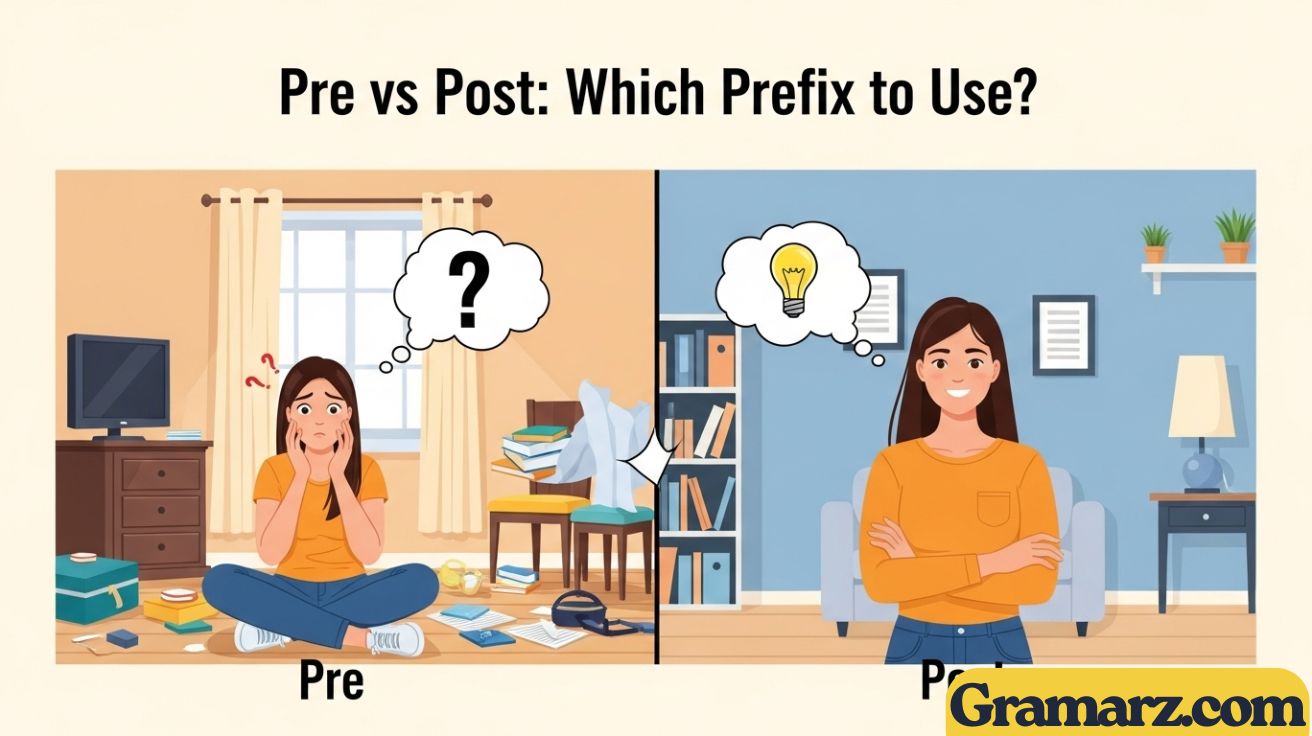
Pre vs Post are small words called prefixes. Pre means before, and Post means after. They help show time and order in English words.
These prefixes are very useful in daily life. They can change the meaning of a word. Knowing Pre vs Post can make your writing clear and correct.
We see Pre vs Post in many areas. In school, medicine, and work, they show before and after events. Learning them makes English easier to understand.
The Essence of Pre and Post: Understanding Pre and Post

At their core, “pre” and “post” are linguistic prefixes that describe when something happens before or after. The pre meaning before indicates anticipation or preparation, while the post meaning after signals a result or consequence. Knowing the temporal prefixes meaning of these two helps in understanding how they frame time in English. For instance, in examples of pre and post words, prehistoric refers to a time before history, and postmodern refers to something after modernism.
The prefix comparison between the two is essential in both everyday speech and academic writing. When you learn understanding prefixes in words, you begin to see how before and after terminology helps shape entire concepts, from pre-war vs post-war to pre-production vs post-production in film and business.
The Power of Prefixes
Prefixes like pre and post are not just linguistic decorations; they are time indicators. They provide context and create new meanings. The prefix rules in English allow these small word parts to attach to root words, changing their entire sense. These time-related prefixes are crucial for clarity because they help the reader or listener immediately understand the timing of an event or condition. For example, the word preheat clearly means to heat something before cooking, while postgraduate refers to education after graduation. The English language is full of such prefix usage examples, and mastering them strengthens both writing and comprehension.
Pre: Before It All Begins
Let’s begin with what does pre mean. The pre prefix definition comes from the Latin word prae, which means “before” or “in front of.” This prefix emphasizes preparation, planning, or anticipation. Words that use “pre” show readiness for what will come next. The pre meaning before can refer to time, position, or even condition. For instance, in preliminary, it means something that comes before the main event, and in prenatal, it refers to the period before birth.
Common Uses of “Pre”
The prefix pre appears in many different kinds of words. Here is a useful pre words list that shows its flexibility across contexts.
| Category | Prefix Pre Examples | Meaning |
| Time | Prehistoric, Predawn | Before a specific time or period |
| Preparation | Preheat, Preplan, Prearrange | Getting ready beforehand |
| Condition | Preexisting, Predisposed | Having a state before something occurs |
| Position | Prefrontal, Precursor | Before in place or order |
These words illustrate how the pre examples in grammar always relate to something happening ahead of time or earlier in sequence.
The Nuances of “Pre”
The prefix “pre” does not only deal with time. It can suggest importance or superiority as well. For example, preeminent means to stand out before others, preempt means to act before someone else can, and predominate means to have more influence. These show how understanding prefixes in words goes beyond simply knowing when something happens. It’s about knowing how the prefix changes the tone and purpose of the word.
Pre- Examples in Context
| Word | Meaning | Example Sentence |
| Preorder | To order in advance | “I preordered the book before its release date.” |
| Prenuptial | Before marriage | “They signed a prenuptial agreement.” |
| Preschool | Before formal schooling | “My son goes to preschool.” |
| Preheat | Heat before cooking | “Always preheat the oven before baking.” |
These examples clarify how to use pre and post by focusing first on the pre prefix definition and its connection to preparation or anticipation.
Post: After the Dust Settles

Now let’s look at what does post mean. The post prefix definition originates from the Latin word post, meaning “after” or “behind.” The post meaning after shows completion or consequence. Words with “post” often describe results or actions that follow an event. When we study post examples in grammar, we see how they deal with aftermath or reflection. For instance, postgame means something that happens after a game, and postwar refers to the period after a war.
Frequent Applications of “Post”
Here is a post words list showing different uses of this prefix across categories.
| Category | Prefix Post Examples | Meaning |
| Time | Postwar, Postmodern | Occurring after an event |
| Position | Postscript, Postnasal | Placed after or behind |
| Change | Posttransition, Posttransformation | Happening following change |
| Continuation | Postproduction, Postprocessing | Work done afterward |
These prefix usage examples show how “post” always carries a sense of following or completion, which is essential in time-related prefixes.
Surprising Uses of “Post”
Sometimes “post” does not just relate to time. It can refer to location or speed. Posthaste means with great speed, postorbital means located behind the eye, and postdate can mean to assign a later date. This flexibility is what makes understanding prefixes in words both challenging and fascinating.
Post- Examples in Context
| Word | Meaning | Example Sentence |
| Postgame | After a game | “The team celebrated their victory at the postgame party.” |
| Postgraduate | After graduation | “She continued her studies as a postgraduate student.” |
| Postmortem | After death | “The postmortem revealed the cause of death.” |
| Postproduction | After filming | “The movie entered postproduction for editing and effects.” |
These examples clearly display pre and post usage in sentences, highlighting the difference between pre and post in function.
Pre vs Post: The Showdown
To make the pre and post difference chart clear, here’s a simple comparison:
| Aspect | Pre | Post |
| Timeline | Before an event | After an event |
| Function | Preparation, anticipation | Reflection, consequence |
| Example | Pre-war vs Post-war | Before and after an event |
When you compare pre vs post meaning in English, you see that both provide a framework for understanding when things happen, giving English its logical structure of time.
Bonus Fun Fact
Although pre and post have opposite meanings, both share the prefix etymology Latin roots from the ancient Proto-Indo-European per, meaning “forward” or “beyond.” That means they’re linguistic cousins separated by time and usage.
Exceptions to the Rule
Language always has exceptions. Postdate doesn’t always mean something after—it can mean to set a future date. Precede sounds like it might come after, but it means to come before. Postpone means to move something to a later time, not after completion. These cases show that even grammar prefixes in English can have flexible meanings depending on the word they attach to.
Read Also : Connector or Connecter: Which is Correct in Modern English?
The Gray Area: When Pre and Post Overlap
There are times when pre and post can refer to overlapping or closely related periods. Historians might discuss pre-modern vs post-classical eras, which sometimes describe the same timeline but from different viewpoints. The before and after prefixes often blur when context changes.
Interchangeability
For example, pre-war vs post-war both describe parts of a historical period, but one looks forward while the other looks backward. This is why context is king when analyzing before and after terminology.
Context is King
Sometimes, a sentence can use both and create a twist. “The pre-dinner drinks were served post-dinner due to a delay.” This playful use shows how important it is to focus on pre and post usage in sentences to understand meaning.
Beyond Time: Other Dimensions of Pre and Post
Although primarily time-related prefixes, both have uses in other areas too.
Spatial Uses
In grammar, a preposition is a word placed before a noun, while in some languages like Japanese, a postposition follows the word it relates to. This shows linguistic prefixes also describe placement.
Hierarchical Applications
A prefect is a leader or one placed before others, while a postmaster holds authority after others in rank or function.
Metaphorical Extensions
Words like prerequisite (something required before another) and postulate (to suggest or assume after thinking) show understanding prefixes in words beyond time.
Pre and Post in Different Fields
These prefixes appear in almost every discipline, showing how universal they are.
Medical Terminology
| Pre-Term | Meaning | Post-Term | Meaning |
| Prenatal | Before birth | Postnatal | After birth |
| Preoperative | Before surgery | Postoperative | After surgery |
| Prediabetic | Before diabetes onset | Posttraumatic | After a trauma |
This chart shows how common pre and post in medical terminology are in healthcare communication.
Academic Jargon
In education, the words pretest and posttest are used to measure progress before and after learning. Similarly, prerequisite courses come before, while postdoctoral work happens after earning a PhD. These examples make pre and post in academic terms easy to understand.
Technology and Social Media
Modern fields like tech use both prefixes frequently. Pre-launch refers to preparation before release, while post-production and post-processing describe refining or editing afterward. The world of software even uses pre-alpha (before testing) and post-install (after setup), perfect examples of pre-production vs post-production logic.
Legal and Business Contexts
The corporate world also relies heavily on before and after terminology. Pre-trial and pre-contract refer to actions taken before a legal process or agreement, while post-merger and post-acquisition describe events that follow major transactions.
The Art of Choosing: Pre or Post?
When deciding between pre and post, consider the timeline, function, and context. Ask: Does this event happen before or after something else? Words like pre-order clearly indicate anticipation, while post-event analysis means reflection. Understanding the difference between pre and post allows you to express time accurately and sound more professional.
Common Pitfalls to Avoid
It’s easy to make mistakes when using before and after prefixes. Never use pre- when you mean re-; for example, redo is not predo. Avoid redundancy, like pre-plan, since “plan” already implies preparation. Always check prefix rules in English, such as when to use a hyphen—postwar and post-war are both correct depending on style.
Pre and Post Around the World
Many languages also use versions of pre and post, proving their universality.
| Language | “Pre” Equivalent | “Post” Equivalent | Example |
| French | pré- | post- | prénatal, postmoderne |
| Spanish | pre- | pos- | preescolar, posguerra |
| German | vor- | nach- | Vorgeschichte, Nachkriegszeit |
| Italian | pre- | post- | preistorico, postmoderno |
Cultural Differences
Culture affects how we interpret time. For example, in some countries, post-dinner refers to dessert time, while in others, it means a social hour after dinner. Likewise, pre-history begins at different times depending on when a culture began keeping records.
The Future of Pre and Post
As English evolves, new pre and post usage in sentences appear regularly. The rise of technology and AI has introduced new phrases like pre-training data and post-quantum cryptography. Climate science uses pre-anthropocene and post-carbon to describe eras before and after human industrial impact. These new uses show how flexible linguistic prefixes continue to be.
Mastering Pre and Post: Practical Exercises

One of the best ways to learn how to use pre and post correctly is through practice. Try filling in blanks such as “The ___-match analysis revealed our strengths.” The correct answer is post-match because it happens after the game. Or describe your daily routine using these prefixes: pre-breakfast (checking email) and post-breakfast (brushing teeth).
Exercise Answers and Explanations
“The post-match analysis helped the team improve.” The word post fits because it describes reflection. Another example: “Post-hurricane, the community rebuilt homes.” This usage demonstrates how before and after terminology conveys sequence and consequence. The more you use them, the easier it becomes to master understanding prefixes in words.
Understanding the Meaning of Pre and Post
The meaning of pre and post is simple yet powerful. The pre prefix definition comes from Latin, meaning “before.” The post prefix definition means “after.” These grammar prefixes in English help us understand time-related prefixes that show when something happens — either before or after an event.
When we learn the difference between pre and post, it becomes easier to use them in sentences. For example, preheat means to heat something before cooking, and postpone means to delay something after it was planned. These linguistic prefixes make communication clear and logical.
How to Use Pre and Post Correctly
Learning how to use pre and post helps improve English fluency. The pre meaning before applies to actions done earlier, such as prepare, prepay, or preschool. The post meaning after applies to actions following an event, like postgraduate or postwar.
Understanding prefix rules in English ensures accurate word choice. When writing, think about the timeline: if it happens before, use “pre”; if it happens after, use “post.” This simple rule keeps your grammar consistent and improves understanding prefixes in words naturally.
Exploring Prefix Pre Examples and Post Examples
Looking at prefix pre examples and prefix post examples gives us real insight into usage. In pre examples in grammar, words like preplan and premedical show pre meaning before. They express preparation or anticipation of something yet to occur.
In contrast, post examples in grammar such as postgraduate or post-election show results or events that come later. These examples of pre and post words help learners understand how before and after prefixes change meaning in English.
The Difference Between Pre and Post in Everyday Life
The difference between pre and post appears everywhere in our daily routines. We often prebook tickets, meaning we secure them before an event. Afterward, we might read post-event reviews, which happen after it ends. Such words show the temporal prefixes meaning clearly.
From healthcare to business, pre and post usage in sentences helps describe stages of an action. Doctors say prenatal for before birth and postnatal for after birth. This clarity in pre and post in medical terminology makes English more precise and professional.
Comparing Pre and Post Through Time-Related Prefixes
When studying pre vs post meaning in English, it’s useful to compare them directly. Both show time relationships, but they work oppositely. Pre examples in grammar refer to actions that occur before, while post examples in grammar reflect actions after an event.
The table below summarizes the pre and post difference chart, helping visualize their distinction:
| Prefix | Meaning | Example |
| Pre | Before | Preheat, Preschool |
| Post | After | Postgraduate, Postwar |
This prefix comparison highlights how these before and after terminology help form clear, time-related prefixes in English.
Pre and Post in Academic and Professional Terms
The pre and post in academic terms and professional language show how prefixes adapt across contexts. In education, pre-test and post-test measure learning progress. In film or tech, pre-production vs post-production shows steps before and after creation.
In medicine, preoperative means before surgery and postoperative means after surgery—classic examples from pre and post in medical terminology. These prefix usage examples show how understanding prefix etymology Latin roots improves comprehension of English across fields.
FAQs
What Does Pre and Post Mean?
Pre means before, and Post means after in English.
Does Post Mean Before or After?
Post always means after, never before.
What Is the Meaning of Pre and Post?
Pre indicates something happens before, while Post indicates it happens after an event.
Is Pre Before or After?
Pre always means before, never after.
Conclusion
The journey through pre vs post reveals just how much power tiny prefixes hold in shaping meaning. Whether in academic terms, medical terminology, or everyday grammar, these time-related prefixes bring precision and clarity. Remember that pre meaning before prepares us for what’s coming, and post meaning after helps us reflect on what has passed. By mastering the difference between pre and post, you not only improve your language skills but also your ability to communicate ideas about time, process, and change with confidence.
As language keeps evolving, so will these prefixes. Stay curious, keep exploring prefix usage examples, and let your understanding of grammar prefixes in English grow stronger every day.