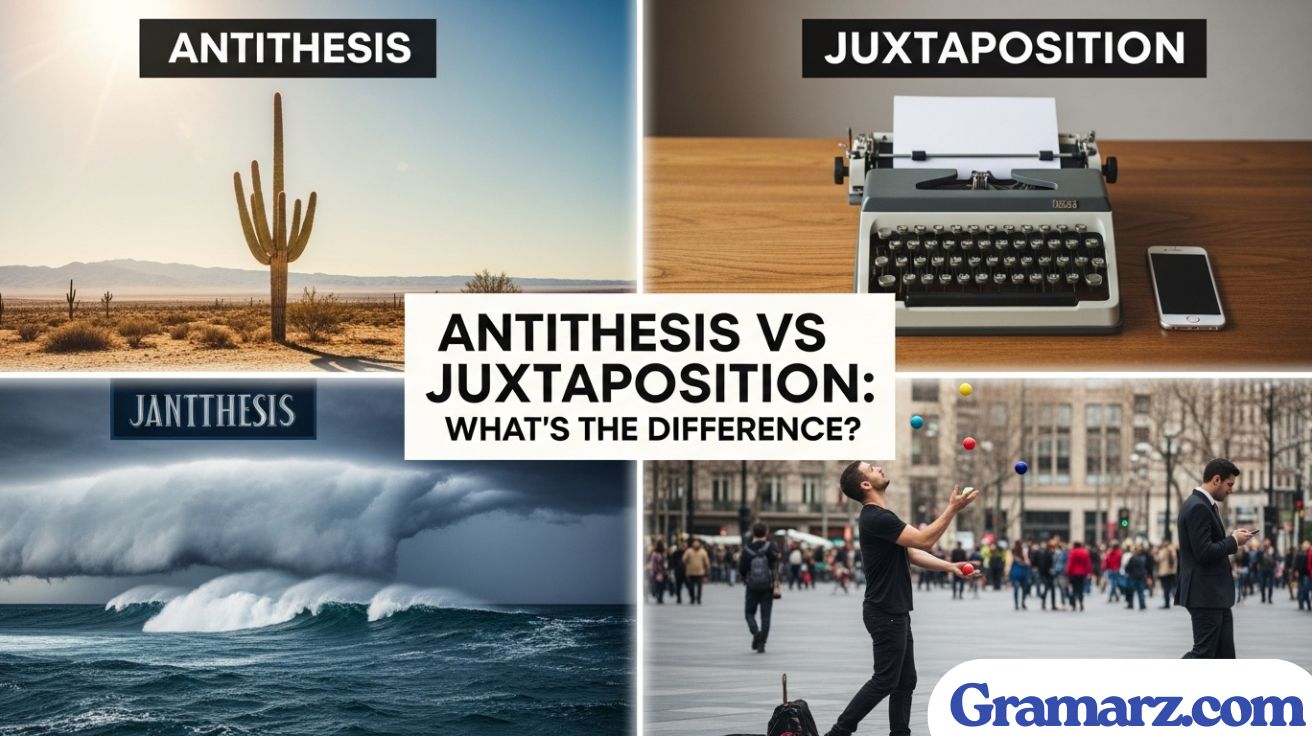
Antithesis vs Juxtaposition shows two ways writers use contrast. Antithesis means using opposite ideas in one sentence. Juxtaposition means placing different ideas or images side by side.
Writers love these tools because they make words powerful. They grab attention and make readers think. They also add beauty and depth to writing.
Antithesis is common in speeches and debates. Juxtaposition is found in literature, art, and films. Both make ideas clear by showing sharp contrasts.
What is Antithesis?
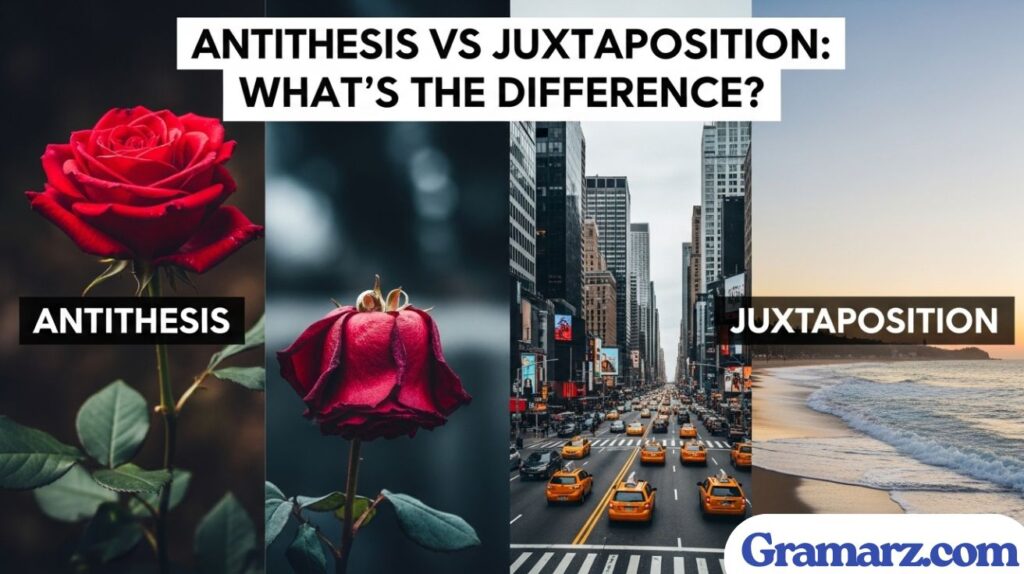
The simplest way to explain antithesis definition is that it places two opposing ideas close together in the same sentence or phrase. It is a rhetorical device example where opposites are deliberately paired to create a sharp contrast. Antithesis works by using parallel structure, meaning both sides of the contrast are balanced in grammar, which makes the sentence memorable.
For instance, Alexander Pope once wrote, “To err is human; to forgive, divine.” This contrast highlights human weakness versus divine greatness. Another famous line comes from John F. Kennedy’s inaugural address: “Ask not what your country can do for you – ask what you can do for your country.” Here, the repetition and reversal of words create impact and make the message persuasive.
Antithesis often appears in antithesis in literature, antithesis examples in speeches, and even in everyday sayings like “Easy come, easy go.” It belongs to classical rhetoric devices and is frequently used in political speeches, sermons, and philosophical texts because it draws the listener’s attention to opposites.
Examples of Antithesis
Writers and speakers have used antithesis for centuries. Some famous antithesis examples in speeches and literature include:
- “It was the best of times, it was the worst of times.” – Charles Dickens, A Tale of Two Cities
- “Give me liberty, or give me death.” – Patrick Henry
- “That’s one small step for man, one giant leap for mankind.” – Neil Armstrong
- “Speech is silver, but silence is golden.” – Proverb
These lines stay in memory because they show opposites so clearly. They also illustrate how contrast writing techniques can emphasize meaning in a way plain sentences cannot.
Origins of Antithesis
The antithesis definition comes from the Greek word antitithenai, meaning “to oppose” or “to set against.” It was an essential part of Aristotle rhetorical devices and was also widely used in Cicero rhetorical style. Ancient philosophers and orators relied on antithesis to persuade crowds, structure arguments, and make points memorable.
Over time, antithesis in philosophy and rhetoric moved into English literature, poetry, and modern speeches. From Shakespeare’s plays to contemporary debates, the device continues to be used as a tool for strong persuasive writing devices.
What is Juxtaposition?
If antithesis is the direct pairing of opposites within a sentence, juxtaposition definition is slightly broader. Juxtaposition means placing two different elements side by side so their differences become clear. These elements do not have to be direct opposites. Instead, they simply need to create contrast when shown together.
For example, a novelist may describe a cheerful wedding scene immediately followed by a tragic accident, allowing the happiness and sadness to play off each other. A photographer may show a fragile flower growing through cracked concrete, a common case of juxtaposition in art and photography.
This device is common in literature, film, and visual arts. Unlike antithesis, which is very concise, juxtaposition can stretch across paragraphs, whole chapters, or even the entire theme of a story. Writers often use it in juxtaposition in literature and juxtaposition examples in poetry to show opposing forces like love and hate, wealth and poverty, or chaos and peace.
Examples of Juxtaposition
Here are some classic examples of juxtaposition in different contexts:
- In literature: Charles Dickens opens A Tale of Two Cities with “the best of times” and “the worst of times,” which is both antithesis and juxtaposition because it contrasts two eras.
- In art: A painting showing a bright, blooming field under a dark stormy sky.
- In poetry: A verse contrasting the peace of a countryside lake with the chaos of a busy city street.
- In film: A wealthy family’s luxury dinner cut against a homeless person’s struggle for food.
These examples demonstrate how imagery and symbolism in literature or art use juxtaposition to deepen meaning.
Origins of Juxtaposition
Juxtaposition also has its roots in classical literature and rhetoric. Ancient poets and dramatists used it to show human struggles and emotional contrasts. Unlike antithesis, it was not limited to concise phrases but was part of larger storytelling. Over centuries, juxtaposition in art and photography became a standard technique, often used to critique social inequality or to show the contrast between human-made structures and nature.
Today, filmmakers, poets, and even advertisers use juxtaposition to trigger emotion and highlight differences.
Antithesis vs Juxtaposition: The Differences
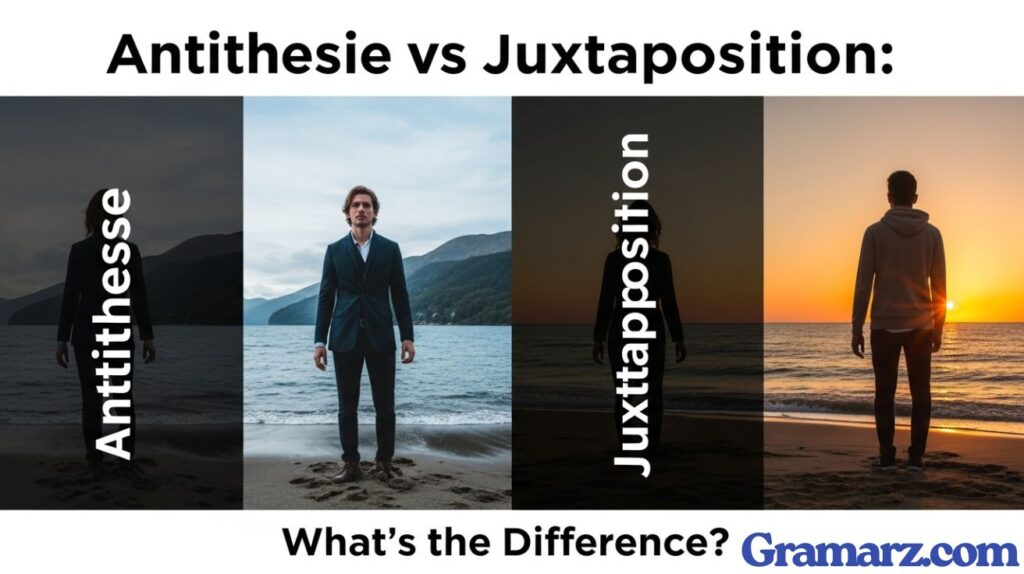
While both are stylistic devices in English literature, they are not identical. The clearest way to see the antithesis vs juxtaposition difference is in structure and purpose. Antithesis is about placing exact opposites in a balanced phrase, while juxtaposition is about showing contrast by placing two elements together, even if they are not total opposites.
Here is a table for clarity:
| Aspect | Antithesis | Juxtaposition |
| Definition | Opposing ideas in one sentence or phrase | Contrasting elements placed side by side |
| Purpose | Rhetorical impact, persuasion | Thematic depth, emotional effect |
| Example | “Give me liberty, or give me death.” | Rich man’s mansion next to poor neighborhood |
| Form | Concise, symmetrical, rhetorical | Broad, narrative, visual or descriptive |
| Usage | Speeches, debates, persuasive writing | Literature, poetry, art, film, photography |
Knowing this difference helps you choose the right tool. Use antithesis for sharp points and contrast in writing styles. Use juxtaposition when you want to explore layers of meaning across a bigger canvas.
How To Use Antithesis and Juxtaposition In Sentences
Antithesis
To use antithesis, start with two ideas that are opposite in meaning. Make sure the words or phrases have parallel structure, so the contrast feels balanced. For example, “Many are called, but few are chosen.” This makes the sentence sound polished and memorable. Students of rhetoric can look at oxymoron vs antithesis to see how antithesis differs from other close devices.
Juxtaposition
Juxtaposition works by placing different elements side by side to create meaning. In a novel, you might describe the luxury of a king’s palace followed immediately by the suffering of peasants. In poetry, you might set irony vs juxtaposition to show how humor can mask sadness. Juxtaposition does not require symmetry; it only requires proximity.
Combining Antithesis and Juxtaposition
Sometimes, writers use both. For example, a poet may place two contrasting characters together (juxtaposition) and then have them speak in lines full of opposites (antithesis). This layering of poetry contrast techniques makes the work richer.
Examples Of Antithesis and Juxtaposition Used In Sentences
Antithesis Examples
“She was kind in words but cruel in action.”
“In the heart of darkness, he found a light of hope.”
“The company grew in wealth but shrank in reputation.”
Juxtaposition Examples
“The laughter of children filled the streets while the cries of beggars echoed in the alleyways.”
“A fragile rose bloomed against the rusted fence.”
“The bright neon lights of the city clashed with the stillness of the night sky.”
Combined Examples
“In the chaos of war, where bombs shattered silence, hope whispered softly in the heart of survivors.”
“The old man’s wrinkled face told stories of joy and grief, of laughter and sorrow interwoven.”
Common Mistakes to Avoid when using Antithesis and Juxtaposition
Writers often fall into traps when trying to use these contrast writing techniques. The most common mistake is overusing them, which can make writing feel forced. Another mistake is creating weak contrasts that do not feel meaningful. For antithesis, lack of parallelism makes the sentence confusing. For juxtaposition, placing elements that do not naturally contrast makes the effect fall flat.
Read Also : Antithesis vs Juxtaposition: What’s the Difference?
Tips for Avoiding These Mistakes
The best way to avoid mistakes is to use these devices sparingly. Always check if the contrast is strong enough to matter. Make sure your reader will clearly understand the opposition. Revise your sentences to improve clarity. And remember that the purpose of persuasive writing devices like these is to serve your overall message, not distract from it.
Where to Use Antithesis and Juxtaposition
These devices shine in certain contexts. They are effective in speeches and debates, in novels and poems, in advertising slogans, and in films or visual arts. Teachers often include them in literary terms and definitions because they are central to understanding stylistic devices in English literature. In creative writing, they help build emotional depth, while in journalism or commentary, they highlight social contrasts.
Where Not to Use Antithesis and Juxtaposition
They are not suitable for every type of writing. You should avoid them in technical documents, legal contracts, medical papers, and scientific reports, where clarity and precision are more important than style. In casual emails or text messages, these devices may feel pretentious or out of place.
Why Writers Use Contrast in Storytelling
Writers often rely on contrast to highlight meaning and add emotional power to their work. When opposites are placed together, readers immediately notice the tension and depth in the message. This technique makes writing more memorable and helps ideas stand out clearly.
In storytelling, contrast can reveal hidden truths or expose deeper conflicts between characters and themes. Devices like antithesis and juxtaposition serve as tools to emphasize these differences. By carefully balancing opposites, writers create richer narratives that engage both the mind and emotions of the reader.
The Role of Antithesis in Persuasive Speech
Antithesis has long been a favorite device for leaders and public speakers. By setting one idea against another, speakers create a rhythm and balance that make their words easier to remember. The sharpness of opposites strengthens arguments and encourages listeners to think more deeply.
Famous speeches, from Abraham Lincoln to Martin Luther King Jr., use antithesis to create lasting impact. These speeches show that pairing opposites within a single sentence can transform a simple statement into a powerful call to action. It turns persuasion into art through clarity and precision.
Juxtaposition in Literature and Art
Unlike antithesis, juxtaposition works across broader spaces in writing and visual art. Placing two different elements side by side allows their contrasts to appear naturally. This can create irony, tension, or even humor, depending on how the differences are presented to the audience.
In art and photography, juxtaposition often highlights social or emotional contrasts. A delicate flower growing in concrete, or wealth shown next to poverty, immediately evokes emotion. Literature also uses this device to develop themes, reveal character struggles, and paint complex human experiences.
Antithesis vs Juxtaposition in Modern Writing
Modern writers and creators often blend both devices for stronger impact. Antithesis brings balance and structure to a single sentence, while juxtaposition builds larger themes across scenes or images. Together, they create writing that is both sharp in detail and rich in meaning.
Understanding when to use each device is key. Antithesis works best in direct, persuasive statements, while juxtaposition is better for setting moods, contrasts, or themes. Knowing the difference between antithesis and juxtaposition allows writers to choose the right tool for their creative purpose.
FAQ,s
What is the difference between juxtaposition and paradox?
Juxtaposition places two contrasting elements side by side for effect, while a paradox is a statement that seems self-contradictory but reveals a deeper truth.
What is the difference between oxymoron, juxtaposition and antithesis?
An oxymoron combines opposite words, juxtaposition places contrasting ideas or images together, and antithesis sets direct opposites within a balanced sentence.
What is antithesis with one example?
Antithesis is a rhetorical device that contrasts opposite ideas in a sentence, for example: “Speech is silver, but silence is golden.”
Which is an example of juxtaposition?
An example of juxtaposition is describing a rich banquet held in a palace next to starving villagers outside its gates.
Conclusion: A Final Look at Antithesis vs Juxtaposition
In summary, both antithesis and juxtaposition are powerful contrast writing techniques, but they work differently. Antithesis is about opposites in one sentence, while juxtaposition is about placing different elements side by side across a wider context.
The difference between antithesis and juxtaposition is subtle but important for writers and readers alike.By studying these figures of speech in literature, from Aristotle rhetorical devices to Cicero rhetorical style, from Shakespeare’s plays to modern photography, we see that contrast is at the heart of expression. Mastering these devices will make your writing more p