The words “Arised” and “Arose” often confuse English learners. “Arised” looks correct but it isn’t a real word. The correct past tense of arise is “arose.”
Many people use “arised” by mistake when they mean “arose.” It sounds natural but is grammatically wrong. This simple mix-up can change how your sentence sounds to native speakers.
In English, “arose” means something appeared, happened, or came up. For example, “A problem arose during the meeting.” Learning the right form helps you speak and write better.
The Rise of Confusion: Why “Arise” Trips Us Up
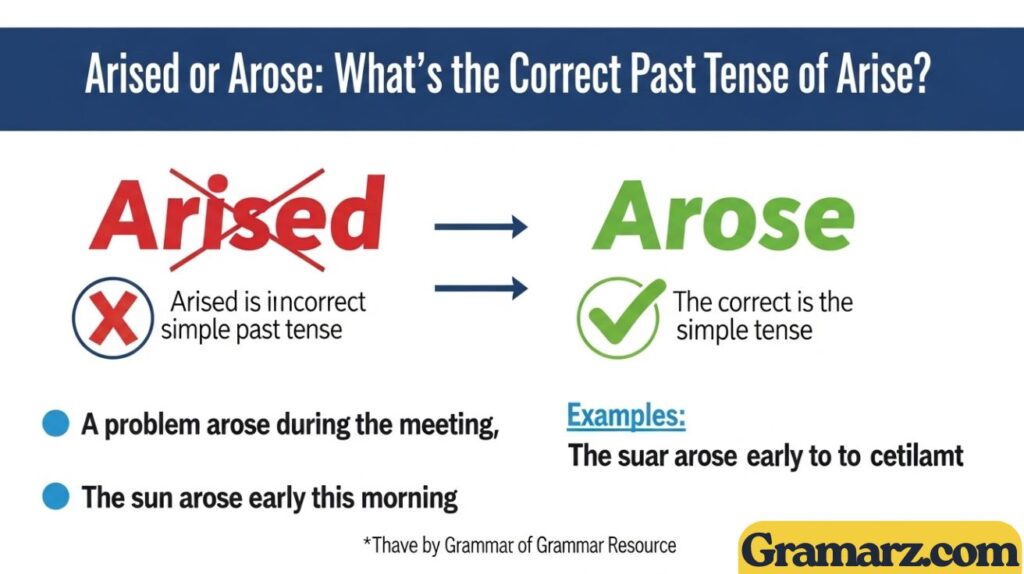
The confusion around the past tense of arise comes from the simple tendency to add “-ed” to form the past tense of regular verbs. We say “jumped,” “walked,” and “played,” so naturally, many people think “arised” must be correct. But it isn’t. The correct form is “arose.”
The reason is that arise is an irregular verb in English. Irregular verbs don’t follow the normal pattern of adding “-ed.” Instead, their vowel sounds change. This makes arose the correct arise past form. It belongs to a family of strong verbs in English, like ride → rode, sing → sang, or begin → began. These verbs have been irregular since Old English times and haven’t changed much since then.
So, is arised correct? The short answer is no. Although it sounds logical, it’s not a real English word and never has been. The correct form is always “arose.”
Arise: More Than Just Getting Out of Bed
Before we go deeper, let’s look at what is the meaning of arise. The verb arise means more than simply “to get up.” It can also mean “to come into existence,” “to appear,” or “to occur.” Understanding the different arise meanings and examples helps us use it correctly in speech and writing.
Here’s a helpful table that shows various meanings of arise with examples and synonyms:
| Meaning | Example Sentence | Synonym |
| To get up | He arose from his chair to greet the guests. | Rise |
| To come into existence | New problems arose during the experiment. | Emerge |
| To occur | A conflict arose between the two teams. | Develop |
| To appear | A smile arose on her face. | Appear |
| To ascend | Smoke arose from the burning wood. | Rise up |
There’s also a subtle arise vs rise difference. While “rise” usually means moving upward physically, “arise” is often used for abstract things—like problems, opportunities, or situations that come up unexpectedly.
The Correct Past Tense: Arose
Let’s answer the key question: What is the correct past tense of arise? The answer is arose. The word “arised” is grammatically incorrect. Understanding the conjugation of arise helps clarify this.
Here’s how the arise verb forms look:
| Tense | Form | Example |
| Present | arise / arises | I arise early every morning. |
| Past | arose | The sun arose at 6 AM. |
| Past participle | arisen | New challenges have arisen. |
| Present participle | arising | Problems are arising quickly. |
Learning this grammar rule for arise will help you avoid one of the most common grammar mistakes in English. Always remember: I arise, I arose, I have arisen. Never say “I arised.”
Why “Arised” is a Common Mistake
People often form arised by mistake because they’re applying regular verb rules. Words like “surprised” or “exercised” end with “-ed,” so our brain wants to do the same for “arise.” However, English irregular verbs don’t follow that rule. Instead, they change their internal vowels, creating a unique arise past form—which is arose.
Let’s look at similar verb conjugation examples to help remember this pattern:
| Present | Past | Past Participle |
| ride | rode | ridden |
| write | wrote | written |
| drive | drove | driven |
| sing | sang | sung |
| arise | arose | arisen |
As you can see, these strong verbs in English don’t add “-ed.” They change their vowel sound instead, which is what makes arose correct.
The Evolution of Arise: A Journey Through Time
To understand why “arise” is irregular, we have to look at its history. The word comes from Old English ārīsan, which meant “to get up” or “to rise.” Back then, verbs didn’t add “-ed” for the past tense. Instead, they changed vowels, a pattern we still see in today’s English irregular verbs.
Over centuries, “arise” kept its irregular nature, evolving through Middle English and into modern English without losing its distinct pattern. This is why the correct form today remains arose, not “arised.” The word is a linguistic survivor from ancient English, preserving its old grammar.
Mastering Arise: A Tense-by-Tense Guide

To use arise correctly, you need to understand how it behaves in different tenses. Let’s look at each one carefully.
Present Tense
In the present tense, arise describes things that happen now or regularly. Examples include:
I arise early every day to exercise.
Problems often arise when people forget to plan.
These are examples of how to use arise in writing or everyday speech.
Past Tense
The arose past tense examples are used to talk about something that already happened.
For instance:
A problem arose during the meeting.
The idea arose from an interesting discussion.
This is the correct past tense usage and follows the rule for irregular verbs.
Future Tense
The future form “will arise” talks about events yet to happen. For example:
New opportunities will arise with experience.
If any issues arise, we will handle them quickly.
These examples show the flexibility of the verb across all tenses.
Read Also : Cart vs Kart: Which Spelling to Use?
Pronunciation Guide: Say It Right
Pronouncing arise, arose, and arisen correctly helps you sound confident and fluent. Here’s how each is pronounced:
| Word | Phonetic Spelling | Sounds Like |
| Arise | /əˈraɪz/ | uh-RIZE |
| Arose | /əˈroʊz/ | uh-ROZE |
| Arisen | /əˈrɪzən/ | uh-RIZ-en |
The arise pronunciation is smooth and rhythmic. Avoid saying “a-REEZ” or “a-ROOZ.” Practicing out loud helps you remember the correct sound naturally.
Arise in Action: Real-world Examples
Seeing how arise, arose, and arisen appear in different contexts can make learning easier. Let’s explore real-life usage across literature, media, business, and daily speech.
Literature and Famous Quotes
Writers have used arose beautifully in classic literature.
Jane Austen wrote, “I arose in the morning, uncertain of what the day would bring.”
Mary Shelley described, “The sun arose upon an altered world.”
These arose definition and examples show how elegantly the word fits in storytelling.
News Headlines
You’ll often see “arose” and “arise” in journalism.
“New Concerns Arose Over Climate Policy.”
“Opportunities Arise from Economic Shifts.”
These are perfect arose in a sentence examples that appear naturally in formal writing.
Business and Legal Contexts
In business or legal documents, arise appears in phrases like:
“Any disputes that arise under this agreement will be resolved through mediation.”
“New challenges arose during the merger process.”
This precise arise grammar explanation shows how the word fits professional contexts where clarity is vital.
Everyday Usage
In daily life, we use arise sentence examples like:
“An issue arose during the event.”
“A new idea arose after the discussion.”
These show how to use arise correctly in casual or conversational English.
Common Pitfalls and How to Avoid Them

There are a few common grammar mistakes learners make with “arise.” People sometimes confuse it with “raise” or “rise.” Remember that “raise” means to lift something, while “arise” means something happens or appears. For example, “A problem arose” (correct) vs. “A problem raised” (incorrect).
Another frequent mix-up is between arose and arisen. Arose is the past tense, while arisen is the past participle of arise used with “have” or “had.”
Incorrect: The issue has arose.
Correct: The issue has arisen.
Understanding the arisen vs arose difference helps you avoid these errors easily.
The Arise Challenge: Test Your Knowledge
Fill in the blanks to test your understanding:
- New challenges ______ during the project.
- The issue has ______ since last week.
- Any disputes that ______ will be discussed tomorrow.
Answers: 1. arose 2. arisen 3. arise
If you got all correct, you’re mastering one of the trickiest English irregular verbs out there.
Beyond English: “Arise” in Other Languages
The concept of “arise” exists in many languages, often with their own irregular patterns. This shows how common the idea of something “coming up” or “emerging” is in human communication.
| Language | Present | Past | English Meaning |
| French | se lever | s’est levé | to get up |
| Spanish | surgir | surgió | to arise, emerge |
| German | entstehen | entstand | to come into being |
| Italian | sorgere | è sorto | to appear |
| Russian | возникать | возник | to arise |
| Japanese | 起こる (okoru) | 起こった (okotta) | to occur |
| Chinese | 出现 (chūxiàn) | 出现了 (chūxiàn le) | to appear |
This shows that even across languages, irregular verbs in English have global parallels.
Understanding the Past Tense of Arise
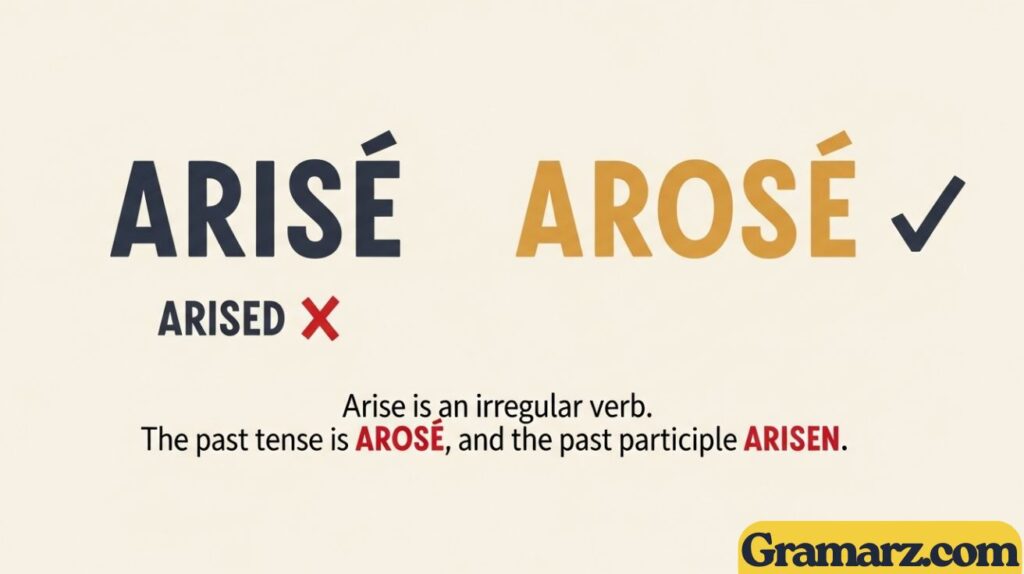
The past tense of arise often confuses learners because it doesn’t follow the regular “-ed” rule. Instead of “arised,” the correct form is arose. This difference exists because arise is an irregular verb in English, changing its internal vowel to indicate past time. Learning these exceptions improves accuracy in both writing and speaking.
Using arose correctly demonstrates strong grammar skills and confidence. For example, “A problem arose during the meeting” is proper usage. Remembering patterns in English irregular verbs like arise → arose → arisen helps you build fluency. It’s essential for mastering verb conjugation examples in English grammar.
Why “Arised” Is Incorrect in English
Many learners mistakenly use “arised” because it sounds natural. However, is arised correct? No—it’s grammatically wrong. The confusion happens because people assume every verb follows the “-ed” pattern. Yet arise doesn’t; it’s an irregular verb, just like go → went → gone.
Always use arose when referring to the past. For example, “New challenges arose overnight.” English has many strong verbs in English that change vowel sounds instead of adding “-ed.” Learning these helps avoid common grammar mistakes and improves your writing precision.
The Arise Verb Forms Explained
Understanding all arise verb forms is key to using it correctly. The base form is arise, the past tense is arose, and the past participle of arise is arisen. Each has a specific grammatical role depending on the sentence’s time and structure.
For instance, “I arose early” shows a completed past action, while “Problems have arisen” indicates something ongoing. Knowing the grammar rule for arise helps you apply it correctly in everyday writing and communication.
Difference Between Arose and Arisen
The arisen vs arose difference often confuses English learners. Arose is the past tense, while arisen is the past participle used with have or had. Example: “A conflict arose yesterday” (simple past) vs “Conflicts have arisen before” (perfect tense).
Understanding these differences avoids errors in verb use. It’s also a part of mastering English language learning tips for better writing. Proper use of tense shows command over irregular verbs in English and builds confidence in expression.
How to Use Arise Correctly in Sentences
To use arise correctly, focus on context. It means “to appear,” “to occur,” or “to come into being.” You might say, “A new issue arose during the project.” This shows how situations can suddenly happen.
In professional writing, phrases like “problems may arise” or “disputes have arisen” are common. These arose in a sentence examples show proper grammatical usage. Using arise sentence examples during practice strengthens understanding of arose meaning and usage.
Arise vs Rise: Key Difference
Though similar, the arise vs rise difference is significant. Rise means to move upward physically, while arise means something appears or comes up. For instance, “The sun rises every day,” but “A problem arose during the event.”
This subtle difference changes meaning entirely. Understanding arise meaning and examples ensures clarity in writing. Using both verbs correctly also helps improve comprehension of English irregular verbs and enhances written communication accuracy.
Mastering the Conjugation of Arise
To remember the conjugation of arise, practice using all forms: arise → arose → arisen. Example: “Issues arise daily,” “One arose yesterday,” “Several have arisen before.” Repetition and examples make the rule easier to remember.
This simple formula is crucial for learners mastering correct past tense usage and verb conjugation examples. Once memorized, it prevents mistakes like saying “arised.” Continuous practice builds natural fluency and a deeper grasp of English grammar explanation.
FAQ,s
Is the word “arised” correct?
No, “arised” is incorrect; the correct past tense of “arise” is “arose.”
Is it arised or arose?
It’s “arose,” not “arised.” “Arose” is the proper past tense of arise in standard English.
What is arised?
“Arised” is a common grammar mistake made by confusing irregular verbs with regular ones.
What is another word for arised?
You can use “appeared,” “occurred,” or “emerged” as alternatives to the incorrect word “arised.”
Conclusion: Rising to the Occasion
Now that you know the difference between arose and arised, you can confidently use arose as the correct past tense usage of arise. Remember, “arised” is not correct—the proper past tense is “arose”, and the past participle of arise is “arisen.”
Understanding the conjugation of arise—I arise, I arose, I have arisen—helps you write and speak clearly. The next time confusion arises, you’ll know exactly how to handle it. Whether in business, literature, or everyday conversation, your grammar will now always arise to the occasion.