“Cacoon or Cocoon” often confuses many people. Cocoon is the correct spelling for the silky case made by insects like butterflies and moths. Cacoon is usually a misspelling, though it can also refer to a tropical plant.
It’s easy to mix these two words. They sound similar and look almost the same. But knowing the difference helps you write and speak English more clearly.
A cocoon represents growth and change, while cacoon has a different meaning in botany. Understanding both words improves your English vocabulary and avoids common spelling mistakes.
The Root of Confusion: Why Do People Mix Up Cacoon and Cocoon?
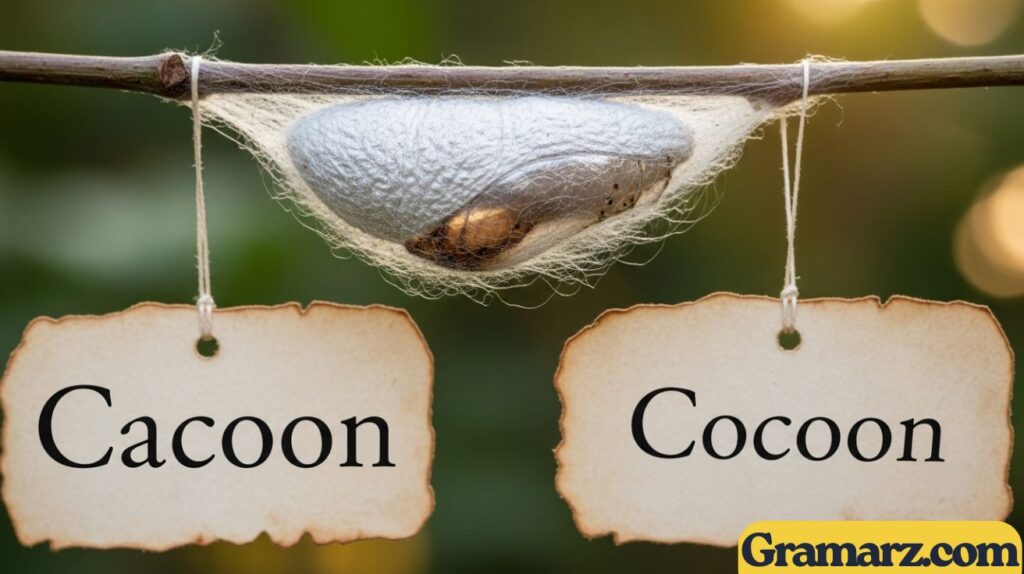
Spelling mistakes often happen when two words look or sound very similar. The confusion between “Cacoon” and “Cocoon” is one of the most common English spelling errors because the words differ by just one letter and share nearly identical pronunciation. When people hear the word in conversation, it’s easy to imagine either version could be correct.
Another reason for this cacoon spelling mistake lies in English’s complex spelling patterns. The language borrows words from French, Latin, and other roots, creating inconsistencies that can confuse even native speakers. Because many people rarely encounter the word “cocoon” outside of nature documentaries or literature, they may not recall the correct English word cocoon when writing.
Regional pronunciation differences also play a role. In certain accents, the “co” and “ca” sounds can blur together, further adding to the misunderstanding. However, while “Cacoon” looks believable, it’s actually incorrect when referring to insects or transformation. The correct spelling of cocoon includes a double “o,” just like in the words “moon” and “balloon.”
Cocoon: The Correct Spelling and Its Rich Meanings
The word “Cocoon” is the correct spelling and has several fascinating meanings. According to standard dictionaries, the cocoon meaning in English refers to a silky protective covering spun by the larvae of certain insects. However, it has also developed deep metaphorical and cultural meanings over time.
The cocoon origin word comes from the French “cocon,” meaning a shell or casing. In English vocabulary learning, it has grown to represent protection, growth, and transformation. Understanding what does cocoon mean gives you a glimpse into both nature and language evolution.
In simple terms, a cocoon definition and examples show that this is not just an insect’s creation but a concept that symbolizes change. People often use “cocoon” to describe a safe space or a period of self-development — a time when someone isolates themselves to emerge stronger, just as a caterpillar becomes a butterfly.
Cocoon Definition in Entomology
In entomology cocoon definition, a cocoon is a silky envelope spun by the larvae of moths and some butterflies during their pupal stage. It serves as a shield, protecting the developing insect from predators, temperature changes, and other environmental dangers.
An insect cocoon example can be found in the silkworm, scientifically known as Bombyx mori. It spins one of the most valuable cocoons in the world, producing fine silk fibers used in textiles. This natural creation highlights how complex and purposeful nature can be.
Inside a cocoon, something remarkable happens — metamorphosis. The caterpillar’s body breaks down and rebuilds itself into a completely new form. The cocoon provides the perfect environment for this transformation, which has inspired humans for centuries.
The Science Behind Cocoon Formation
Understanding how cocoons are made reveals one of nature’s most fascinating processes. When a caterpillar is ready to transform, it begins to secrete liquid silk from special glands near its mouth. As this liquid touches the air, it hardens into a thin, strong fiber. The insect then spins the fiber around itself in overlapping layers, forming a smooth and secure casing.
This process can take several hours or even days, depending on the species. Once finished, the cocoon hardens to protect the insect while it undergoes metamorphosis — the process that turns the caterpillar into a moth or butterfly.
Butterfly cocoon facts show that not all insects build cocoons; some have a similar but uncovered stage called a chrysalis. This is one reason people often confuse cocoon vs chrysalis, even though they describe different stages for moths and butterflies.
The entire process demonstrates how delicate and precise nature’s engineering can be. The silk fibers that make up the cocoon are incredibly strong and lightweight — inspiring many cocoon-inspired design ideas in modern technology.
Cocoon in Metaphorical Context
Beyond biology, the cocoon metaphor meaning has become a symbol of transformation, protection, and personal growth. When someone says they are “in a cocoon,” they often mean they are taking time away from the world to heal, reflect, or evolve into something new.
The transformation cocoon symbolism is frequently used in literature, psychology, and even spirituality. It represents how people can change profoundly when they take time for self-development. A famous quote by LeeAnn Taylor says, “We are all butterflies. Earth is our cocoon.” This poetic line shows how the cocoon symbolizes growth and the beauty of change.
Cocoon in Popular Culture
The word “cocoon” has made its way into movies, books, and songs. One famous example is the 1985 film “Cocoon,” which explores themes of renewal and youth. Music artists like Milky Chance and Simon & Garfunkel have also used the term in their song titles, emphasizing emotional rebirth.
In literature, “cocoon” is often a cocoon synonym for safety and introspection. Writers use it to describe characters finding refuge or transforming their lives. This widespread use in cocoon in popular culture reflects how deeply the concept resonates with human experience.
Cocoon in Technology and Design
Modern innovations often draw inspiration from nature. The structure of cocoons — lightweight yet strong — has inspired architects, engineers, and designers worldwide. In cocoon-inspired design, you can see the influence in everything from sleep pods and safety systems to futuristic architecture.
The cocoon-inspired technology includes cocoon chairs, protective car interiors, and even cocoon-like pods for relaxation and sleeping. This blending of biology and design showcases how nature continues to shape human invention.
Cacoon: The Misspelling and Its Unexpected Twist
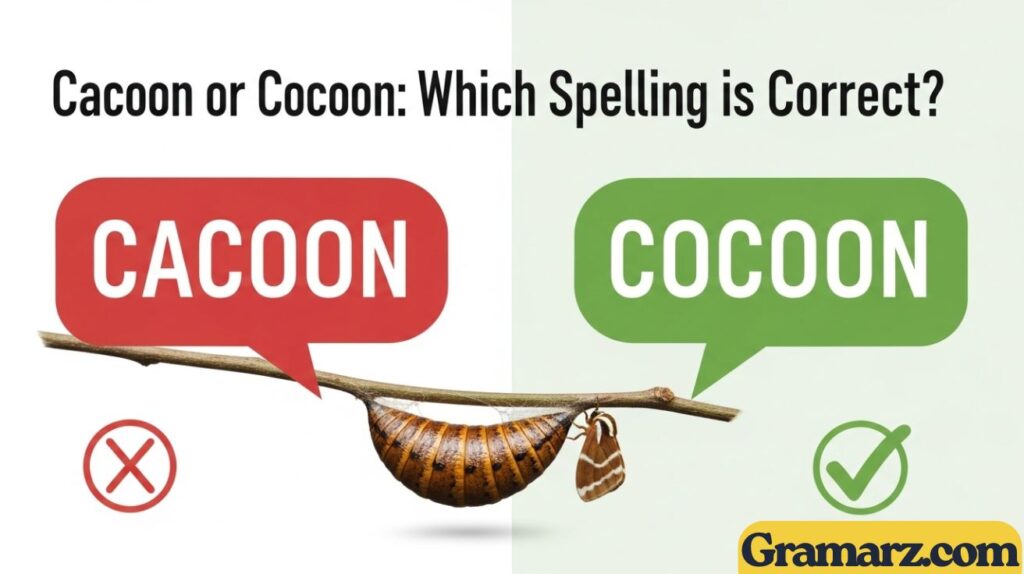
While “cacoon” is typically a cacoon spelling mistake, it does have a surprising legitimate use. In most contexts, cacoon vs cocoon usage clearly shows that “cacoon” is wrong when referring to insects. However, in botany, cacoon plant meaning exists — it refers to a unique tropical plant used in traditional medicine.
This word is not a variant spelling but rather a completely different term with a separate origin and meaning. The correct vs incorrect spelling distinction is essential for maintaining linguistic accuracy in English and avoiding confusion in writing or academic work.
Cacoon as a Botanical Term
In botany, the botanical name Fevillea cordifolia represents what’s commonly called the cacoon plant or cacoon fruit. This woody vine belongs to the cucumber family (Cucurbitaceae) and is native to tropical regions of Central and South America.
The botanical meaning of cacoon lies in its role as a medicinal plant. Its large, round fruits contain seeds that have been used in natural remedies for centuries. Though unrelated to insect cocoons, the cacoon medicinal plant has earned attention in herbal medicine for its healing potential.
People in the Caribbean often use traditional uses of cacoon for various treatments, such as digestive support and fever reduction. However, while cacoon plant benefits are widely mentioned in folk medicine, scientific studies on its safety remain limited.
Traditional Medicinal Uses of Cacoon
The cacoon medicinal plant has played a vital role in traditional healing practices. The seeds, when dried and prepared, are believed to serve as an antidote for certain poisons and as a treatment for fever and inflammation. Some cultures have used the cacoon fruit for promoting digestion and relieving joint pain.
Although these remedies are popular in local traditions, there is limited scientific evidence to verify their effectiveness. Nevertheless, the cacoon plant benefits continue to attract interest from researchers studying natural medicine. It serves as a fascinating example of how one misspelled word, “cacoon,” can refer to an entirely different world — that of tropical botany.
Read Also : What is the Plural of Chief? Chiefs or Chieves?
Comparison Table: Cocoon vs. Cacoon
| Aspect | Cocoon (Insect-related) | Cacoon (Plant-related) |
| Definition | Protective casing for pupal stage | Tropical vine plant used in medicine |
| Field | Entomology | Botany |
| Origin | French “cocon” | Indigenous and Latin American roots |
| Usage | Refers to insects and transformation | Refers to tropical plant species |
| Correct Spelling | ✅ Cocoon | ⚠️ Cacoon (rare botanical term) |
| Common Context | Metaphor, silk production, insects | Traditional medicine, herbal studies |
| Recognition | Globally known | Regionally specific |
This cacoon vs cocoon difference table makes it easy to see that while “cocoon” is the correct word for insect casings, “cacoon” exists only in a limited botanical sense.
The Impact of Misspelling: Why Correct Spelling Matters
Using incorrect words such as cacoon in place of cocoon can lead to confusion and misunderstandings. In academic writing, it undermines credibility, and in digital spaces, it can even hurt search engine optimization since search engines prioritize the correct English word cocoon.
Maintaining language learning and spelling accuracy ensures clarity in communication. As English learners strive to master common English misspellings, distinguishing between “cacoon” and “cocoon” is a great exercise in linguistic accuracy in English.
Remember, precise spelling doesn’t just make your writing look professional — it also reflects your understanding of the topic and helps your message reach the audience effectively.
Fascinating Facts About Cocoons in Nature
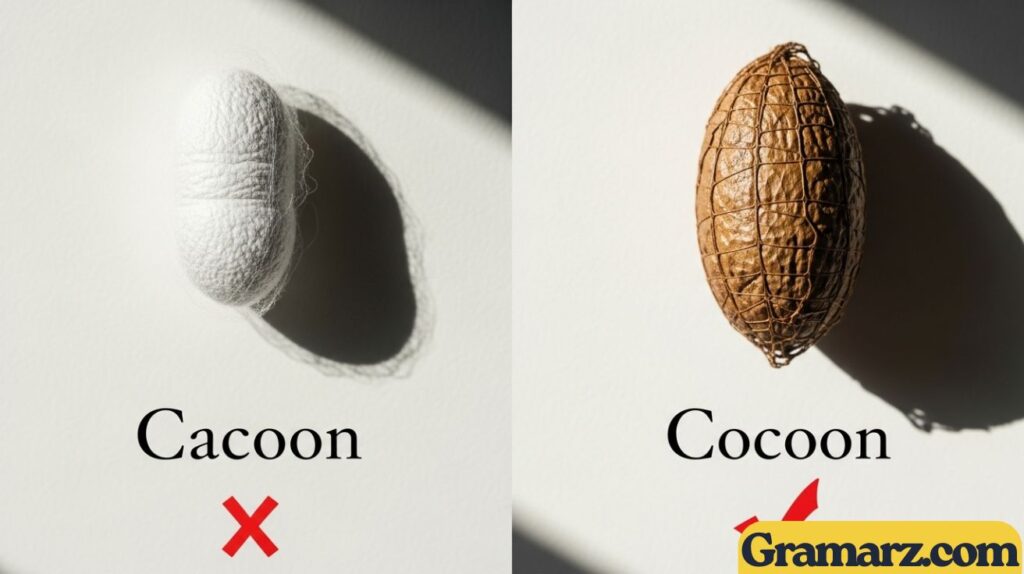
Cocoons are one of nature’s most intricate creations. Here are some interesting silk cocoon facts and natural cocoons examples that show just how diverse and essential they are to ecosystems.
Silkworms (Bombyx mori) produce some of the most valuable cocoons used in silk production from cocoons. A single cocoon can yield hundreds of meters of silk thread. Other insects, like caddisflies, even make underwater cocoons, while some caterpillars use leaves and twigs for camouflage.
Not all cocoons are solitary. Some species form communal structures, protecting multiple pupae inside a single cocoon. Others build cocoons that change color or texture to mimic their surroundings. These adaptations highlight how insects evolved complex behaviors to survive through metamorphosis.
The Evolutionary Significance of Cocoons
The cocoon is not just a protective case — it’s an evolutionary masterpiece. For millions of years, insects have relied on cocoons to shield their vulnerable pupal stage from predators and harsh climates. This adaptation allowed them to thrive in different environments across the planet.
By remaining immobile in a cocoon, insects conserve energy and undergo their most dramatic change. This process also enables them to colonize diverse ecosystems, contributing to the vast variety of insect species we know today.
In many ways, cocoons symbolize the harmony between protection and transformation — two forces that drive both biological and personal growth.
Tips for Remembering the Correct Spelling
If you struggle with the spelling difference examples, try these simple cocoon spelling tips. Remember that “cocoon” has two “O’s,” just like the “two eyes” of a butterfly. You can also think of the phrase, “Caterpillars Create Cocoons for Change.”
Another method is to visualize the double “o” as the safe shell surrounding the insect. This mental image reinforces the correct spelling. With a bit of English vocabulary learning, you’ll never mix up cacoon and cocoon again.
Case Study: The Silk Industry and Cocoons
A classic real-world example of cocoons’ importance is the global silk industry. Every year, more than 200,000 metric tons of silk are produced from silk production from cocoons, primarily in China and India.
The process begins when silkworms spin their cocoons, which are then collected and boiled to extract the silk thread. Workers carefully unwind these threads to create fine fabrics. Some companies are now focusing on ethical silk, known as “Ahimsa silk” or “peace silk,” which allows moths to emerge before harvesting.
This industry shows the economic power of cocoons and their influence on human craftsmanship, culture, and sustainability.
The Future of Cocoon-Inspired Technology
Scientists and engineers have long admired the cocoon’s balance of strength, flexibility, and protection. This has led to new discoveries in materials science, cocoon-inspired design, and even biomedical technology.
Researchers are studying cocoons to create biomimetic materials for use in medicine, aerospace, and packaging. Medical experts are exploring cocoon-like scaffolds for tissue growth, while designers are inventing eco-friendly packaging that mimics cocoon structures.
The world of innovation continues to draw lessons from nature’s engineering. Just as the cocoon supports a butterfly’s transformation, cocoon-inspired technologies could guide humanity’s sustainable transformation toward the future.
Cacoon or Cocoon: Understanding the Spelling Difference
Many people confuse Cacoon or Cocoon, but the correct English word cocoon is used to describe the protective case insects make during transformation. The cacoon spelling mistake often happens because both words sound similar. Understanding this spelling difference example helps avoid common English misspellings in writing and conversation.
The difference between cocoon and cacoon lies in their meanings. Cocoon meaning in English relates to insects, while Cacoon is a rare word referring to a tropical plant. Knowing how to spell cocoon correctly improves linguistic accuracy in English and builds stronger English vocabulary learning habits.
Cocoon: The Correct Spelling and Its Meaning
The correct spelling of cocoon refers to the silky casing made by insects such as moths and butterflies. This word comes from the cocoon origin word, which traces back to French and Latin roots. It represents safety and change, making it rich in both scientific and metaphorical meaning.
When you ask what does cocoon mean, it symbolizes protection and transformation. In entomology cocoon definition, it is a shell spun by insects before emerging as adults. In daily life, “cocoon” also has emotional meaning, linked to transformation cocoon symbolism and personal growth.
The Science of How Cocoons Are Made
To understand how cocoons are made, imagine a caterpillar producing silk threads from special glands. These threads harden to form a safe casing. The insect cocoon example shows nature’s design for protection during metamorphosis, a key concept in entomology cocoon definition studies.
These natural cocoons examples vary among species, with some made from silk, others from leaves or twigs. Learning silk cocoon facts reveals that humans have used cocoons for silk production from cocoons for thousands of years. This process connects science, industry, and English vocabulary learning about insects.
Cacoon: The Rare Botanical Meaning
While “cacoon” looks like a misspelling, it has a botanical meaning of cacoon referring to a plant known by the botanical name Fevillea cordifolia. This cacoon medicinal plant grows in tropical areas and has historical importance in local medicine.
The cacoon plant benefits include being used as a traditional remedy for digestion and inflammation. Some regions call its seeds cacoon fruit, used for health tonics. Understanding this rare meaning prevents English spelling errors and clarifies the cacoon vs cocoon usage difference for better language learning and spelling accuracy.
Cocoon in Culture and Symbolism
The word “cocoon” is more than a scientific term — it also represents comfort, safety, and transformation. In movies and literature, cocoon in popular culture often symbolizes rebirth or isolation before growth. This connects to cocoon metaphor meaning and transformation cocoon symbolism in psychology.
Artists and designers use cocoon synonym concepts to express renewal and peace. From cozy architecture to mindful living spaces, the cocoon-inspired design trend promotes comfort and creativity. This shows how correct vs incorrect spelling can influence artistic expression and cultural depth.
Comparison: Cocoon vs Cacoon
To summarize, understanding cocoon vs cacoon usage helps learners avoid mistakes. The correct English word cocoon refers to an insect case, while Cacoon refers to a plant. These words belong to different fields — one in entomology, the other in botany.
| Aspect | Cocoon | Cacoon |
| Meaning | Insect casing | Tropical plant |
| Field | Entomology | Botany |
| Origin | French “cocon” | Native to Americas |
| Example | Butterfly cocoon | Cacoon fruit |
| Correctness | ✅ Correct | ⚠️ Rare use |
This simple cacoon vs cocoon difference table makes remembering how to spell cocoon correctly easier.
Tips for Remembering the Correct Spelling
Learning the correct spelling of cocoon becomes easy with a few tricks. Think of the word “Cocoon” as having two O’s, like the shape of a cocoon itself. This visual cue helps prevent spelling confusion words in English and improves language learning and spelling skills.
Another tip is to link it with meaning: “Caterpillars Create Cocoons for Change.” Such cocoon spelling tips make it easier to write confidently. Avoiding the cacoon spelling mistake ensures linguistic accuracy in English and enhances your grasp of English vocabulary learning in daily writing.
FAQs
What is the meaning of Cacoon?
Cacoon refers to a tropical plant called Fevillea cordifolia, not the insect’s protective casing. It’s often seen as a common spelling mistake for “cocoon.”
What exactly is a Cacoon?
A Cacoon is a botanical vine plant used in traditional medicine in tropical regions, though it’s frequently confused with the word “cocoon.”
How do you spell cocoon like a butterfly?
The correct spelling is “Cocoon,” which means the silky case created by butterflies or moths during their metamorphosis stage.
How do you hang a Cacoon?
To hang a Cacoon hammock or hanging chair, attach it securely to a strong branch, ceiling hook, or stand in a stable area for safe use.
Conclusion
“Cacoon or Cocoon: Which Spelling is Correct?” has a clear answer. The correct spelling of cocoon refers to the silky covering spun by insects and symbolizes transformation and safety. The term “Cacoon” is generally a cacoon spelling mistake, except when referring to the cacoon plant, a tropical vine used in traditional medicine.
Understanding the difference between cocoon and cacoon not only improves language learning and spelling but also reveals the beauty of words shaped by science and nature. Whether you’re studying entomology cocoon definition or exploring the botanical meaning of cacoon, these words remind us of the deep connection between language, life, and evolution.
By mastering such distinctions, we enhance our communication, our writing, and our appreciation for the natural world. So next time you write about a butterfly’s transformation, remember: it’s always cocoon — two O’s, endless meaning.