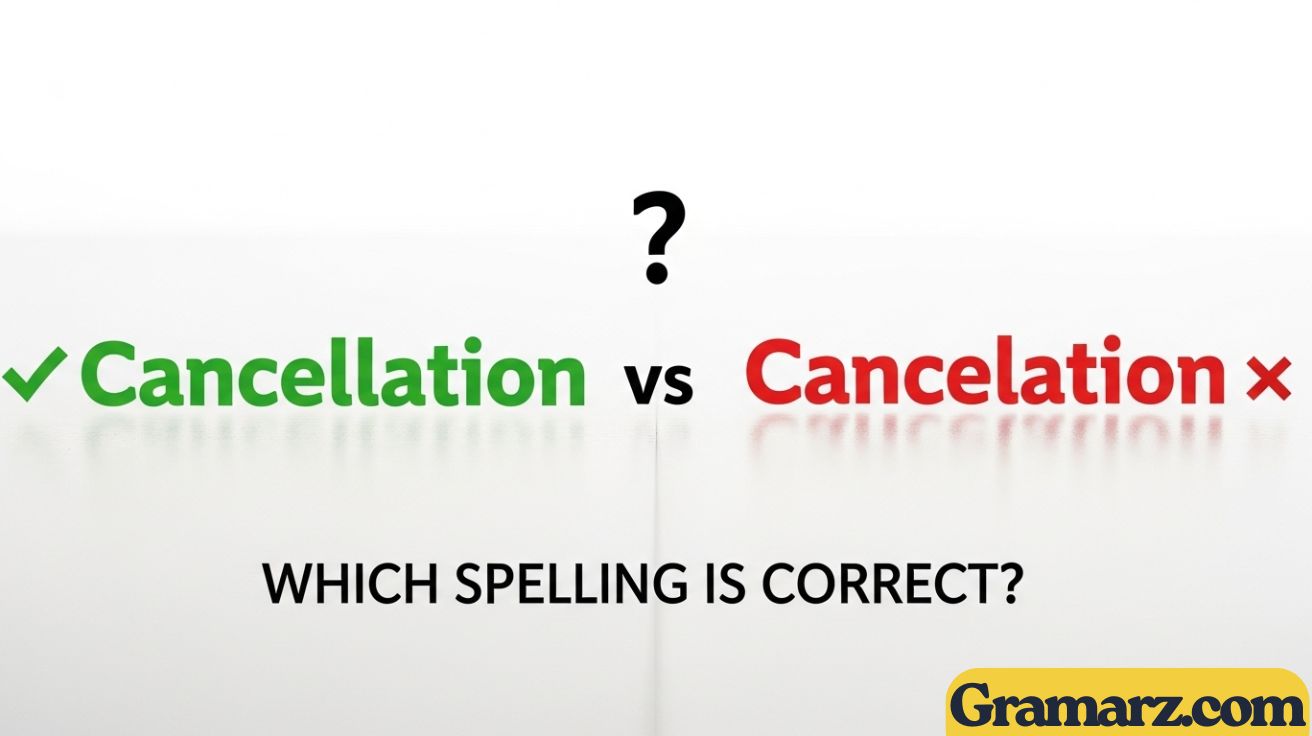
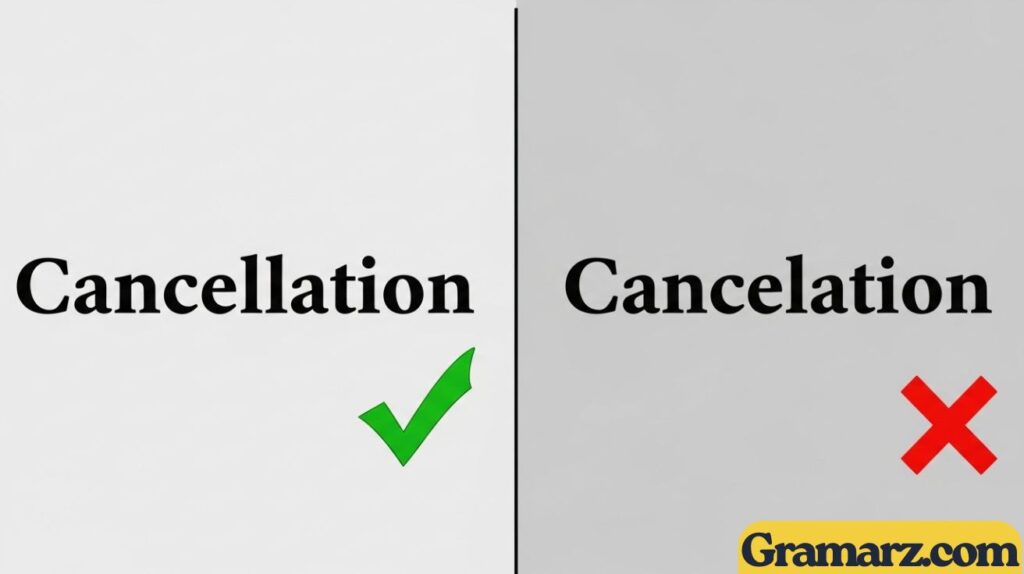
Cancellation vs Cancelation are two different spellings of the same word. Both mean the act of stopping or ending something planned. The meaning does not change, only the spelling does.
Many people feel confused when they see these spellings. Both appear in books, articles, and even online tools. This makes writers wonder which one is correct.
The truth is that cancellation with double L is the standard form. Cancelation with one L is rare and less accepted. Knowing the difference helps make writing clear and correct.
Why is There Confusion?
The confusion around cancellation spelling comes from the history of the English language and the differences between American and British spelling rules. For many words, especially those ending in “-el,” you may see both a double L vs single L word depending on where the text comes from. In the United States, simplified spellings became more popular in the 19th century, partly because of Noah Webster spelling reforms. Webster wanted to make English easier to learn, so he suggested dropping extra letters. For example, Americans write “color” instead of “colour,” and “honor” instead of “honour.”
The same thing happened with the word cancel. Some people began writing cancelation spelling with one “L,” following the rule of English spelling simplification. Others kept the traditional form, cancellation spelling with two “L’s,” which matched older orthographic differences in English. Today, both spellings appear, but one is far more common than the other.
What Do “Cancellation” and “Cancelation” Mean?
When we look at cancellation meaning and cancelation meaning, both words point to the exact same idea: the act of calling something off or making it invalid. For example, if a flight is not going to take place, the airline announces its cancellation. If a streaming service subscription is stopped, that is also a cancellation.
The cancellation definition and the cancelation definition are the same. Both mean “an official decision to stop or withdraw something planned or agreed upon.” The difference is only in spelling, not in meaning. If you see cancel vs cancelation or cancellation vs cancelation, you should remember that they carry no difference in sense, only in style.
“Cancellation vs Cancelation”: Which Spelling Should You Use?
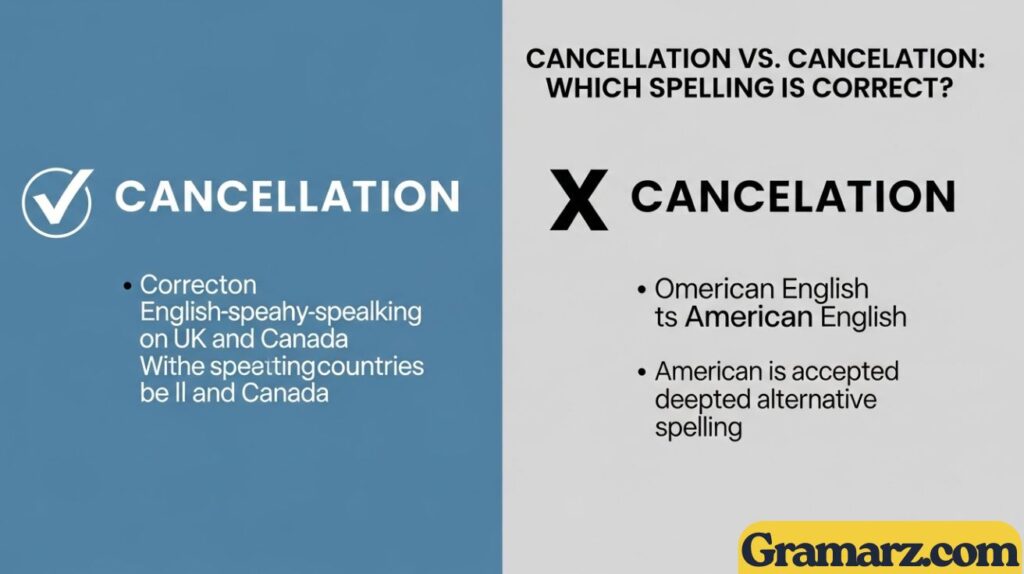
The most important question is: cancellation or cancelation, which is correct? The answer depends on what type of English you are using, but in most cases, you should use cancellation with two “L’s.” Even though cancelation American spelling with one “L” exists, it is rare and much less recognized. Major dictionaries, newspapers, and official documents in the U.S. continue to prefer cancellation spelling as the standard form.
If you want your writing to look professional and trustworthy, especially in business, legal, or academic work, you should choose cancellation. The version cancelation may not always be marked as wrong, but it looks unusual to most readers. Writers are advised to maintain language consistency in writing, and that means sticking with the spelling that is most widely accepted.
Why Do American and British English Differ in the Use of Single or Double “L”?
To really understand the debate around cancellation American vs British, we need to look at the history of spelling rules. In British English, the traditional spelling pattern requires doubling the consonant “L” when adding suffixes like “-ed,” “-ing,” or “-ation.” This is why British writers say cancelled, cancelling, canceller, and cancellation.
In American English, however, the rules were changed. According to Noah Webster spelling reforms, you only double the consonant when the stress is on the syllable that receives the suffix. Since the stress in “cancel” is on the first syllable (CAN-cel), Americans dropped the double “L” in some forms, producing words like canceled, canceling, canceler, and even cancelation.
Here is a useful table that shows the difference:
| American English | British English |
| canceled | cancelled |
| canceling | cancelling |
| canceler | canceller |
| cancellation (preferred) / cancelation (rare) | cancellation (only accepted form) |
| traveled | travelled |
| modeled | modelled |
This table shows how many spelling variations in English exist. The American system simplifies, while the British system preserves words with double consonants. Both are correct depending on the variety of English you use, but the key point is that in the U.S., even with simplification, cancellation remains dominant.
Synonyms of “Cancellation”

Sometimes writers want to avoid repeating the same word many times. In such cases, it helps to use synonyms for cancellation. Depending on the situation, you can use:
- Termination – when an agreement, job, or contract is officially ended.
- Annulment – often used in legal contexts, such as annulment of a marriage.
- Revocation – when a license, order, or permission is officially withdrawn.
- Rescission – common in law, describing the undoing of a contract.
All of these words express the idea of ending something, just like cancellation, but they fit different contexts. Choosing the right synonym adds variety and precision to your writing.
Examples in Context
To see how the word is used, here are several real examples. An airline may announce the cancellation of dozens of flights due to weather. A company may email customers about the cancellation of a subscription service. Universities sometimes issue notices of the cancellation of classes. Concerts, conferences, and festivals are also common examples where cancellation notices disappoint people.
You could also write, “The unexpected cancellation of the meeting created confusion among employees.” Another sentence could be, “Customers are entitled to refunds in case of cancellation within 48 hours.” These examples show how natural and common the double “L” spelling is in daily life. The one “L” spelling, cancelation, would look unusual and may cause readers to question whether it is a common spelling mistake.
Origins of “Cancellation”
The history of the word goes back to Latin. The root is cancellare, which meant “to cross out” or “make lattice-like.” In early English, the noun form appeared as cancellation in the 1530s. Writers used it to describe the act of crossing out text or making something invalid. Over time, its meaning expanded to cover the act of stopping events, reservations, and agreements.
The spelling with two “L’s” was always the main form, and this is why dictionaries treat it as standard today. The form with one “L,” cancelation, emerged later in the United States during the period of spelling reforms. While it has survived, it never became more common than cancellation.
Read Also : IGHT Mean in Text: What This Slang Means and When to Use It
Related Spelling Variations: Canceled vs Cancelled
The same confusion appears with the past tense of the verb. In the U.S., the preferred form is canceled, while in the U.K., the correct spelling is cancelled. The same rule applies to cancelling vs canceling and canceller vs canceler. These are typical examples of British vs American spelling differences.
Writers in the United States often wonder if they should use canceled vs cancelled. The answer is that canceled is the standard in American English, just as cancellation with double “L” is the standard noun form. This shows that the rules are not always perfectly consistent, but they follow the general American tendency toward simplified forms.
The Common Mix-Up Between Cancellation and Cancelation
Many writers in the U.S. wonder about cancellation vs cancelation because both spellings appear in books, websites, and even official documents. This causes confusion, especially for students, professionals, and businesses that want their writing to look polished and correct. The truth is, while both exist, only one form dominates in everyday English.
The confusion increases when people notice similar cases, like canceled vs cancelled or canceling vs cancelling. These variations show the British vs American spelling differences that often leave writers uncertain. Understanding why the spellings differ helps you make the right choice and maintain language consistency in writing, whether you are writing an email, an essay, or an official notice.
Cancellation and Cancelation: Same Meaning, Different Look

The interesting part is that cancellation meaning and cancelation meaning are exactly the same. Both refer to ending an event, agreement, or subscription. The difference is only in spelling, not in meaning. A canceled flight or a subscription cancellation carries the same sense regardless of how many “L’s” appear in the word.
Readers should note, however, that while cancelation American spelling with one “L” does appear, it is uncommon. Most dictionaries, style guides, and professional documents strongly favor cancellation spelling with two “L’s.” Choosing the standard form avoids misunderstandings and helps ensure your writing looks correct to both U.S. and international audiences.
Why Cancellation Is the Preferred Choice
If you are asking cancellation or cancelation which is correct, the safest choice is cancellation. It is the version used in official policies, corporate writing, and dictionaries. Although cancelation is not technically wrong, it is rare and may be flagged by spellcheckers as a mistake. For clarity and professionalism, most writers stick with the double “L.”
Even within American vs British spelling differences, cancellation remains consistent in both regions. Unlike other words such as traveled vs travelled or modeled vs modelled, the noun form “cancellation” does not shift much between U.S. and U.K. usage. This consistency makes it the best choice, especially when writing for global audiences.
Double L vs Single L in English Spelling
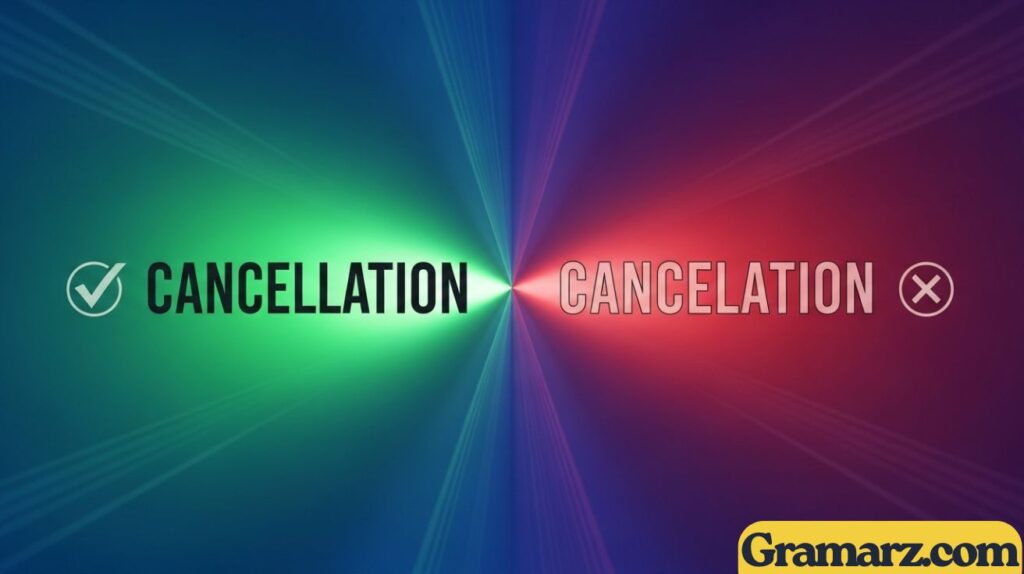
The debate over double L vs single L words goes back to the 19th century. American reformer Noah Webster spelling reforms simplified many words by removing what he considered “unnecessary letters.” This is why Americans often write canceled, traveler, and modeled, while British English keeps cancelled, traveller, and modelled.
However, cancellation spelling with two “L’s” survived even in American English because it looked more natural and was already established. Although the shorter cancelation spelling is sometimes seen, it never gained wide acceptance. This shows how spelling rules can change, but tradition often decides which form becomes dominant.
FAQs
What is the difference between cancellation and cancelation?
There’s no difference in meaning; cancellation is the preferred spelling, while cancelation is a rare U.S. variant.
Is cancellation spelled with one L or two?
It is correctly spelled with two L’s in both American and British English.
What is the difference between cancelled and canceled?
Both mean the same; canceled is standard in American English, while cancelled is used in British English.
Does the double ‘l’ matter in cancellation?
Yes, the standard form is cancellation with double “L,” and the single “L” version is not widely accepted.
Conclusion
So when we ask, cancellation vs cancelation: which spelling is correct? the answer is clear. Both forms exist, but cancellation with two “L’s” is the correct, standard, and widely accepted spelling in both American and British English. The version cancelation appears only occasionally in American usage and is far less common. To avoid confusion and maintain language consistency in writing, it is always best to use cancellation.
The next time you find yourself uncertain about canceled vs cancelled, cancelling vs canceling, or even canceller vs canceler, remember that these are just examples of spelling variations in English. What matters most is consistency and clarity. And in this case, whether you are in the U.S. or the U.K., cancellation is the safest and most professional choice.