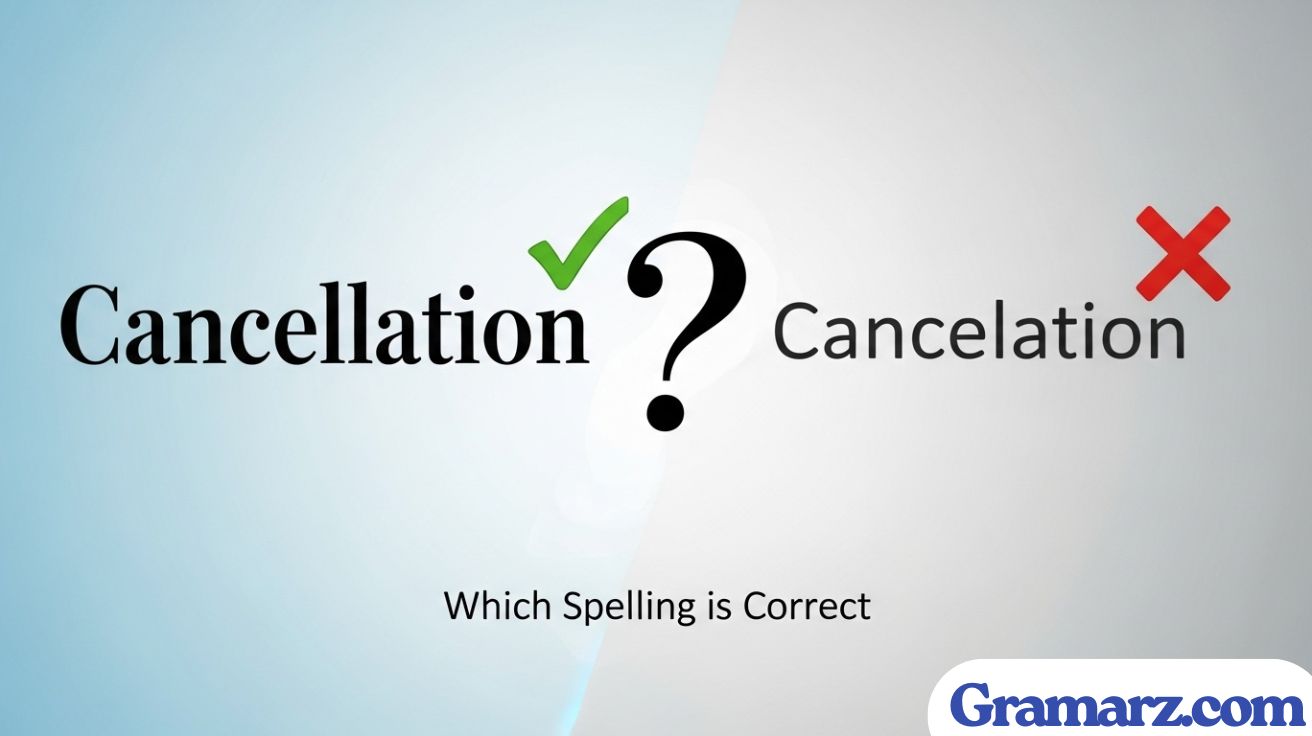
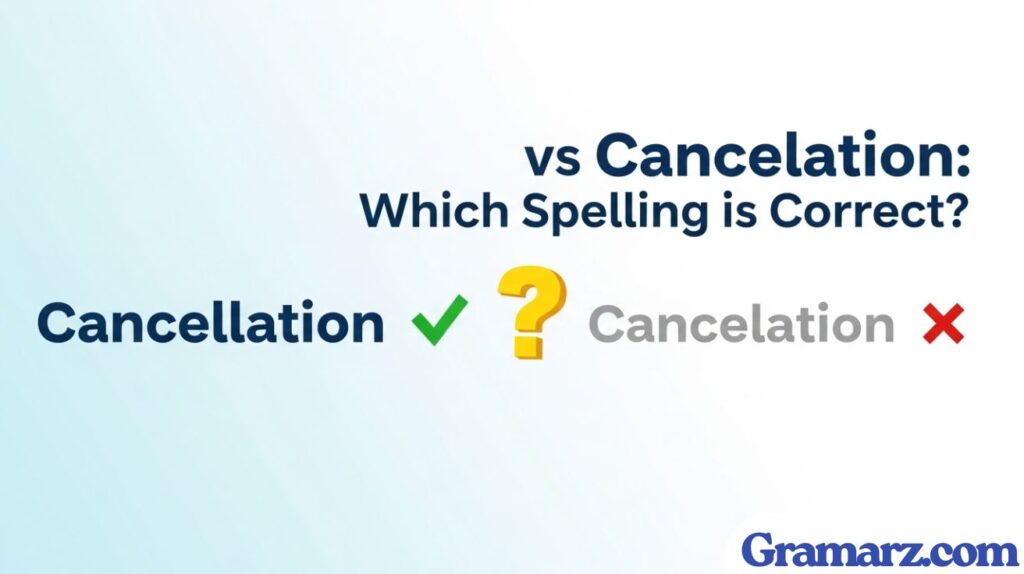
Cancellation vs Cancelation are two spellings of the same word. Both mean the act of ending or stopping something. The cancellation definition is to make an event, agreement, or plan invalid. The cancelation definition means exactly the same. The difference is only in spelling, not in meaning.
Many writers feel unsure when they see both versions. Which one is correct? Which one should they use in writing? This question comes up often in emails, contracts, and policies. The small difference in spelling can confuse readers. That is why the right choice matters.
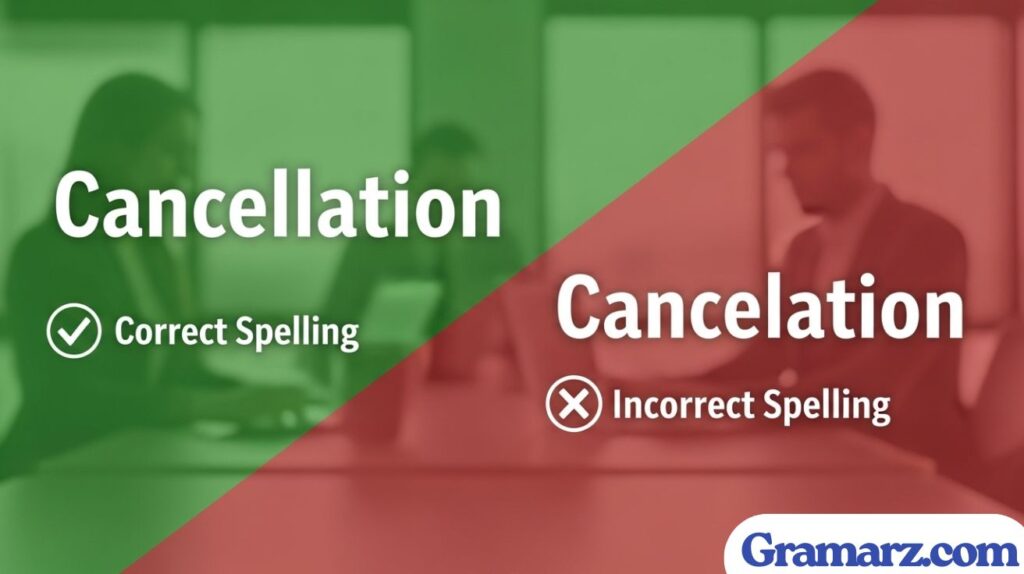
In American English, cancellation with two “L’s” is the standard. The single “L” form, cancelation, is rarely used. British English never uses cancelation spelling. Most dictionaries, style guides, and businesses prefer cancellation spelling. It is the safest and most professional form to use.
Why is There Confusion?
The confusion around cancellation spelling and cancelation spelling comes from the natural English spelling variations that developed over time. English is not a fixed language; it changes across different regions and time periods. A major reason for these variations lies in the reforms made by Noah Webster, the American dictionary creator in the early 1800s. He believed in simplified spellings and wanted Americans to have a language that was logical and independent of British traditions. His Noah Webster simplified spelling method influenced many words. This is why Americans write “color” instead of “colour,” or “theater” instead of “theatre.”
In this effort, some words with double consonants were reduced to single consonants. That explains why Americans usually prefer canceled vs cancelled and canceling vs cancelling, while the British keep the double letters. However, the noun form, which is cancellation vs cancelation, never fully changed in the U.S. Even though cancelation spelling appeared in some dictionaries, cancellation spelling remained dominant both in the U.S. and worldwide.
This confusion continues because writers often see both spellings on websites, advertisements, and social media posts. Even spell-checkers sometimes allow both forms, creating more doubt. In the age of digital communication, these regional spelling differences become more obvious because Americans and British readers frequently read each other’s texts online.
What Do “Cancellation” and “Cancelation” Mean?
Both words share the same meaning. The cancellation definition and the cancelation definition refer to the act of ending, stopping, or invalidating something. Whether you use cancellation vs cancelation, the meaning remains identical. For example, an airline might announce the cancellation of flights due to weather, or a hospital may explain an appointment cancellation policy to manage patient schedules.
In professional settings, companies often use the term when they want to explain policies. Subscription services may send emails about the cancellation of a service, hotels create clear hotel reservation cancellation policies, and schools announce the cancellation of classes when emergencies occur. In all these cases, the meaning does not change, only the spelling differs.
So, whether you are reading an American legal document or a British newspaper, the concept is the same. What changes is only the spelling preference.
Canceled or Cancelled? Canceler or Canceller? Canceling or Cancelling?
The variations do not stop with the noun. Words like canceled vs cancelled, canceler vs canceller, and canceling vs cancelling also show how spelling depends on geography. In American English, the single “L” is favored, while in British English, the double “L” remains. The table below makes the difference between American and British spelling clear.
| Word Form | American English | British English |
| Past tense | Canceled | Cancelled |
| Noun (person) | Canceler | Canceller |
| Present participle | Canceling | Cancelling |
| Noun (event) | Cancellation | Cancellation (Cancelation rare in U.S.) |
The rule is simple in the United States: consonants are usually doubled only when the stress falls on the final syllable. That is why Americans write “traveled” instead of “travelled,” or “labeled” instead of “labelled.” These patterns extend to travel vs travelling spelling and label vs labelled spelling. In the United Kingdom, however, consonants are doubled more frequently, regardless of stress. This explains why a British newspaper will print cancelled while an American magazine will publish canceled.
“Cancellation vs Cancelation”: Which Spelling Should You Use?
For American writers, the safe and professional choice is cancellation. Even though cancelation spelling has appeared in U.S. dictionaries, it has never become the standard form. In fact, most formal writing guidelines and style guides in the United States, including those used by universities and publishers, recommend cancellation.
In everyday business use, the preference is also clear. Companies write business communication spelling in a way that avoids confusion. For example, airlines always write “flight cancellation” in their policies, not “flight cancelation.” Similarly, government agencies, universities, and professional organizations prefer “cancellation.” Choosing this spelling shows professional writing consistency and avoids distracting readers with unusual spelling.
So, while both are technically accepted, cancellation is the spelling that will look correct and polished in any professional or academic situation.
Why Do American and British English Differ in the Use of Single or Double “L”?
The history of cancellation word and its variations connects to the bigger story of how English developed. When Noah Webster simplified spelling in the early 1800s, he wanted Americans to write words in a way that made more sense phonetically and was easier to learn. His dictionary left a lasting mark on U.S. spelling.
This is why American English uses single “L” in words like canceled, traveled, modeled, and labeled, while British English doubles them. The difference between American and British spelling can be seen clearly in the following table.
| American English | British English |
| Traveling | Travelling |
| Modeling | Modelling |
| Labeling | Labelling |
| Quarreling | Quarrelling |
| Signaling | Signalling |
| Dialing | Dialling |
The American rule is simple: double the consonant only if the stress is at the end of the word. The British rule is less restrictive, leading to more doubled letters. This difference explains not just cancellation vs cancelation, but also many other common spelling mistakes in English that learners often face.
Read Also : What Kind of Vs What Kinds of: Easy Tips to Use Them Right
Synonyms of “Cancellation”
Sometimes, using a synonym makes writing clearer. Several synonyms for cancellation exist, each with a slightly different use. Lawyers may use annulment vs cancellation when discussing the end of contracts or marriages. Human resources officers might use termination vs cancellation when talking about employment contracts. Officials often use revocation in contracts when licenses or permissions are taken back. Finance professionals use rescission in law to describe the reversal of a legal agreement. Governments may prefer abolishment meaning when referring to ending laws or institutions.
These synonyms show that while the spelling of cancellation may vary, the idea is deeply embedded in legal, business, and social contexts across the world.
Examples in Context
To make the differences clearer, consider these examples. An airline might issue a notice: “Due to severe weather, the airline announces the cancellation of flights scheduled for today.” A university may send students an email: “The cancellation of classes tomorrow is due to the snowstorm.” A hospital might write: “Patients are requested to follow the appointment cancellation policy for rescheduling.” A travel company may say: “Guests are advised to read the hotel reservation cancellation rules before booking.”
In some rare American texts, you may still see “cancelation,” but in each of these cases the meaning remains unchanged. Readers, however, may pause at the unusual spelling, which is why cancellation spelling is recommended for clarity.
Origins of “Cancellation”
The etymology of cancellation is fascinating. The word comes from the Latin cancellare, which meant “to cross out” or “to make a lattice pattern.” In medieval times, scribes drew cross-hatched marks over mistakes in manuscripts, and this action was called cancellation. By the 1500s, the word entered English, where it was used to describe invalidation or removal.
Over time, as contracts, appointments, and reservations became part of modern life, the word’s meaning expanded. In the 19th and 20th centuries, as business practices grew more complex, cancellation spelling became standardized in industries such as travel, education, and healthcare. This historical journey explains why the word has remained so consistent, even in the face of English spelling variations.
Cancellation vs Cancelation in American English
In the United States, many writers wonder whether cancellation vs cancelation is the right choice. While both appear in American texts, cancellation spelling is far more common and considered the standard form. Dictionaries list cancelation spelling, but it is rarely used in professional contexts, where consistency and clarity are more important.
Americans typically follow simplified spellings introduced by Noah Webster simplified spelling, which explains forms like canceled vs cancelled and canceling vs cancelling. However, for the noun form, “cancellation” resisted change. Today, business documents, contracts, and academic writing almost always use cancellation, making it the safer option for anyone writing in the United States.
Cancellation vs Cancelation in British English

In Britain, the spelling difference is easier to explain because cancelation spelling is almost never used. British English consistently prefers cancellation spelling with two “L’s,” keeping the word aligned with its historic roots. This fits into a larger pattern of British English vs American English spelling where consonants are often doubled.
For example, words like travel vs travelling spelling and label vs labelled spelling highlight how British writers maintain double consonants. This practice extends to cancelled, cancelling, and canceller, all of which are spelled with two “L’s” in the UK. Writers working with international audiences should therefore rely on cancellation spelling to ensure clarity.
Why Cancellation is the Preferred Spelling
When considering cancellation vs cancelation, the safest choice is always “cancellation.” Not only is it more common in the U.S., but it is also universally recognized across English-speaking countries. This consistency avoids unnecessary questions about spelling errors and helps maintain a professional appearance in writing.
In contexts like business reports, airline cancellation policy, appointment cancellation policy, or hotel reservation cancellation, using the recognized form adds authority. Choosing cancellation spelling also aligns with formal writing guidelines, where readers expect standardized word forms. For professional communication, this spelling ensures readers focus on meaning, not mistakes.
Examples of Cancellation in Everyday Life
The word cancellation appears constantly in American daily life. Airlines frequently announce flight cancellation due to bad weather, while hospitals apply strict appointment cancellation policy rules. Hotels emphasize their reservation cancellation terms, often linking them to customer refunds or penalties. In all these situations, the spelling with two “L’s” is dominant.
Although cancelation spelling exists, it is rare in everyday documents. Readers may even see it as a spelling mistake. That is why businesses, schools, and government offices all prefer cancellation spelling. The word has become part of standard English communication, ensuring consistency across industries and avoiding the appearance of common spelling mistakes in English.
FAQ,s
What is the difference between cancellation and cancelation?
They mean the same, but cancellation (double “L”) is the standard spelling, while cancelation (single “L”) is a rare U.S. variant.
Is cancellation spelled with one L or two?
The correct and preferred spelling is cancellation with two “L’s.”
What is the difference between canceled and cancelled?
Both mean the same; canceled is American English, while cancelled is British English.
Does the double ‘l’ matter in cancellation?
Yes, because cancellation with two “L’s” is recognized as the correct form in professional and global use.
Conclusion
The debate between cancellation vs cancelation is really about tradition and regional differences. Both spellings exist, but in the United States and worldwide, cancellation is by far the more common, accepted, and professional choice. Even though Webster’s reforms created many regional spelling differences, they did not fully replace this word. If you want professional writing consistency, especially in business documents, contracts, or formal writing, you should always choose cancellation.
As language learners and professionals, we may encounter both spellings online, but the rule is simple: in the U.S., the correct spelling of cancellation is with double “L.” This choice ensures clarity, avoids confusion, and follows the formal writing guidelines that most institutions and organizations prefer.