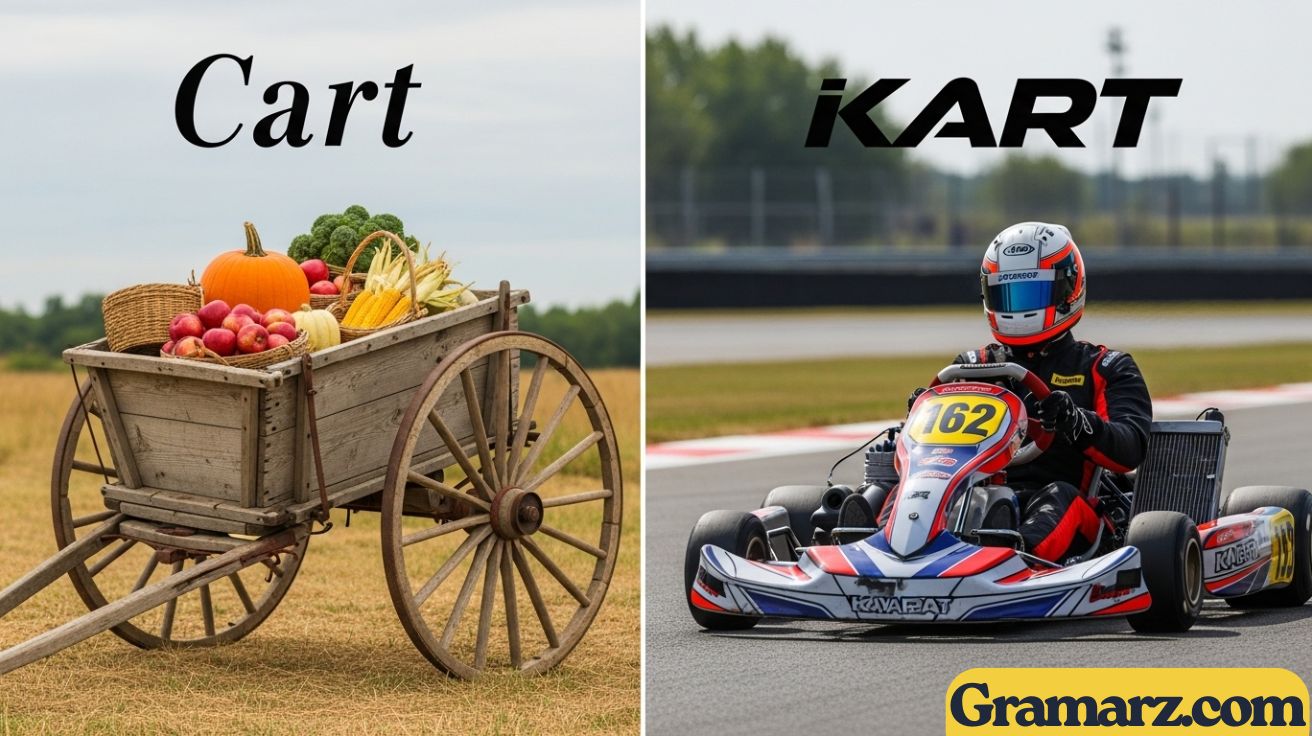
The words kart vs cart may look similar, but they have different meanings. A cart is used for carrying goods or shopping, while a kart is a small racing vehicle. Both sound the same but are used in different situations.
Many people get confused when choosing between kart and cart. They look identical, and the pronunciation adds to the mix-up. Let’s make it easy to understand which one to use and when.
In everyday life, you push a shopping cart at a store, but you race in a go-kart on a track. Knowing the difference helps you write and speak correctly. It’s a small change that makes a big difference in meaning.
The Evolution of “Cart”
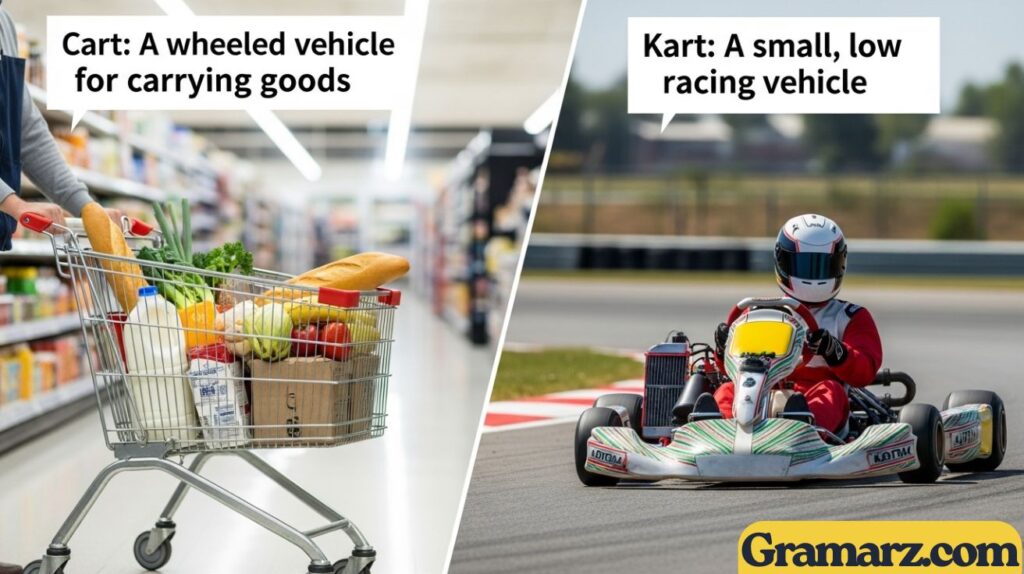
The word cart has an ancient history deeply connected to human civilization and the history of transportation. The origin of the word cart comes from the Old Norse term “kartr” and the Old English word “cræt,” both of which meant a heavy vehicle used for carrying goods. Over centuries, as languages evolved, “cart” became the standard spelling we use in modern English writing.
Carts were vital for moving crops, building materials, and people. They represented progress — the ability to transport goods efficiently. The cart meaning in English refers to a wheeled vehicle or container used for carrying or transporting goods. This definition of cart remains consistent even today, though the forms have changed.
Ancient Origins and Etymology
The concept of a cart goes back to ancient times. Archaeologists have found wheeled vehicles dating back to 3500 BCE in Mesopotamia. Early carts were simple wooden platforms with solid wheels. These primitive designs marked the beginning of human innovation in mobility. The term evolved from Old Norse kartr and Old English cræt into Middle English cart or carte before settling into the spelling we use now.
Carts were not only useful; they were symbols of economic and social life. They allowed civilizations to expand trade routes and agriculture. Without carts, transporting goods over long distances would have been nearly impossible.
Historical Uses Across Cultures
Throughout history, the meaning of cart has changed slightly depending on culture and era. Ancient Egyptians used chariots in warfare, while Romans used large carts to carry supplies across their empire. In medieval Europe, merchant carts filled markets, and horse-drawn carts became the backbone of trade. Farmers used agricultural carts for carrying crops, while soldiers used war carts for transporting weapons and materials.
In early America, settlers relied heavily on horse-drawn carts and wagons to move westward. These vehicles symbolized freedom, exploration, and hard work — values still strong in American culture today.
Modern-day Applications of Carts
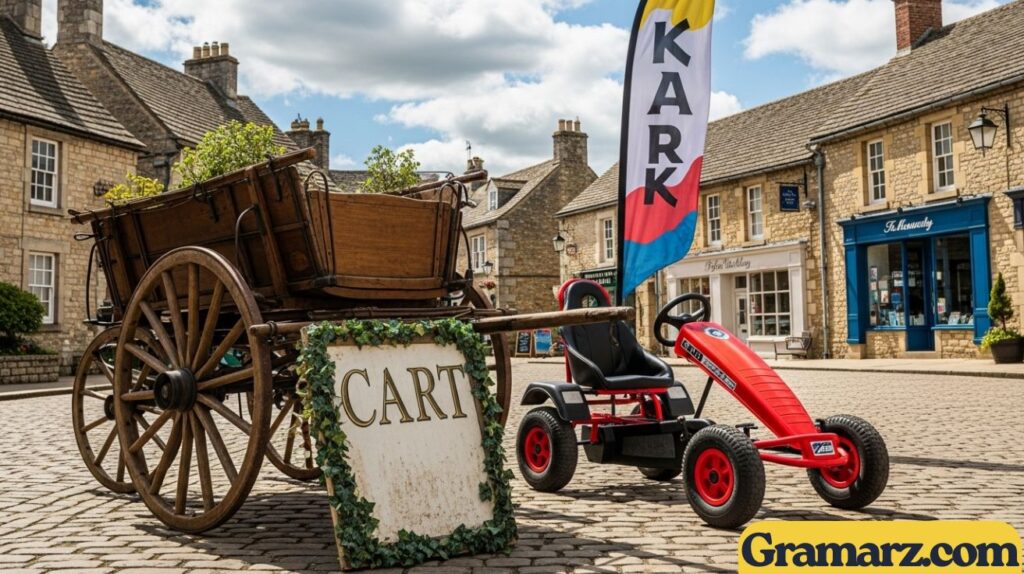
In modern society, the word cart still plays a major role in daily life. You see it everywhere — from supermarkets to the internet. A shopping cart is the most common type, used in both physical stores and as a digital shopping cart in e-commerce websites. Online stores like Amazon and Walmart depend on the online shopping cart system for transactions.
Other examples include the golf cart, a small electric vehicle used to carry golfers and their clubs, and the food cart, a mobile kitchen often found on city streets. Even in industrial settings, workers use hand carts or trolleys to move heavy items. The difference between cart and trolley often comes down to regional usage — “cart” is more common in American English, while “trolley” appears more in British English.
The Birth of “Kart”
While “cart” has deep historical roots, kart is a modern invention. The definition of kart refers to a small, open racing vehicle used in motorsports. The history of go-kart began in 1956 when Art Ingels, a race car mechanic in California, built the first go-kart using a small engine and a lightweight frame.
The meaning of kart came to represent speed, competition, and innovation. Unlike a traditional cart, a kart was designed for fun and racing. This new spelling helped create a unique identity in the growing motorsport culture of the 20th century.
When and Why “Kart” Emerged
The 1950s marked the birth of recreational racing. The new word “kart” was intentionally created to distinguish these small racing vehicles from ordinary carts. The word fit the high-energy world of go-kart racing, appealing to both hobbyists and professionals.
By 1962, the International Karting Commission was established, confirming “kart” as the official spelling in motorsports terminology. From there, the word spread globally, becoming part of the vehicle terminology used by drivers, engineers, and racing fans alike.
Connection to Motorsports
In motorsport culture, karts are considered the starting point for professional racers. Many Formula One drivers, including Lewis Hamilton and Michael Schumacher, began their careers in racing karts. The go-kart racing meaning extends beyond entertainment — it’s a training ground for precision, reflexes, and strategy.
The rise of indoor karting and kart racing tracks across the U.S. made the sport accessible to everyone. Today, families and enthusiasts alike participate in karting as a hobby and sport.
Cultural Impact of Go-karting
The cultural impact of go-karting is massive. It’s not just a racing activity but a global phenomenon that inspired video games, sports, and events. The Mario Kart video game series, first released in 1992, popularized the spelling “kart” among millions of gamers. The franchise transformed kart into a fun, familiar word, linking it with excitement and entertainment.
Go-karting also serves as a bonding activity and an introduction to mechanical engineering for young racers. In the U.S., go-karting has become a family-friendly motorsport found in amusement parks and professional circuits.
Diving Deep: “Cart” vs “Kart”

Understanding the difference between cart and kart requires looking at language, pronunciation, and meaning. Although they sound identical, their purposes are completely different.
Linguistic Analysis
Phonetic Similarities and Differences
The cart vs kart pronunciation is the same in most English dialects: /kɑːrt/. This identical sound often leads to confusion in writing, especially among new learners.
Morphological Considerations
“Cart” is an old English word with deep historical roots, while “kart” is a newer spelling developed for a specific industry. The change in spelling distinguishes old from new, traditional from modern.
Semantic Distinctions
“Cart” is used for carrying goods; “kart” is for racing or games.
| Term | Primary Meaning | Context | Example |
| Cart | Wheeled vehicle for goods | Shopping, agriculture | “The farmer loaded his cart with hay.” |
| Kart | Small racing vehicle | Motorsports, gaming | “He drove his kart around the track.” |
Contextual Usage
If you are in a supermarket, you push a shopping cart. But if you are racing, you drive a go-kart. Choosing the right spelling depends entirely on the situation.
The Go-Cart Conundrum
History of the Term “Go-cart”
The term “go-cart” first appeared in the 16th century, describing a small wheeled frame used to help babies learn to walk. It was only in the 20th century that it began referring to small motorized vehicles.
Transition to “Go-kart” in Racing Contexts
As racing grew popular, the spelling shifted to “go-kart.” Enthusiasts preferred it because it looked modern and matched the energetic spirit of the sport.
Current Usage and Preferences
Today, the correct spelling of go-kart is “go-kart.” The older form, “go-cart,” still exists but is used in non-racing contexts. So if you’re talking about racing, always write go-kart, not “go-cart.”
| Form | Meaning | Preferred Use |
| Go-cart | Old-fashioned or children’s toy | Rare |
| Go-kart | Small racing vehicle | Standard spelling |
Digital Age Implications
Search Engine Optimization Considerations
In the online world, spelling matters. Businesses selling products must use “shopping cart” or “digital shopping cart” to reach customers. For racing content, “go-kart” performs best in search engines. Choosing the right word affects SEO rankings, click-through rates, and user trust.
Brand Naming Strategies
A company focused on e-commerce should use “cart” because it feels familiar and professional. A brand in motorsports or gaming can use “kart” to feel energetic and youthful. For example, “Amazon Cart” sounds natural, while “SuperKart Racing” appeals to thrill seekers.
Social Media Hashtag Usage
The correct hashtags depend on context. For e-commerce, users post with #ShoppingCart or #OnlineShoppingCart, while racing fans use #GoKart, #MarioKart, or #IndoorKarting.
Read Also : Pre vs Post: Which Prefix to Use?
Pop Culture and Media Representation
“Cart” and “Kart” in Literature
The word usage guide in literature shows clear patterns. Carts appear in historical novels like Charles Dickens’ “A Tale of Two Cities.” Meanwhile, karts show up in modern adventure and sports stories.
Video Games and the Popularity of “Kart”
The massive success of Mario Kart solidified the word “kart” in pop culture. Games like “Crash Team Racing” and “Team Sonic Racing” continue this legacy, introducing new generations to the word “kart.”
Movies and TV Shows Featuring Carts and Karts
Films such as “The Fast and the Furious” showcase go-kart racing, while historical dramas like “Downton Abbey” depict horse-drawn carts. These portrayals highlight how each word represents different worlds — one old and practical, the other fast and exciting.
Grammar Rules and Style Guides
What Major Dictionaries Say
| Dictionary | “Cart” Definition | “Kart” Definition |
| Merriam-Webster | Vehicle or container on wheels | Small motorized racing vehicle |
| Oxford English Dictionary | Strong vehicle for goods | Small, light racing car |
| Cambridge Dictionary | Basket on wheels used in shops | Light vehicle for racing |
AP Stylebook and Chicago Manual of Style Guidelines
According to the AP Stylebook, always write go-kart for racing contexts. The Chicago Manual of Style follows this rule, confirming that “kart” is specific to motorsports.
Industry-specific Style Preferences
The retail world prefers “cart” (e.g., shopping cart, golf cart), while racing and gaming use “kart” (e.g., go-kart, Mario Kart). Following the right style helps maintain professionalism.
Common Mistakes and How to Avoid Them
Misuse in Formal Writing
Writers often confuse the two spellings. Using kart in a shopping context or cart in a racing one creates confusion. Always remember the difference between cart and kart before you write.
Inconsistencies in Branding
Mixing both spellings in one brand harms credibility. Businesses should stick to one consistent form depending on their field.
Tips for Remembering the Correct Usage
An easy trick is: Cart is for Carrying, Kart is for Karting. If you’re unsure, “cart” is safer because it has more general use in English.
Understanding the Difference Between Cart and Kart
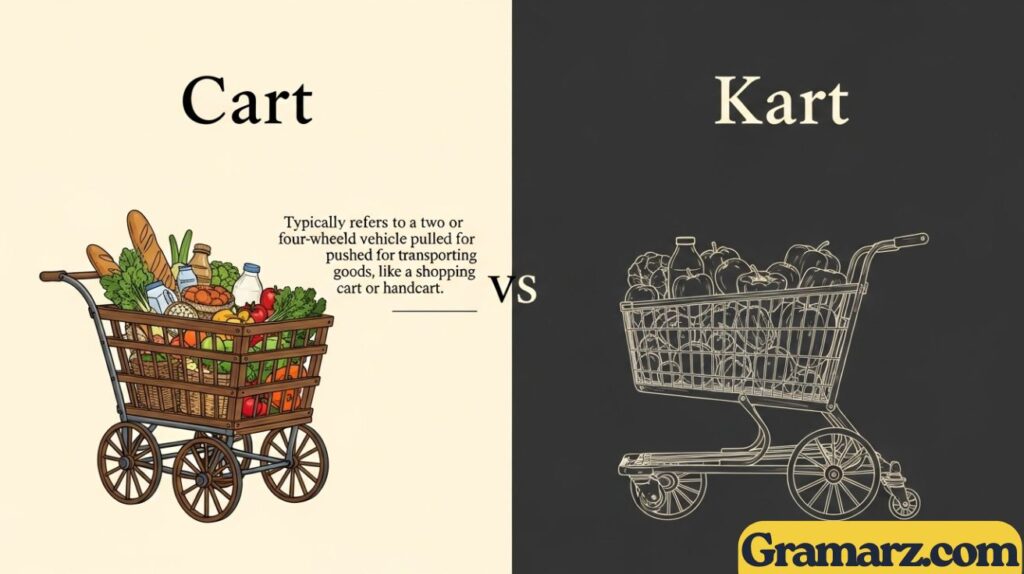
The difference between cart and kart comes from their meanings and uses. A cart is a vehicle used for carrying goods, while a kart is used for racing or entertainment. Both words sound the same, but they are written differently and used in very different situations.
In English, this confusion is common because cart vs kart pronunciation is almost identical. However, knowing the meaning of cart and kart helps you choose the right one in writing. “Cart” fits normal transport use, while “kart” fits in motorsport or gaming contexts like go-kart racing or Mario Kart.
The Origin of the Word Cart and Its Evolution
The origin of the word cart goes back to Old Norse and Old English. It was used for horse-drawn carts that carried goods across villages and cities. Over time, it became a common English word used for moving or transporting items in trade and farming.
Today, “cart” is still part of daily life. Americans use it for shopping carts, food carts, and even digital shopping carts in online stores. This shows how language evolves from physical to digital meaning while keeping the original purpose of carrying or transporting something.
What Does Kart Mean and How It Became Popular
The word kart is much newer than “cart.” It appeared in the mid-1900s when engineers built small racing vehicles. The definition of kart refers to a small, open racing vehicle with four wheels. The history of go-kart began in California, where the sport quickly became popular among both children and adults.
The popularity of go-kart racing spread worldwide, and the spelling “kart” became standard to make it unique. The correct spelling of go-kart is always with a “k,” not “go-cart.” If you wonder which is correct: go-cart or go-kart, remember that “go-kart” is for racing, while “go-cart” is an older term for a child’s push toy.
Modern Uses of Cart in Everyday English
In modern English, “cart” appears in many forms. You can find a shopping cart in supermarkets, a golf cart on the golf course, and a food cart selling street snacks. The cart meaning in English remains about carrying or moving something from one place to another.
Online businesses also use the term digital shopping cart or online shopping cart for checkout systems on websites. This digital use connects the old meaning of “cart” with modern technology. It proves that traditional words can adapt as human life changes, especially in e-commerce and digital marketing.
Go-Kart vs Go-Cart: Which is Correct?
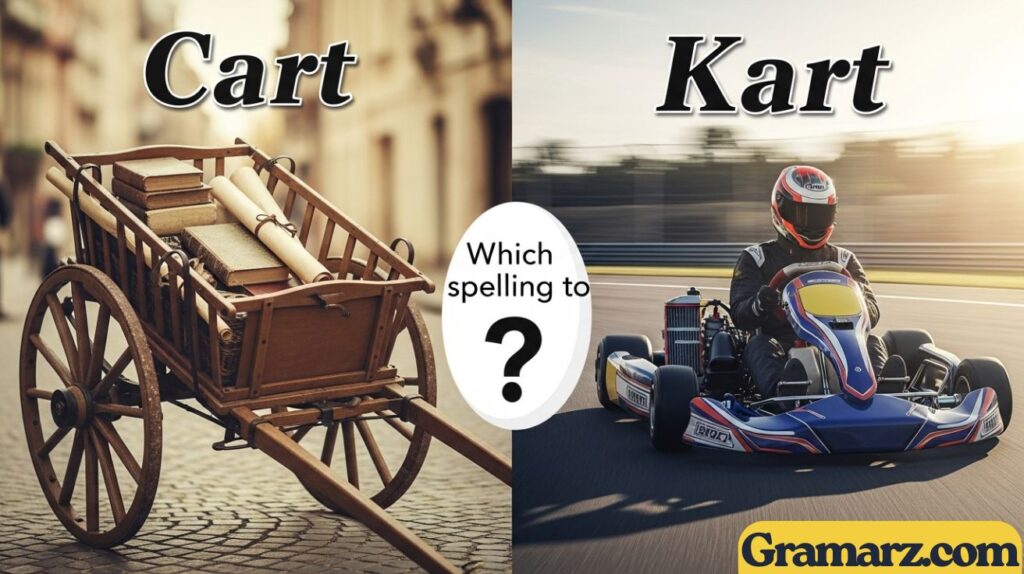
There’s often confusion about go-kart vs go-cart. The correct spelling of go-kart uses a “k,” not a “c.” The “go-kart” refers to a small, motorized racing vehicle. On the other hand, “go-cart” was once used for baby walkers or hand-pulled carts before the racing sport was invented.
If you’re talking about go-kart racing or indoor karting, always spell it with a “k.” Many dictionaries like Merriam-Webster confirm that how to spell go-kart correctly is with a “k.” This spelling separates motorsport from non-racing meanings, creating a distinct identity in modern English.
How Carts and Karts Appear in Culture and Media
Both words have left marks in culture. Movies and TV shows often feature horse-drawn carts, food carts, and shopping carts to show traditional or modern life. Literature also uses “cart” as a symbol of travel, work, or trade in human history.
In contrast, kart meaning in English became popular through video games and sports. The game Mario Kart made the term famous among children and gamers. It also helped spread the motorsport culture of racing karts worldwide, showing how language and entertainment influence each other.
Tips for Remembering When to Use Cart or Kart
To remember when to use cart or kart, think of what the word describes. If it’s something that carries goods, like a shopping cart or golf cart, use “cart.” If it’s for racing or gaming, like a go-kart, use “kart.” This simple rule prevents common writing mistakes.
Writers and learners often mix them up because of their similar sounds. When in doubt, remember: “Cart is for carrying, Kart is for racing.” Understanding the difference between cart and kart improves your English writing tips and helps avoid confusion in both formal and casual communication.
FAQs
Is it spelled cart or kart?
It depends on the meaning — cart is for carrying goods, while kart refers to a small racing vehicle.
What is the difference between a car and a kart?
A car is a full-sized road vehicle, while a kart is a lightweight, open-wheel racing vehicle used on tracks.
Is it a go-kart or go-cart?
The correct spelling is go-kart — “go-cart” is an outdated term for a child’s push toy.
Is it a shopping kart or cart?
It’s always shopping cart, not “kart,” because it refers to a vehicle or basket for carrying purchased goods.
Conclusion
Language constantly evolves, and so do spellings. The language and spelling evolution of “cart” and “kart” shows how English adapts to new inventions and cultures. The difference between cart and kart lies not only in meaning but also in history, usage, and identity.
So, when writing, remember: if it carries groceries, it’s a cart. If it races on a track, it’s a kart. Whether you’re talking about a shopping cart or a go-kart, choosing the right word will make your writing clear, professional, and precise.
Final Tip: In short, cart is for carrying and kart is for racing — a simple rule that ensures you always spell correctly and communicate effectively.