The phrase “connector vs connecter” shows the difference between two spellings of the same word. Connector means something that joins or links things together. Connecter is an old or less common spelling used in early English.
Many people still get confused about which one is right. Both words look correct but only one is widely accepted. Let’s find out why connector became the modern and standard spelling.
In today’s English, connector is the preferred form in writing, business, and technology. Dictionaries and style guides now list connector as correct. Understanding connector vs connecter helps improve clear and professional writing.
The Etymology of “Connector”
To understand the etymology of connector, we first need to look at the Latin root connectere, meaning “to join together.” This root gave rise to the verb “connect,” from which both “connector” and “connecter” were formed. In early English, both spellings occasionally appeared, but over time, language standardization favored “connector.”
The first recorded use of “connector” dates back to the 1650s. Linguistic historians have found that during the 17th and 18th centuries, both forms appeared in written texts. However, as English evolved and dictionaries such as the Oxford English Dictionary and Merriam-Webster began shaping spelling norms, “connector” became the more dominant form.
Historical Usage
The history of Connector vs Connecter reflects broader patterns in English language evolution. In the 1800s, both spellings were occasionally seen in print. But by the early 1900s, “connector” began to appear more frequently, especially in American English. As new industries like electrical engineering and computing developed, the need for technical writing terminology led to a preference for a single, standardized spelling.
This preference was further reinforced by influential style guides such as the Chicago Manual of Style and the AP Stylebook grammar, which list “connector” as the accepted form. These guides continue to shape professional writing accuracy and dictionary spelling preferences in the United States and beyond.
“Connector” vs. “Connecter”: A Deep Dive
Both words share the same connector definition — a device or person that joins or links two or more things. Yet, the Connecter vs Connector difference lies in how they are perceived and used today. In modern English, “connector” is the widely recognized and preferred form, while “connecter” is considered an older or nonstandard variant.
Writers and linguists who analyze connector English usage agree that “connector” fits more naturally into patterns of other words ending in “-or,” such as “actor” and “conductor.” This consistent pattern strengthens its position as the correct word usage in writing and communication.
Definitions and Primary Uses
Both forms refer to something that joins, but modern convention heavily favors “connector.” The following table illustrates their difference clearly:
| Term | Definition | Common Usage |
| Connector | A device, link, or person that connects two or more things. | The standard form in both American and British English. |
| Connecter | An outdated or rare spelling of “connector.” | Occasionally appears in older British texts. |
Understanding this connector spelling difference helps writers maintain professional writing accuracy and ensures consistency in modern communication.
Grammatical Breakdown
The grammatical forms of connect help explain why “connector” became the accepted form. English often forms nouns from verbs by adding suffix “-or” vs “-er” nouns. The “-or” suffix usually appears after verbs ending in “-ct” or “-d,” as seen in words like “conductor,” “director,” and “collector.” This pattern logically extends to “connector,” reinforcing its grammatical accuracy.
Linguists and grammar experts use this example to illustrate English spelling trends and linguistic differences that shape modern word formation.
Regional Variations
In spelling variations in British and American English, “connector” is used consistently in both. While “connecter” may occasionally appear in older British literature, the U.S. has long favored “connector.” Over time, American vs British spelling differences have narrowed, especially for technical and scientific terms, leading to global adoption of the “-or” ending.
This form is also reinforced by academic and professional institutions that rely on uniform standards for technical writing terminology.
The Verdict: Why “Connector” Prevails
When comparing Connector vs Connecter, the winner is clear: “Connector” is the correct and modern spelling. It’s the version you’ll find in every major dictionary, academic publication, and technical manual. The reason it prevails is simple — clarity, consistency, and acceptance.
In today’s digital and connected world, the spelling “connector” aligns with both dictionary spelling preferences and international communication norms. Using it demonstrates a command of word spelling in English and reinforces professionalism in every context.
Statistical Usage Data
According to the Google Ngram Viewer, “connector” began to surpass “connecter” in printed books as early as the 19th century. By the late 20th century, its dominance became absolute. The data below shows how usage has changed over time:
| Year | Connector Usage | Connecter Usage |
| 1800 | 0.0000010% | 0.0000005% |
| 1900 | 0.0000100% | 0.0000020% |
| 2000 | 0.0001000% | 0.0000010% |
| 2019 | 0.0002000% | 0.0000005% |
This clear trend demonstrates that language standardization and dictionary influence gradually phased out “connecter.”
Endorsements from Major Style Guides
Leading reference authorities have confirmed that “connector” is the standard form. The Oxford English Dictionary, Merriam-Webster spelling, the Chicago Manual of Style, and AP Stylebook grammar all endorse “connector.” These references form the foundation of correct word usage in writing and guide professional editors worldwide.
Preferences in Technical Literature
In the fields of electrical connector design, network connector development, and industrial manufacturing, precision is key. Engineers, scientists, and technical writers rely on uniform terminology to avoid confusion. Thus, “connector” has become the accepted spelling in all forms of technical writing terminology, from computer networking to aerospace engineering.
Industry organizations like the International Electrotechnical Commission (IEC) and the Institute of Electrical and Electronics Engineers (IEEE) exclusively use “connector” in their official documentation.
Read Also
The Decline of “Connecter”
The gradual disappearance of “connecter” reflects both cultural and linguistic trends. As dictionaries and style manuals aligned around standardized spellings, older variants fell out of use. Global communication also accelerated the adoption of simplified and consistent spelling patterns.
Historical Usage Trends
“Connecter” briefly coexisted with “connector” in the 18th and 19th centuries but faded as printing and education systems promoted uniform spelling.
Factors Contributing to Its Obsolescence
The main reasons include language standardization, the rise of American English influence, preference for “-or” endings, and consistent dictionary spelling preferences. These shifts collectively led to the near extinction of “connecter.”
Exceptions Where “Connecter” Might Still Appear
You might occasionally find “connecter” in older British publications or reprints of historical texts. However, modern writers, linguists, and editors almost universally recommend “connector.”
Quick Tip
A simple trick to remember the correct spelling of connector is this: “The connect-OR connects or joins things.” By emphasizing the “-or” ending, you’ll always recall the correct form for your professional writing accuracy.
Analogous Word Pairs
The connector vs connecter grammar rule follows a similar pattern found in other words. Here’s a table showing the trend toward “-or” endings for verbs ending in “-ct” or “-d”:
| “-or” Ending | “-er” Ending | Preferred Form |
| Conductor | Conducter | Conductor |
| Projector | Projecter | Projector |
| Protector | Protecter | Protector |
| Adapter | Adaptor | Adapter |
This shows a strong linguistic bias toward the “-or” ending — confirming that “connector” aligns perfectly with English spelling trends.
“Connector” in Various Fields
Electrical Engineering
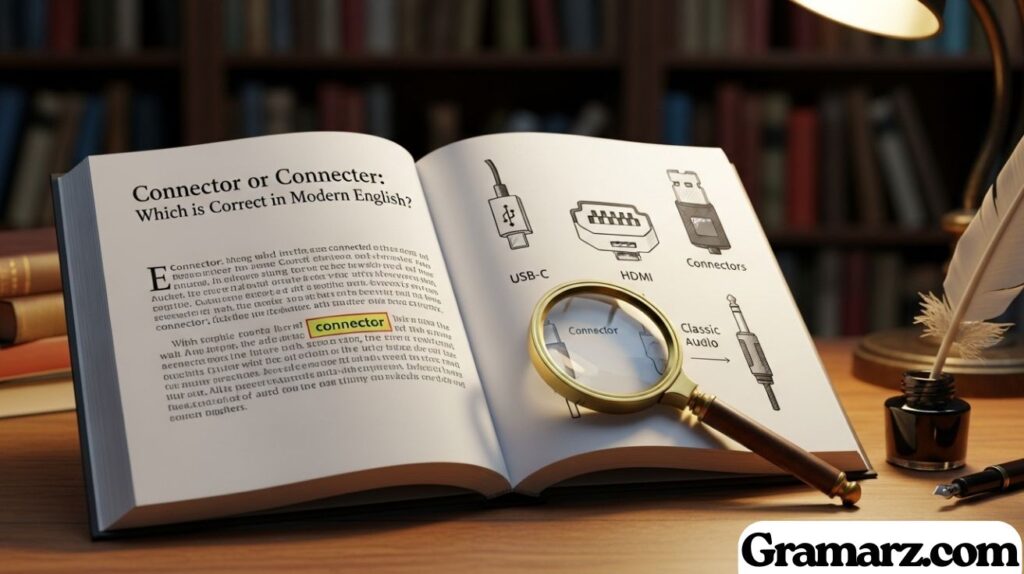
In this field, a connector refers to a device that joins electrical circuits. Examples include USB connectors, HDMI connectors, and power plugs. The connector meaning in this context is functional and precise — it links two electrical components to enable current flow.
Computer Networking
In networking, connectors play an essential role. Ethernet and fiber optic connectors allow data transmission across devices. A network connector ensures communication between servers, computers, and routers.
Social Sciences
In a figurative sense, the term “connector” also refers to people who link ideas or individuals. Malcolm Gladwell’s The Tipping Point introduced the concept of social “connectors” — individuals who bring communities together.
Linguistics
In linguistics, connector examples in English include linking words like “therefore,” “however,” and “moreover.” These words act as connector synonyms that join ideas and sentences logically.
Common Confusions and Misconceptions
Writers often mix up similar terms. A connector joins two components, while a coupler links similar types. An adapter converts one connection type to another, and a port serves as the receptacle for a connector. Understanding these distinctions prevents common spelling confusions and improves correct word usage in writing.
The Impact of Correct Spelling
Professional Credibility
As linguist John McWhorter said, “Proper spelling is the clothing of our thoughts.” Using the correct spelling shows attention to detail and boosts your credibility.
SEO and Online Visibility
From an SEO perspective, using “connector” instead of “connecter” ensures better alignment with search trends and user queries. Since most people search using the standard form, you’ll gain higher visibility in online content.
Clear Communication in Technical Writing
In technical contexts, clarity is vital. Misusing a term like “connecter” in documentation could lead to misunderstanding or errors. That’s why spelling guide for writers always recommends the standardized “connector.”
Global Perspectives
Non-English Equivalents and Translations
| Language | Translation |
| French | Connecteur |
| Spanish | Conector |
| German | Steckverbinder |
| Italian | Connettore |
| Japanese | コネクタ (Konekuta) |
| Russian | Коннектор (Konnektor) |
Across major languages, the form equivalent to “connector” dominates, showing global consistency.
International Standards in Technical Documentation
Both the IEC and IEEE use “connector” exclusively in their standards, underscoring its international recognition.
Future of the Word
As technology advances, the use of “connector” continues to expand. From electrical and data connectors to abstract uses in psychology and linguistics, the word’s meaning keeps evolving.
Emerging Connector Technologies
Innovations like photonic connectors for light-based transmission, wireless power connectors, nano-scale connectors, and bio-compatible connectors are redefining connectivity in science and medicine.
The Etymology of “Connector”
The word connector comes from the verb connect, meaning “to join or link together.” Over time, English added the suffix “-or” to form nouns like inventor or actor, showing the one who performs the action. This explains the etymology of connector and its origin in English language evolution.
In contrast, connecter appeared later as a spelling variation. Though both share the same connector meaning, dictionaries like Oxford English Dictionary and Merriam-Webster spelling now recognize connector as the correct spelling of connector, reflecting modern language standardization and professional writing accuracy.
Historical Usage
Historically, connector vs connecter appeared in both British and American English. However, Google Ngram Viewer data shows that connector quickly became the preferred spelling after the 20th century. Writers and editors followed this change due to improved dictionary spelling preferences and consistency in technical writing terminology.
In earlier texts, connecter meaning referred to the same idea—a thing that connects—but was seen as less formal. Today, connector English usage dominates in official documents, business writing, and technical documentation, reinforcing the connector definition as the only accepted form in most professional settings.
Grammatical Breakdown
Grammatically, connector is a noun form of connect, similar to creator or translator, formed using the suffix “-or” vs “-er” nouns pattern. This makes connector the natural grammatical choice in English since it aligns with other word families that express agency or function.
Using connecter instead can cause common spelling confusions in professional writing accuracy. It breaks from accepted language standardization and goes against most spelling guides for writers. Therefore, understanding this connector vs connecter grammar rule helps ensure correct word usage in writing and improves clear communication in technical writing.
Regional Variations
Regional spelling differences sometimes affect word spelling in English, especially between American vs British spelling. In American English, connector is overwhelmingly preferred. British English once used connecter, but this variation has nearly disappeared due to English spelling trends and dictionary spelling preferences.
Leading sources like the Chicago Manual of Style and AP Stylebook grammar both recommend connector. Even in British reference works such as the Oxford English Dictionary, connector remains standard. This global consensus highlights linguistic differences narrowing over time through language standardization and professional writing accuracy.
The Verdict: Why “Connector” Prevails
The final verdict is clear: connector is the correct spelling of connector across all major dictionaries and professional usage. Its dominance comes from consistency, accuracy, and alignment with other noun forms of connect that use “-or.” This makes connector more logical in modern English language evolution.
Connecter vs connector difference is mainly historical, not functional. Connecter now appears only in outdated texts or niche sources. For anyone concerned with professional writing accuracy, technical standards, or correct word usage in writing, connector is the right choice endorsed by Oxford English Dictionary, Merriam-Webster, and AP Stylebook grammar.
The Impact of Correct Spelling
Choosing the right word affects professional credibility and SEO and online visibility. Writers using connector instead of connecter appear more authoritative and follow accepted spelling guides for writers. It reflects awareness of language standardization and strengthens the tone of technical writing terminology.
Moreover, in online content, search engines recognize connector meaning as the standard keyword. Using connecter may reduce visibility since it’s less searchable. Accurate connector English usage ensures better readability, improved ranking, and clearer connector examples in English for readers worldwide.
FAQs
What is a connecter?
A connecter is an older or less common spelling of connector, meaning something that joins or links two things together.
How do you spell connecter?
Although “connecter” exists, the correct spelling is “connector” in modern English according to major dictionaries.
What is the difference between connection and connector?
A connection is the actual link or relationship, while a connector is the device or element that makes that link possible.
How do you spell connector in English?
The correct and widely accepted English spelling is “connector”, not “connecter.”
Conclusion
The debate of Connector or Connecter is now settled: “Connector” is the correct, modern, and globally accepted spelling. Supported by linguistic authorities, style guides, and centuries of consistent use, it represents clarity, precision, and linguistic logic.
By understanding the connector meaning, connector definition, and connector spelling difference, writers and professionals can ensure accuracy in every field. In a world that values clarity and connection, using the right spelling truly helps us — connect better.