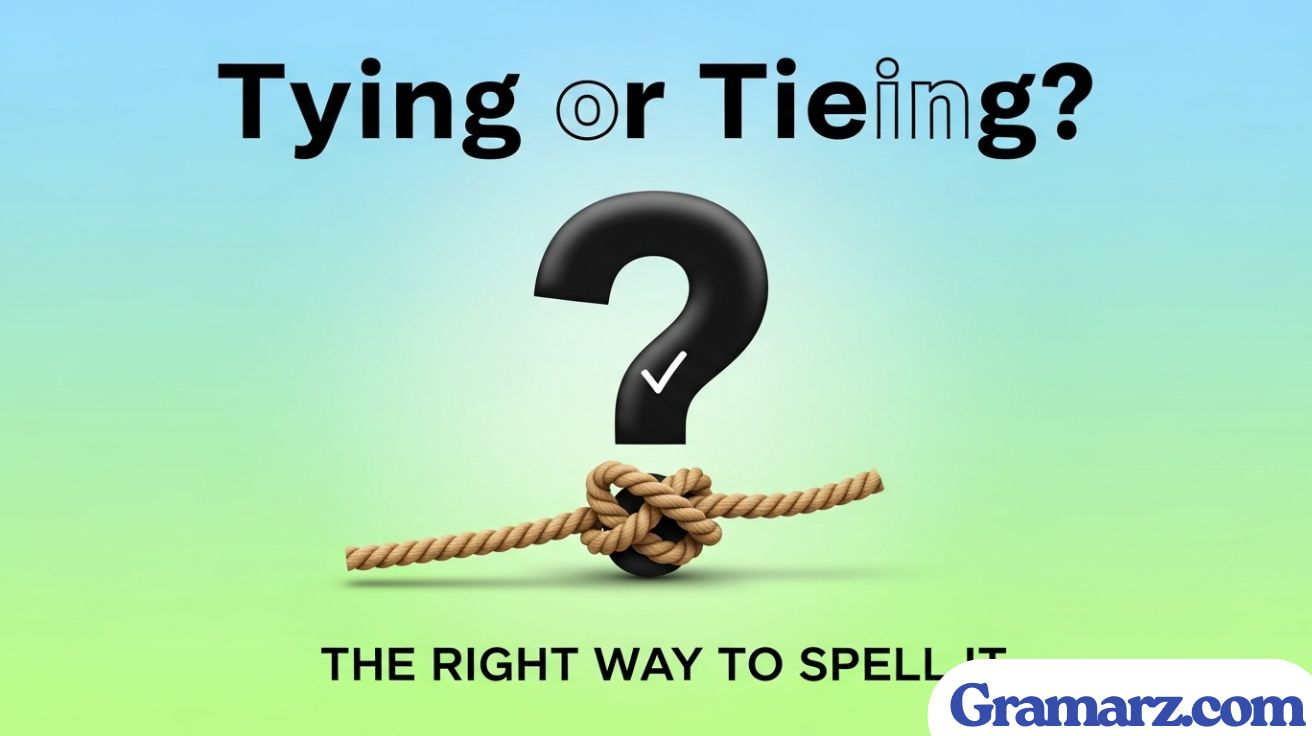
“Tying or Tieing” is a common spelling confusion. Tying means fastening, binding, or securing. Tieing is not correct in modern English.
Many people get this wrong when writing. It looks natural to keep the word “tie” and add “ing.” But English spelling rules work differently here.
The correct form follows the -ie to -y rule. That is why we write tying, not tieing. This mistake is one of the most common in English.
Why is There Confusion?
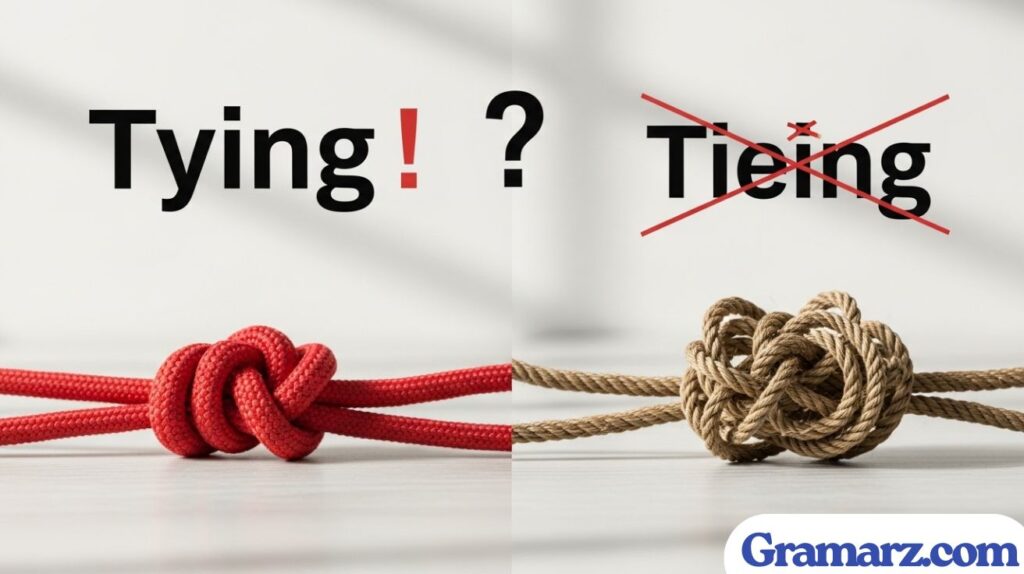
The confusion between tying vs tieing is linked to general word formation rules in English. Normally, when verbs end in -e, the spelling rule is to drop the -e before adding -ing. For example, the verb “make” becomes “making,” “write” becomes “writing,” “bake” becomes “baking,” and “drive” becomes “driving.” Most learners of English get used to this pattern very quickly.
However, things are different when we look at verbs ending in -ie. These verbs do not simply drop the -e. Instead, the -ie changes to -y before adding -ing. This special case is one of the well-known spelling exceptions in English, and it often causes doubt. For example, the verbs “die,” “lie,” and “vie” change into “dying,” “lying,” and “vying.” That is why “tie” changes into “tying” and not “tieing.”
The mistake comes from the fact that learners want to preserve the full base word “tie” and add “ing,” creating tieing spelling mistake. Although it looks logical, it is not correct. It breaks the tying grammar rule for verbs ending in -ie.
“Tying” or “Tieing”: Which is Correct?
The simple answer is that tying is the correct spelling, while tieing is not correct in modern English. If you are writing for an American audience, you must always use tying.
The rule behind this is clear. For verbs ending in -ie, we replace the -ie with -y before adding -ing. This avoids awkward letter combinations and makes the word easier to read and pronounce. The same rule applies when we look at other examples such as:
| Base Word | Present Participle |
| Tie | Tying |
| Die | Dying |
| Lie | Lying |
| Vie | Vying |
| Untie | Untying |
If you are wondering, is tieing a word? The answer is no, not in modern usage. Some older texts from the 19th or early 20th century may include tieing word meaning in a rare context, often connected with industrial processes like “tieing logs together.” However, this usage is now considered outdated. In today’s English, especially in the United States, it is a spelling mistake in English.
What Does “Tying” Mean?
The tying definition is simple. It is the present participle of tie and refers to the action of fastening, securing, or binding something. It can be used both in literal and figurative ways.
In daily life, tying shoelaces is the most common example. Parents often remind children about the importance of tying a knot properly so their shoes do not fall off. Similarly, in outdoor activities such as camping or sailing, tying rope securely is an essential skill. Beyond the physical action, the phrase “tying loose ends” is a common expression that means finishing incomplete work or resolving pending issues.
So, whether you are talking about tying a knot, tying shoelaces, or tying loose ends at work, the word carries the same idea of connection, completion, or securing something.
Words Following the -ie to -y Rule
The tying grammar rule is not unique. Many other verbs ending in -ie follow the same transformation when adding -ing. Here is a table that shows how this works with other common verbs:
| Base Word | Present Participle | Example Sentence |
| Die | Dying | The soldier was dying of thirst. |
| Lie | Lying | She was lying on the grass in the park. |
| Vie | Vying | The teams were vying for the championship. |
| Untie | Untying | He was untying the boat from the dock. |
| Belie | Belying | His nervous laugh was belying his confidence. |
This pattern proves why tie vs tying is not a random case but part of a larger group of spelling exceptions in English.
Synonyms of “Tying”
Although “tying” is the correct word, writers may sometimes use synonyms to avoid repetition. Depending on context, some of the most common synonyms of tying are binding, fastening, knotting, securing, lacing, linking, attaching, and tethering. For instance, when you say “binding a package,” it carries the same idea as tying rope around it. “Fastening” can also replace tying when you mean to make something secure, such as “fastening a belt.” “Knotting” directly refers to the act of creating a knot, while “lacing” is specific to shoes or corsets. These synonyms of tying expand the vocabulary and make writing richer.
Sentences Using “Tying”
To avoid confusion, it is helpful to look at real tying grammar examples. Here are sentences that show how to use tying in a sentence correctly:
He is tying his shoes before gym class starts.
The sailor spent an hour tying the ropes to the dock.
After tying the ribbon around the gift, she placed it under the Christmas tree.
I am tying up the last of the loose ends before the big meeting.
The boy kept tying knots in the fishing line until it was too short to use.
She was tying her hair back before stepping into the kitchen.
Each of these examples shows that “tying” always expresses the act of securing, fastening, or connecting.
Read Also : Pre vs Post: Which Prefix to Use?
Etymology of “Tying”
The etymology of tying goes back to Old English, where the verb tīegan meant “to fasten or bind.” In Middle English, it became teien, still carrying the same meaning. Over time, the word entered Modern English as “tie,” and its participle became “tying.” By the 13th century, people were already using “tying” to refer to securing objects like shoes or animals.
Later, figurative meanings developed. For example, the phrase “tying the knot” came to symbolize marriage by the early 18th century, and “tie one’s hands” developed as a metaphor for preventing someone from acting. Even expressions like “tie one on,” meaning to get drunk, came into use by the 20th century. Despite these cultural and idiomatic changes, the core sense of “tying” as binding or fastening has remained constant.
Why Do People Confuse Tying and Tieing?
Many learners struggle with tying vs tieing because English spelling can be unpredictable. While most spelling of verbs ending in e follow a simple rule of dropping the letter before adding -ing, verbs ending in -ie are an exception. This creates doubt and often leads to the tieing spelling mistake.
Another reason for confusion is how the word looks when written. People assume keeping the base word “tie” makes sense, but English has spelling exceptions. This is why we must learn the tying grammar rule. Understanding the difference between tieing and tying ensures correct spelling and avoids common grammar mistakes in writing.
Tying vs Tieing: Which One Is Accepted in the USA?
When we ask, “tying or tieing which is correct,” the answer is simple: American English recognizes only tying as correct. The form tieing may appear in rare historical texts, but it is not accepted in modern writing. Dictionaries, grammar guides, and schools all confirm that the correct spelling of tying must follow the word formation rules of verbs ending in -ie.
Writers in the United States are expected to use “tying” in both casual and formal contexts. Whether describing tying shoelaces, tying a knot, or tying loose ends, this spelling is consistent. If someone uses “tieing,” readers may see it as a spelling error. So, to maintain clarity, always use “tying” to match correct spelling in English standards.
How to Spell Tying Correctly Every Time
If you want to avoid the tieing spelling mistake, remember the tying grammar rule: verbs ending in -ie change to -y before adding -ing. This is the same reason “die” becomes “dying” and “lie” becomes “lying.” Learning this simple pattern makes it easy to spell tying correctly in every situation.
A quick memory trick is this: “Change -ie to -y, then add -ing.” By practicing with words like “untie → untying,” learners can reinforce the rule. Over time, spelling tying becomes second nature. When you ask yourself again “how to spell tying,” the answer will come automatically, and you won’t confuse it with “tieing.”
What Does Tying Mean in Everyday English?
The tying definition is straightforward: it refers to fastening, securing, or binding something. In everyday life, you will find this word used in practical situations, such as tying shoelaces before walking, tying a knot while camping, or tying rope when sailing. These examples show how the word is tied to daily routines.
Beyond physical actions, “tying” has figurative meanings too. Phrases like “tying loose ends” mean completing unfinished tasks, while “tying someone down” suggests limiting their freedom. These expressions are part of American English and help learners understand cultural use. Whether literal or figurative, the word always carries the sense of connection or securing.
FAQ,s
Which is correct, tieing or tying?
The correct spelling is tying; tieing is considered a spelling mistake.
Is it tying up or tieing up?
It is always tying up, never tieing up.
What is the meaning of tieing?
Tieing has no standard meaning; the correct form tying means fastening, securing, or binding.
Is tieing or tying in the Oxford Dictionary?
Only tying appears in the Oxford Dictionary as the accepted form; tieing is not listed.
Conclusion
The debate of tying vs tieing is settled. The correct spelling is always tying, while tieing spelling mistake should be avoided in formal and informal writing. The reason is simple: for verbs ending in -ie, the English spelling rule requires changing -ie to -y before adding -ing. That is why we say tying shoelaces, tying a knot, or tying rope, and not “tieing.”
To remember the rule, think of similar words like “dying” and “lying.” The pattern is consistent, and it removes the confusion about tie vs tying. If you ever ask again “is tieing a word?”, the answer will remain no. The correct spelling in English is always “tying,” and now you can use it with confidence in every context.