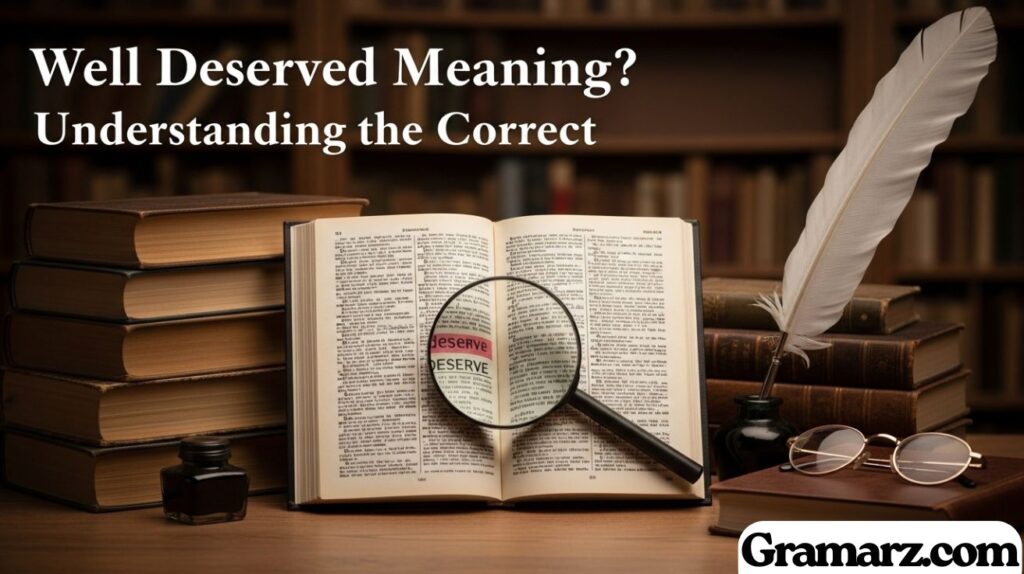
The well deserved meaning is something that is rightfully earned or truly justified. It shows that a reward, praise, or success comes from hard work and effort. This phrase is often used to honor someone’s achievement or dedication.
Everyone loves to feel appreciated for their efforts. Saying something is well deserved makes that appreciation stronger. It connects emotion with recognition and makes praise more meaningful.
The well deserved meaning applies in many situations—like work, school, or personal goals. It helps express fairness, respect, and acknowledgment of true merit. It’s a simple way to say, “You’ve earned it.”
What Does “Well Deserved” Mean?

The well deserved meaning revolves around something that is rightfully earned, justified, or appropriate. When someone says, “Your promotion was well deserved,” they mean the achievement resulted from effort and ability. It is built from an adverb + past participle combination, where “well” modifies “deserved.”
In simple terms, “well deserved” expresses acknowledgment of achievement and serves as a polite, powerful way to give praise and recognition. It’s used in both professional writing and daily communication to honor someone’s effort, such as a well-deserved promotion, a well-deserved award, or even a well-deserved break after months of hard work.
Here’s a quick table showing how context changes usage:
| Situation | Correct Form | Example Sentence |
| Describing a noun | Well-deserved | She received a well-deserved award. |
| Following a verb | Well deserved | Her success was well deserved. |
The Noun Form: Well-Deserved
When “well-deserved” acts as part of a noun phrase, it transforms into a description of a specific achievement or recognition. This form conveys something tangible—like an honor, a victory, or an award—that has been rightfully earned. In the well-deserved meaning in English, this version usually precedes a noun and always carries a hyphen.
It is a perfect example of compound modifiers in English, where two or more words work together to modify a noun. The hyphen rules in English grammar require you to join them to avoid confusion. Therefore, we say “a well-deserved honor” and not “a well deserved honor.”
When used properly, this form enhances the writing style correctness and highlights that recognition is not accidental—it’s justified and meaningful.
Examples in action:
Dr. Chen received a well-deserved award after years of medical research.
The team earned a well-deserved victory in the championship.
After a long week, she enjoyed a well-deserved rest at home.
Each well deserved sentence above demonstrates how the hyphenated adjective strengthens the phrase’s meaning by connecting effort and reward.
Key points to remember:
In this noun form, always use the hyphen. It often follows an article like “a” or “the” and pairs with words such as recognition, reward, achievement, or promotion. This form helps writers show formal acknowledgment while maintaining professional writing grammar standards.
The Adjective Form: Well-Deserved
The adjective vs verb usage of this phrase can be confusing, but here’s the rule: when it describes a noun directly, it’s an adjective and must be hyphenated. The correct use of well-deserved in this form emphasizes that the subject earned something through effort and ability.
When you say, “He took a well-deserved break,” you’re using it as an adjective. The phrase appears before the noun break, showing that the rest was justified. This usage aligns with standard grammatical rules for compound adjectives in English.
This adjective form appears frequently in daily communication. It helps create smoother, more formal language that feels complete and polished. Common hyphenated adjectives examples include well-known, high-quality, and long-term, all of which follow the same grammar principle.
To master this, remember the English grammar tips:
If “well-deserved” appears before the noun, it must be hyphenated to form a clear compound modifier.
The Verb Form: Well Deserved
In contrast, when “well deserved” follows a verb, it drops the hyphen. Here, it’s part of the verb phrase that evaluates or comments on an achievement rather than describing a noun. This version is more dynamic and expresses a judgment.
For example, “Her applause was well deserved” implies that her performance merited appreciation. The focus is on the action—applauding—rather than the noun itself. Similarly, “The team’s victory was well deserved” tells us that success was justified by effort.
This form illustrates the difference between well-deserved and well deserved clearly. One functions as a compound modifier, while the other completes a statement of evaluation.
In professional writing, this understanding ensures clarity and avoids confusion in meaning. It also demonstrates strong writing style correctness, which is crucial in business and academic communication.
Read Also : 20 Other Ways to Say “I Enjoyed Your Company” (With Meaning, Examples
Importance of Grammar Rules
Following the hyphen rules in English grammar is more than a matter of correctness—it’s about precision and professionalism. Inconsistent hyphenation can change the tone of your writing and even alter meaning.
For instance, “a well-deserved promotion” describes the type of promotion, while “the promotion was well deserved” comments on it. Both are grammatically correct, but context dictates which one fits.
Understanding this well deserved grammar enhances readability and ensures your writing reflects attention to detail. In professional environments, such mastery communicates reliability and confidence in language use.
Tips for mastering the grammar:
To master the correct use of well-deserved, remember that context is key. When it appears before a noun, hyphenate it. When it follows a verb, leave it open. You can apply this same logic to similar structures like “long-awaited” or “much-needed.”
Reading sentences aloud often helps. If the phrase directly modifies a noun, it needs the hyphen. Over time, consistent practice with commonly misused hyphenated words builds fluency and accuracy.
Writers who follow these English grammar tips naturally produce cleaner, more professional text.
Consistency in UK and US English
One major advantage of this phrase is its consistency. There is no difference between British and American English when it comes to well deserved vs well-deserved. Whether you write for a U.S. audience or a global readership, the British vs American English hyphenation rules for this phrase remain the same.
In both variants, the hyphenated adjectives examples apply identically. This means American writers can confidently use well-deserved recognition, well-deserved promotion, or well-deserved success without worrying about regional variation. Such uniformity makes this phrase a dependable choice in all forms of communication.
Is “well deserved” grammatically correct?

Yes, it is. The well deserved definition refers to something justly earned or rightfully obtained. The phrase itself follows standard grammatical patterns: an adverb (well) modifying a past participle (deserved). It fits comfortably within the adverb + past participle combinations that appear commonly in English.
Thus, both “well deserved” and “well-deserved” are correct depending on their role in the sentence. The first appears after linking verbs like is, was, or has been, while the second appears before nouns as an adjective. Both forms align with modern professional writing grammar and are recognized across all English-speaking regions.
How do you write “well deserved”?
When learning how to write well-deserved correctly, focus on placement and function. The difference between well-deserved and well deserved lies entirely in where and how you use it. Before a noun, always add the hyphen: “She took a well-deserved vacation.” After a verb, drop it: “Her vacation was well deserved.”
Writers should also note that this rule applies to many other compound modifiers in English, ensuring consistency throughout their work. By mastering these details, you not only show your command of professional writing grammar but also your appreciation for clear, precise language.
Understanding the Meaning of Well Deserved
The meaning of well deserved lies in recognizing achievements that are rightfully earned. It represents acknowledgment of someone’s hard work, dedication, or skill that led to success. When used properly, it conveys genuine appreciation and respect for effort. This phrase is common in workplaces, education, and daily communication when celebrating accomplishments.
In English writing, the well deserved grammar rule determines how and when to use it correctly. Understanding this helps avoid mistakes and ensures clarity. Whether it’s a well-deserved promotion or well-deserved recognition, the phrase reminds us that success is never accidental but achieved through commitment and perseverance.
The Difference Between Well Deserved and Well-Deserved
The difference between well deserved and well-deserved depends on where the phrase appears in a sentence. When it comes before a noun, it must be hyphenated—for example, “a well-deserved award.” However, when it follows a verb like “is” or “was,” no hyphen is needed, as in “Her award was well deserved.”
Understanding these rules follows the principles of compound modifiers in English. The hyphen connects words that work together to describe a noun. Without it, meaning can change or become unclear. This simple English grammar tip helps writers maintain precision and correctness in their writing.
When to Use Well-Deserved in Sentences

Knowing when to use well-deserved is essential for effective writing. You use the hyphenated form when describing nouns such as well-deserved break, well-deserved success, or well-deserved rest. These expressions show that the reward or relaxation has been fairly earned after significant effort.
Writers should avoid confusion by following hyphen rules in English grammar. The unhyphenated form appears only when the phrase follows a verb. This grammatical distinction ensures your writing maintains proper flow and structure while reflecting professional language use and writing style correctness.
Importance of Using Correct Hyphenation
Many learners struggle with commonly misused hyphenated words, and “well-deserved” is one of them. Using the correct form enhances professional writing grammar and demonstrates an understanding of how adjectives function. The hyphen links the words clearly, creating a single descriptive unit that adds precision to your sentence.
Incorrect hyphenation may lead to misunderstanding or an awkward sentence structure. By following grammatical rules for compound adjectives, writers can express acknowledgment and respect with confidence. Remember, even small punctuation marks like hyphens carry great importance in maintaining proper English grammar tips.
Examples of Well Deserved in Context
Writers often use well deserved examples to illustrate meaning. For instance, “The promotion was well deserved after years of dedication.” Another example is “He enjoyed a well-deserved break after completing the project.” These sentences show how the phrase fits naturally into real-life situations.
Each well deserved sentence expresses earned reward or recognition for someone’s effort. The phrase works equally well in personal and professional communication. Using it appropriately strengthens language skills and helps writers deliver messages of praise and recognition effectively and clearly.
British vs American English Hyphenation
When it comes to British vs American English hyphenation, the rules for “well-deserved” remain consistent. Both forms of English follow the same logic: use a hyphen before a noun and remove it after a verb. This makes the phrase easy to apply across international contexts.
For global writers, this consistency simplifies grammar learning. Whether you’re describing a well-deserved award in the U.S. or a well-deserved honor in the U.K., the rule stays unchanged. This shared standard reflects the strength and harmony of English grammar tips worldwide.
FAQs
Is it correct to say “well deserved”?
Yes, it is correct. “Well deserved” means something that is rightfully earned or justly achieved through effort.
What is another word for well deserved?
Other words for well deserved include earned, merited, justified, and well-earned depending on context.
Is it correct to say “congratulations well deserved”?
Yes, but it’s clearer to say “Congratulations, it’s well deserved” or “Well-deserved congratulations” for better flow.
How do you say well deserved to someone?
You can say “You truly earned it,” “It’s well deserved,” or “You deserve every bit of it” to express genuine praise.
Conclusion
Understanding whether to use well deserved or well-deserved may seem minor, but it represents mastery over one of English’s most elegant grammar structures. It reflects awareness of grammatical rules for compound adjectives and strengthens your writing’s clarity and professionalism.
Whether you’re congratulating someone on a well-deserved award, enjoying your well-deserved rest, or simply writing about a well-deserved success, applying the correct form shows care and skill.
So next time you acknowledge someone’s achievement, you can be confident that both your praise and your grammar are well deserved.