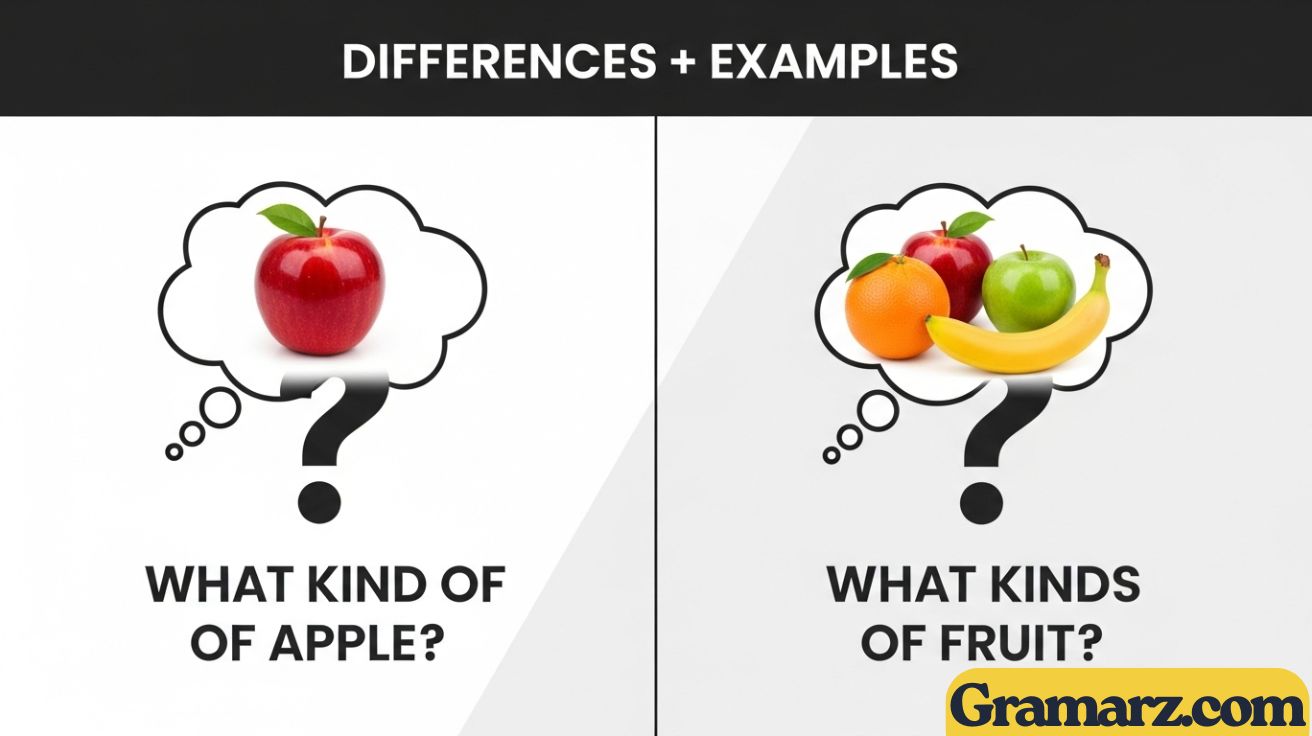
The phrase “what kind of” is used to ask about one specific type or category of something. It helps identify a single group, class, or style. For example, you can say, “What kind of music do you like?” to ask about one favorite genre.
Have you ever wondered why people say “what kind of” instead of “what kinds of”? This small phrase makes your questions sound clear and natural. Learning it helps you speak and write English with confidence.
You can use “what kind of” in many situations in daily life. It fits when talking about food, jobs, movies, or hobbies. Understanding how to use it correctly will make your English sound more fluent and professional.
What Kind of
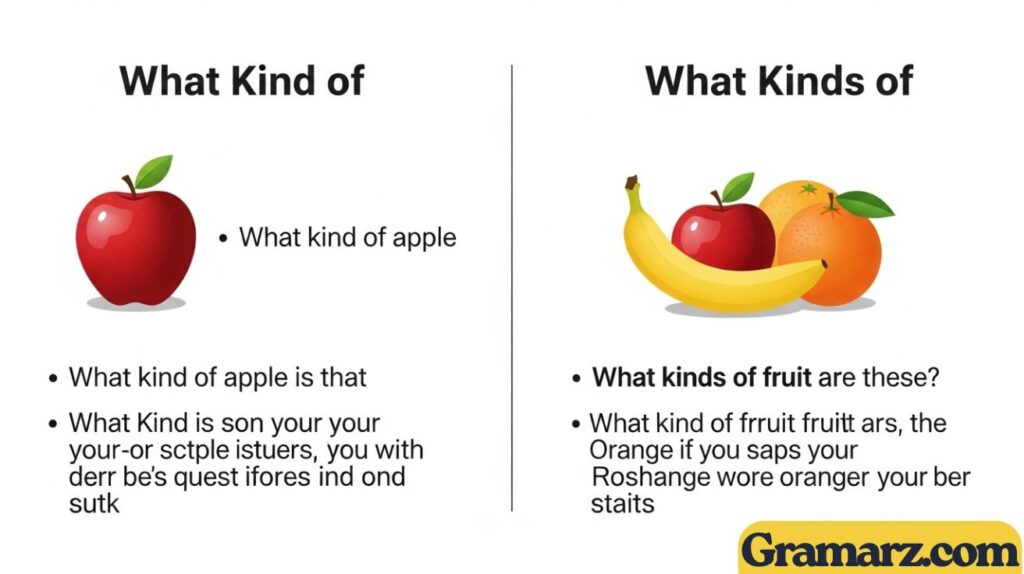
The phrase what kind of is used when talking about a specific type or single category. In types and categories in English grammar, it connects to singular nouns and identifies a single classification within a group. This is the correct choice when your question focuses on one thing or one category, not several.
The what kind of meaning in English grammar refers to asking for one particular class or style of an item. For example, if someone says, “I like movies,” you might ask, “What kind of movie do you like?” This question means you are looking for a specific type, such as horror, comedy, or romance.
In workplaces, what kind of adds clarity and professionalism to communication. When you ask, “What kind of project are we planning?”, you narrow the focus to a specific project type, such as marketing, development, or research. This shows clear and effective communication through grammar and helps avoid misunderstandings.
In grammar terms, the grammar rule for kind vs kinds states that what kind of must be followed by a singular noun because it refers to one specific thing. Using plural nouns with “what kind of” can make the sentence grammatically incorrect or confusing.
Examples with “What Kind of”
Below is a table of examples of what kind of and what kinds of sentences showing correct singular and plural usage of kind.
| Sentence | Explanation |
| What kind of food do you like? | Refers to one specific type of food, like Italian or Mexican. |
| What kind of job are you applying for? | Focuses on one particular job category, such as remote or office-based. |
| What kind of car do you drive? | Asks about a single classification or model. |
| What kind of problem are you solving? | Refers to one specific challenge or issue. |
These sentence structure and examples show that “what kind of” keeps the question focused and specific. Using it correctly ensures grammar for writing and speaking stays accurate and professional.
What Kinds of
In contrast, what kinds of is used when asking about multiple types or categories. This phrase connects with plural nouns and is useful for expressing variety and diversity. The difference between kind and kinds is simple: the plural form “kinds” means more than one type or category.
For example, you might ask, “What kinds of books do you read?” This question expects more than one answer—perhaps novels, biographies, or poetry. In this way, “what kinds of” opens up broader discussion and invites more detailed responses.
In professional English usage, you might say, “What kinds of issues are we facing?”, which indicates that there could be several different challenges, such as financial, technical, or communication-related problems. This phrasing provides language usage and communication clarity because it acknowledges diversity in the subject being discussed.
The grammar rule for kind vs kinds here is that “what kinds of” must be followed by plural nouns, making it suitable when referring to various options or classifications. Using this correctly improves grammar for writing and speaking and avoids common English grammar confusions.
Examples with “What Kinds of”
| Sentence | Explanation |
| What kinds of music do you enjoy? | Refers to multiple genres like jazz, rock, or pop. |
| What kinds of movies do you like? | Indicates various types, such as comedies or dramas. |
| What kinds of challenges do you face at work? | Asks about multiple problems or obstacles. |
| What kinds of tasks are part of your job? | Invites different examples of work responsibilities. |
In each case, “what kinds of” refers to variety and multiple categories, showing plural vs singular grammar rules in action.
Contextual Understanding
A deep contextual grammar understanding helps you decide which form to use. The context determines whether your question is about one category or many. If your question focuses on a single specific type, use what kind of. If you are referring to several types, use what kinds of.
For example, saying “What kind of phone do you have?” implies one specific type, such as a smartphone or flip phone. But “What kinds of phones are popular now?” suggests different models or brands like iPhone, Samsung, and Google Pixel.
Understanding context also improves grammar tips for ESL learners. Many learners make errors by mixing up singular and plural forms. However, practicing what kind of vs what kinds of exercises will help solidify the correct structure.
Common Errors and Misconceptions
One of the biggest grammar mistakes and corrections concerns noun number. Learners often use what kind of with plural nouns or what kinds of with singular nouns. For example, saying “What kind of hobbies do you have?” is incorrect because “hobbies” is plural. The correct question is “What kinds of hobbies do you have?”
Similarly, saying “What kinds of food do you like?” is correct when you mean several cuisines. But if you want a single preference, you should say “What kind of food do you like?” Paying attention to the noun form is crucial for grammar for writing and speaking and for maintaining language usage and communication clarity.
31 Key Points for What Kind of vs. What Kinds of
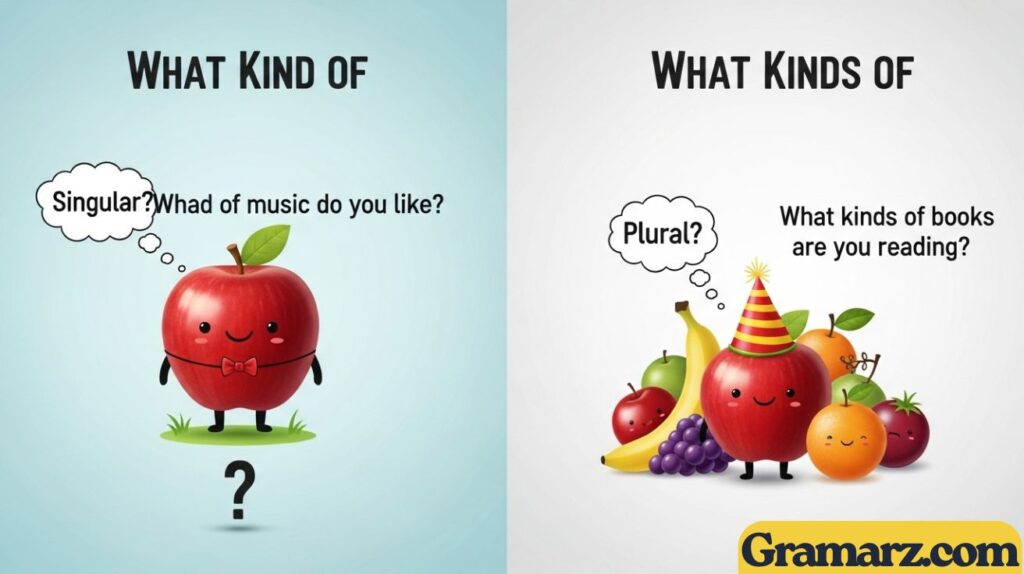
This list summarizes the what kind of vs what kinds of difference and provides a guide for correct usage:
- What kind of is used with singular nouns.
- What kinds of is used with plural nouns.
- “Kind” identifies one category; “kinds” means several.
- “What kind of” makes your question specific and focused.
- “What kinds of” makes your question open-ended.
- Context determines which phrase to use.
- Misusing them can cause confusion in meaning.
- Both improve effective communication through grammar.
- Essential for accurate parts of speech and classification.
- Helps in professional English usage.
- Common in workplace discussions and interviews.
- “What kind of” is singular-focused.
- “What kinds of” suits plural or multiple examples.
- Adds clarity to conversations.
- Supports sentence structure and examples learning.
- Ensures grammatical accuracy.
- Commonly used in grammar for writing and speaking.
- Used frequently in American English.
- Context and intent guide choice.
- “Kinds of” gives a broader meaning.
- “Kind of” focuses narrowly on one thing.
- Using the wrong one can sound unnatural.
- Mastery improves grammar tips for ESL learners.
- Crucial for clear communication.
- Adds depth to both formal and informal English.
- Strengthens English grammar rules explained.
- Applies to both written and spoken communication.
- “What kind of” suits single answers.
- “What kinds of” fits variety-based answers.
- Key concept in kinds vs kind comparison.
- Essential for achieving fluency in English.
Read Also : Vicious vs Viscous: Use Them Correctly in Writing
Kind of vs. Kinds of
This section compares the difference between kind and kinds using a clear table for grammar rule for kind vs kinds.
| Aspect | What Kind of | What Kinds of |
| Focus | One specific type | Multiple types |
| Noun Agreement | Singular noun | Plural noun |
| Example | What kind of dog is that? | What kinds of dogs do you have? |
| Context | One clear category | Multiple classifications |
The what kind vs what kinds meaning becomes easy to remember: use “kind” for one, “kinds” for many.
Singular Nouns with Multiple Attributes
Sometimes a singular noun can have several qualities. This can make it tricky to choose between “what kind of” and “what kinds of.” For example, “What kind of coffee do you drink?” implies a single preference like espresso or latte. But “What kinds of coffee do you enjoy?” opens up the question to include different blends such as cappuccino, mocha, and iced coffee.
In such cases, focus on the intention of your question. If you want a single answer, use “what kind of.” If you want multiple answers, use “what kinds of.” This approach shows mastery of plural vs singular grammar rules and strengthens grammar for writing and speaking.
Collective Nouns
Collective nouns such as team, group, or family can be confusing. Since they represent one unit, they usually go with what kind of. For example, “What kind of team do you coach?” means one specific team type, like a football or basketball team. But when referring to several teams, say “What kinds of teams have you coached?” Understanding this improves your control over singular and plural noun agreement and ensures language usage and communication clarity.
Plural Nouns with Singular Classification
Sometimes plural nouns can represent one category. For instance, “What kind of movies do you like?” focuses on a single type or genre such as action or romance. Meanwhile, “What kinds of movies do you like?” refers to various genres and shows variety.
This section is crucial for understanding what kind of vs kinds of nouns and applying grammar mistakes and corrections correctly. The more you practice what kind of vs what kinds of exercises, the more fluent and natural your English will sound.
Understanding the Difference Between What Kind of and What Kinds of
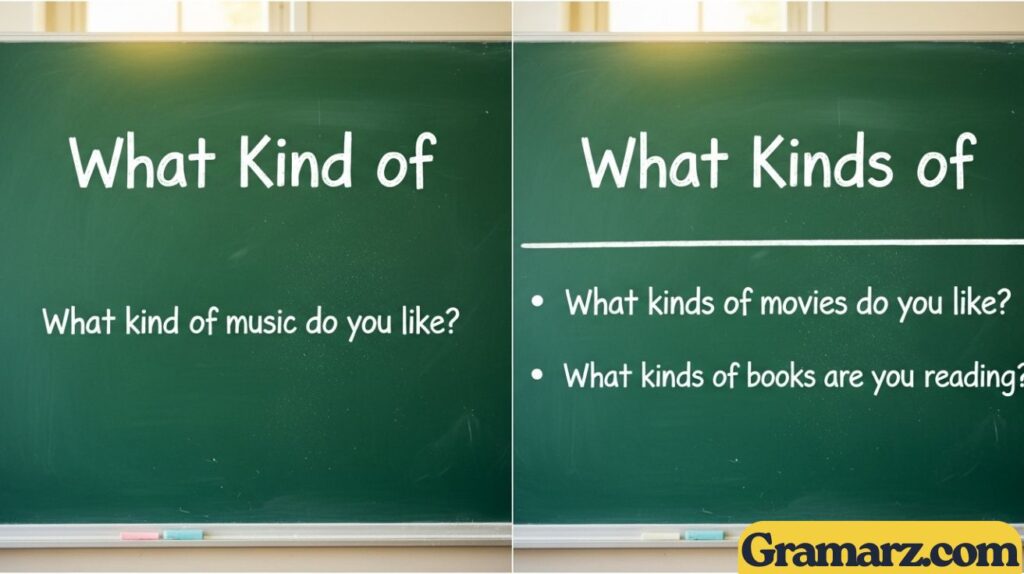
The what kind of vs what kinds of difference may seem small, but it greatly affects clarity. “What kind of” focuses on one specific category, while “what kinds of” covers multiple types. This distinction is key to effective communication through grammar and helps learners express precise ideas clearly.
In English conversations, when to use what kind of or what kinds of depends on the noun’s number. Singular nouns take “what kind of,” and plural nouns take “what kinds of.” This understanding builds strong language usage and communication clarity and prevents common grammar errors in speech and writing.
What Kind of: Singular Focus Explained
The phrase what kind of is used when referring to one type of thing or idea. It shows singular and plural usage of kind, emphasizing a single classification. For example, “What kind of movie do you like?” expects one category such as action or comedy.
Learning what kind of meaning in English grammar helps you ask focused questions. It ensures grammar for writing and speaking remains correct and professional. Using this structure in daily speech builds confidence and demonstrates good English grammar rules explained.
What Kinds of: Exploring Variety and Categories
The phrase what kinds of expresses diversity or multiple options. It matches with plural nouns, such as in “What kinds of books do you read?” where several genres like mystery, romance, and history are possible answers.
This structure reflects the plural vs singular grammar rules clearly. It helps in professional English usage and academic writing by showing a range of ideas. Understanding this improves sentence structure and examples while enhancing contextual grammar understanding for learners.
Common Grammar Mistakes and Corrections
A frequent issue is mixing what kind of with plural nouns or what kinds of with singular ones. For instance, saying “What kind of hobbies do you have?” is incorrect since “hobbies” is plural. The correct form is “What kinds of hobbies do you have?”
Learning these grammar mistakes and corrections sharpens accuracy and reduces confusion. Mastering the difference between kind and kinds helps learners sound more natural. With practice, you’ll know how to use what kind of correctly in all contexts confidently.
Context Matters: Choosing the Right Form
Contextual grammar understanding is vital when deciding which phrase to use. If you are referring to a single type, use what kind of; if asking about multiple categories, use what kinds of. The choice depends on meaning and intent.
For example, “What kind of project are we starting?” focuses on one project, while “What kinds of projects have you done?” asks about many. Context ensures correct parts of speech and classification, improving language usage and communication clarity.
Practical Use in Professional and Everyday English
Both expressions are common in daily and professional English usage. In the workplace, you might ask, “What kind of feedback did you receive?” or “What kinds of challenges did your team face?” These show proper grammar for writing and speaking.
Practicing what kind of vs what kinds of exercises enhances fluency. It supports grammar tips for ESL learners by improving sentence structure and examples. Understanding this rule brings precision, builds confidence, and strengthens language usage and communication clarity.
Conclusion
Mastering the what kind of vs what kinds of difference helps you communicate precisely and confidently. Knowing how to use what kind of correctly and when to choose “kinds of” ensures effective communication through grammar and enhances both your writing and speech. Whether you are speaking in meetings, writing essays, or having casual conversations, understanding this distinction will improve your language usage and communication clarity.
As one English teacher famously said, “Accuracy in small grammar choices leads to big clarity in expression.” Keep practicing with examples of what kind of and what kinds of, and soon this rule will feel completely natural.