A windstorm takes the power at nine at night. A windstorm takes it again three weeks later, and by then plenty of homeowners are asking an electrician puyallup wa what a standby generator really costs. A windstorm does not care what the box on the pallet promises. Most generator disappointment around here traces back to sizing and wiring, not to the brand on the enclosure.
This one is for the homeowner who already lost a freezer of food and is now shopping in earnest. A standby generator is a sound purchase in a county that loses power to wind every winter. Four common mistakes decide whether the unit carries the house or covers almost nothing worth having.
The Mistake Of Guessing Generator Size
Start with the actual load in the house, not the price tag. What we see most often is a homeowner adding up the running watts printed on a few appliance labels and picking the next size up. Motors do not behave that politely. A refrigerator compressor, a furnace blower, and a well pump each pull a brief surge on startup, several times their running draw. If two of them kick on in the same second, an undersized generator drops the whole panel. Buying on running watts alone is like buying a car on its cruising speed and forgetting it also has to merge.
Example scenario: typical running and starting wattages for common backup loads. The starting surge, not the running total, is what an undersized generator fails to cover when several motors start at once. Illustrative typical appliance wattages; room air conditioner about 1,000 watts per MIT News.
| Household load | Running watts | Starting watts |
| Refrigerator or freezer | 700 | 2200 |
| Furnace blower (1/2 hp) | 800 | 1600 |
| Well pump (1/2 hp) | 1000 | 2000 |
| Window air conditioner | 1000 | 1600 |
| Sump pump | 800 | 1300 |
| Lights and outlets | 600 | 600 |
Run the arithmetic on a modest backup list for one Puyallup household. A refrigerator at 700 running watts, a furnace blower at 800, a well pump at 1,000, and lights at 600 come to 3,100 watts of steady draw. Add the largest starting surge on that list, the refrigerator at 2,200, and the honest requirement lands at 5,300 watts. The 5,000 watt unit on sale that afternoon is already short. Add a window air conditioner for a summer heat event and the shopping starts closer to 7,000.
Sizing with room to spare is not gold plating, because the grid is not trending toward forgiveness. Researchers at MIT reported this year that energy systems planned around past climate conditions could face up to a fivefold increase in blackout causing shortfalls by 2050. Western Washington already sits at the end of long, tree lined distribution lines. Size for the house you actually run in January, not for the cheapest sticker in the aisle.
Backfeeding A Panel Without A Transfer Switch
The second mistake on this list is the dangerous one. Never backfeed a generator into a wall outlet or a dryer receptacle to energize your panel, and never run a standby unit without a listed transfer switch. That improvised cord pushes voltage back out through the service drop and can kill a lineworker restoring your street. A transfer switch isolates the house from the utility before the generator picks up the load.
Washington does not treat this as a weekend project either. The state Department of Labor and Industries tells homeowners to hire a licensed, bonded electrical contractor rather than doing their own service or panel work. The permit and inspection that follow are the only outside check that the interlock, the grounding, and the conductor sizing are right. Typically that means one visit to plan the load and a second to set the switch.
A manual transfer switch covering six to ten circuits is the budget answer, and it works as long as somebody is home to throw it. An automatic switch earns the difference the first time the power drops while the house sits empty. Say the installed difference runs about $900 in this market. Call it closer to $1,400 once the added circuits and conduit are counted, which still beats one flooded crawlspace.
Placing The Exhaust Too Close To Home
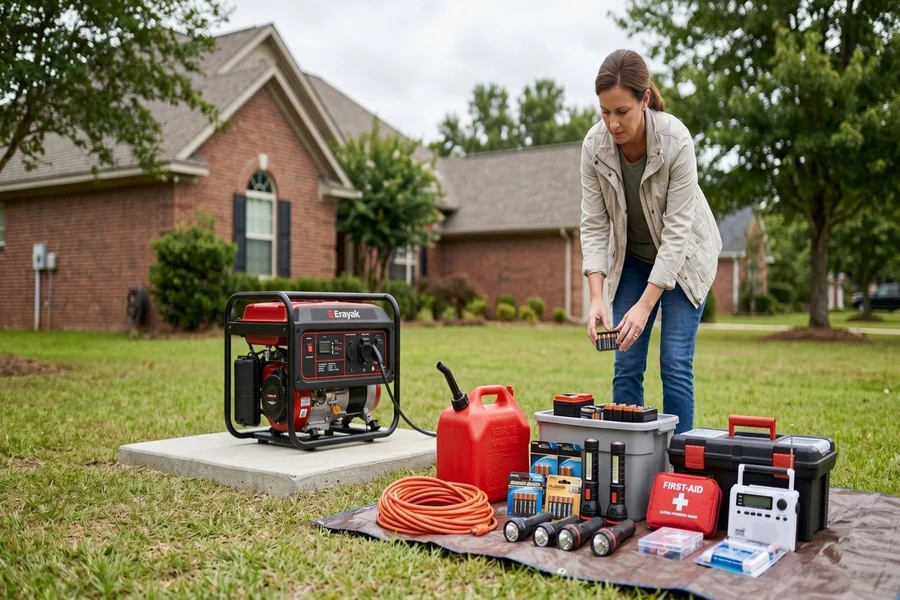
Generator exhaust carries carbon monoxide, and it can be fatal indoors within minutes. Run a generator outdoors only, never in a garage or crawlspace even with the door propped open, and keep the exhaust away from windows and doors. If a carbon monoxide alarm sounds, get everyone outside into fresh air, then call 911 from outside. Standby units on a pad carry their own clearance requirements from the manufacturer and the electrical code.
The other heat risk shows up when the generator cannot carry the furnace. Households fall back on portable heaters, and the Electrical Safety Foundation International ranks heating equipment as the second leading cause of home fires, more than 65,000 a year. A backup plan that pushes a family onto space heaters for three cold days is not much of a plan. Size the unit to run the furnace blower and that branch of risk closes.
Sizing And Wiring It Right The First Time
Cost pressure is part of why this purchase feels heavy right now. ACHR News reported in July 2026 that residential gas and electricity bills rose a median of about 17 percent between 2019 and 2024. Nobody wants to pay twice for backup power, and the way to pay once is a written load calculation before any model number gets quoted.
So the order of operations matters more than the badge on the enclosure. Ask any electrician puyallup wa homeowners recommend to build the load list and the transfer switch plan first, then check that the permit sits inside the quote. The house that stays warm through the next wind event is the one where somebody did the arithmetic back in October. That is the whole difference between backup power and an expensive noise in the side yard.