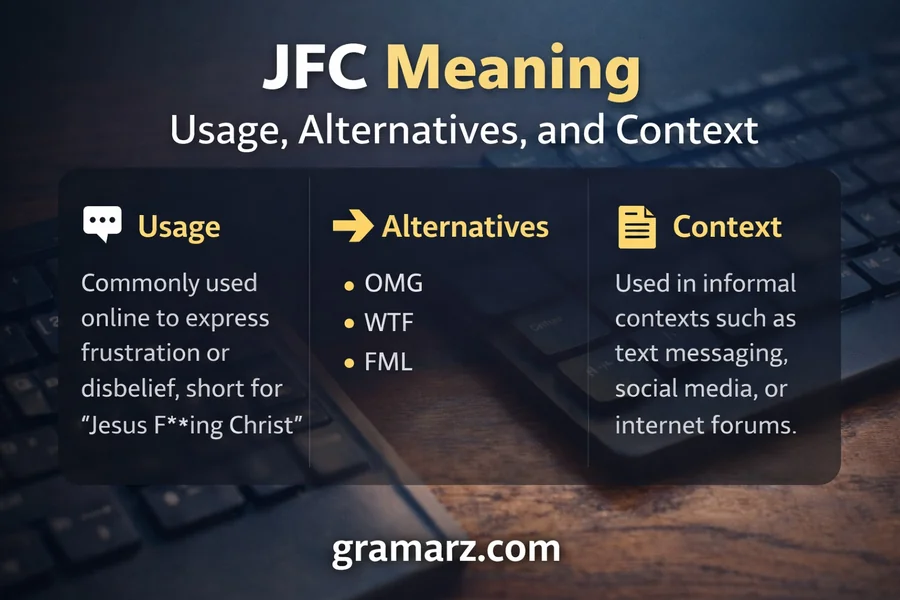
JFC is an acronym that stands for “Jesus F***ing Christ.” People use it in texts, chats, and social media. It shows strong feelings like shock, frustration, or surprise.
Many people see JFC online every day. It appears in tweets, messages, and posts. Knowing its meaning helps you understand others better.
JFC is mostly used with friends or informal groups. It is not good for school or work messages. Learning its usage and alternatives makes chatting easier.
What Does JFC Mean?
The JFC meaning is simple yet powerful. As a JFC acronym, it represents the phrase “Jesus F*ing Christ**,” which conveys strong emotional reactions in texting shorthand 2025. Whether you are surprised, annoyed, or frustrated, typing JFC in a message can instantly communicate your feelings. This JFC slang definition highlights how acronyms have become a core part of informal acronyms online and social media acronyms, helping people express emotions quickly without writing long sentences.
The JFC definition also shows that while this expression is widespread in online platforms, it is considered vulgar and may offend some audiences. This makes it crucial to understand where and when to use this acronym responsibly. Using JFC in casual chats with friends is common, but using it in professional emails or formal communication can be inappropriate.
Origins and Context
The JFC acronym meaning has its roots in online communities, texting abbreviations, and internet slang 2025. Early users in forums and chat rooms sought a quick way to express intense feelings without typing the entire phrase “Jesus F*ing Christ**.” Over time, JFC online usage spread to social media platforms, text messages, and casual conversations worldwide, particularly in the United States.
In terms of context, JFC usage is predominantly informal. It is part of a broader trend of online shorthand for emotions and strong reactions slang, which includes expressions like OMG, LOL, and Geez. These acronyms serve the dual purpose of saving time and amplifying emotional impact, especially in fast-moving digital conversations.
Usage Notes
When using JFC, it is important to be mindful of the audience. While expressing frustration online is acceptable among friends, using this acronym in professional emails, school assignments, or formal settings can be considered disrespectful due to its religious reference and profanity. In informal settings like social media comments or group chats, however, JFC texting abbreviation can add humor, emphasis, or dramatic effect to a message.
For example, a friend might type “JFC, I can’t believe you did that!” to express disbelief, whereas a workplace version would need a more formal alternative. Being aware of these nuances ensures that communication remains effective and appropriate.
Read Also: PTSO Definition Explained in Simple Words for Everyday Use
Examples of JFC in Sentences
Here are some real-life examples of JFC examples in sentences to illustrate its proper usage in casual contexts:
- “JFC, I forgot my wallet at home again!” – expressing frustration.
- “JFC, that movie was so intense!” – showing shock.
- “JFC, how did this happen overnight?” – reacting to disbelief.
- “JFC, I can’t deal with this traffic!” – venting annoyance.
These examples highlight how JFC slang functions as a tool for quick emotional expression in informal expressions online.
Hiatus Meaning – What Is a Hiatus?
In contrast to JFC, the term hiatus is neutral and formal, offering a way to describe a temporary pause or break. The hiatus meaning is simply a temporary break meaning or interruption in a sequence, whether in work, academic projects, or entertainment. Unlike JFC, it carries no emotional weight and is suitable for professional, academic, and casual contexts.
Origins and Definition
The word hiatus comes from Latin, meaning “opening” or “gap.” In modern English, the hiatus definition refers to a pause or gap meaning in a series, activity, or event. Its versatility allows it to be applied to situations like a TV show hiatus, an academic hiatus, or a work hiatus, making it a practical term in various forms of communication.
Common Contexts for Hiatus
Hiatus synonym usage spans multiple contexts. In entertainment, a popular show might go on a TV show hiatus for a few months between seasons. In academia, students may take an academic hiatus to focus on personal growth or travel. Professionals sometimes take a work hiatus to recharge or manage life events.
Even in personal projects, a temporary pause or hiatus alternative words can describe a period of inactivity. Understanding these contexts helps readers use the term appropriately in both formal and casual situations.
Usage Notes
The hiatus definition is straightforward and polite, making it suitable for formal communication in professional or academic settings. It conveys the idea of a temporary break or pause without emotional connotations, unlike JFC meaning, which expresses strong feelings. When using hiatus, always ensure the context clearly indicates the temporary nature of the pause, whether it’s a TV show hiatus, a work hiatus, or an academic hiatus.
Examples of Hiatus in Sentences
Examples help illustrate the hiatus meaning in different contexts:
- “The band announced a hiatus after their world tour.“
- “She took an academic hiatus to travel abroad for a semester.“
- “After the holiday season, the company went on a short hiatus.“
- “The show is on hiatus but plans to return next spring.“
These examples highlight how hiatus synonym can be integrated into professional and casual conversation alike.
Stand For and Meaning in Text
When asking “what does X stand for?” in digital communication, it refers to clarifying the meaning of acronyms or abbreviations. The phrase stand for helps users understand that JFC stands for Jesus F*ing Christ**. Similarly, understanding communication acronyms like hiatus, OMG, or LOL allows readers to interpret text messages accurately and avoid misunderstandings. This is particularly important in texting shorthand 2025 where rapid, efficient communication is common.
Polite, Professional, and Casual Alternatives to JFC and Hiatus
Understanding alternatives to JFC is essential to adapt your message for different audiences. Similarly, choosing the right expression for a hiatus can improve clarity and tone.
Polite Alternatives to JFC
For situations where strong language might offend, using polite substitutes is key. Phrases like “Oh my goodness!,” “Good grief!,” or “For heaven’s sake!” allow people to express surprise or frustration without using profanity. For example, instead of “JFC, this is so frustrating!,” one might say, “Oh my goodness, this is so frustrating!“
Professional Alternatives to JFC
In professional settings, JFC online usage should be replaced with calm, neutral phrases. Expressions like “That’s quite surprising,” “I wasn’t expecting that,” or “This is rather unexpected” convey the same message without offending anyone. For instance, instead of typing “JFC, the project is delayed again,” a professional alternative would be, “That’s quite surprising; the project has been delayed again.“
Casual Alternatives to JFC
Among friends or informal groups, softer expressions maintain emotion without strong profanity. Casual alternatives to JFC include “OMG!,” “Geez!,” “No way!,” and “Whoa!” These phrases function as casual phrases for JFC and fit perfectly in text messages, social media comments, or friendly conversations.
Alternatives to Hiatus
Depending on context and tone, words like break, pause, interval, suspension, gap, and rest can replace hiatus. For example, a TV show hiatus could also be referred to as a “short break between episodes,” and a work hiatus could be described as a “temporary pause in activities.” Understanding hiatus alternative words ensures communication remains clear and contextually appropriate.
How to Choose the Best Alternative Based on Context and Tone
Selecting the right term depends on the audience, platform, and emotional intensity. For professional emails, formal alternatives to JFC are best, while informal chats can use casual alternatives to JFC. Similarly, a hiatus can be described as a temporary break or pause in professional or academic settings, but casually, a “pause” or “rest” works just as well. Cultural sensitivity and awareness of audience expectations are crucial in choosing appropriate words.
Tips for Choosing Alternatives
Always consider tone and context. Avoid profanity in professional settings, and use neutral or polite expressions for wider audiences. Expressing frustration online is natural, but framing it using polite alternatives to JFC or descriptive hiatus synonyms ensures clarity without offense. Matching language to audience expectations improves communication effectiveness and emotional reception.
11 Examples to Illustrate the Use of JFC, Hiatus, and Alternatives
Informal/JFC: “JFC, I can’t believe how messy the kitchen is!“
Polite alternative: “Oh my goodness, the kitchen is quite messy today!“
Professional alternative: “It appears the kitchen was not cleaned properly.“
Informal/Hiatus: “The band took a hiatus after their world tour.“
Casual alternative: “The band took a break after their world tour.“
Formal alternative: “The band announced a temporary suspension of activities after their world tour.“
Casual/JFC alternative: “OMG, did you see that?“
Polite/JFC alternative: “Good grief, that was unexpected!“
Professional/JFC alternative: “That is rather surprising.“
Informal/Hiatus alternative: “She’s on a pause from her studies this semester.“
Formal/Hiatus alternative: “She is currently on a scheduled academic hiatus.“
These examples show how JFC acronym, hiatus synonym, and their alternatives can be applied naturally in real-life situations.
The Popularity of JFC in Online Communication
The JFC acronym meaning has gained significant recognition in digital communication, especially on social media platforms and texting apps. Standing for “Jesus F*ing Christ**,” it is widely used to express shock, frustration, or disbelief. Its use highlights the trend of internet slang 2025, where quick, expressive shorthand is preferred over full sentences in informal acronyms online.
Understanding JFC online usage helps users convey emotions efficiently. While commonly seen in casual chats and comments, recognizing its JFC slang definition ensures proper usage. Misusing it in formal or professional contexts can be offensive. Knowing how and when to apply this JFC texting abbreviation is key to maintaining respectful communication.
Origins of the JFC Acronym
The JFC meaning originated from early internet forums, chat rooms, and text messaging communities. Users wanted a fast way to express strong emotions without writing the full phrase “Jesus F*ing Christ**.” This acronym is part of the wider trend of texting shorthand 2025 that saves time while amplifying emotional impact in digital conversations.
As social media expanded, JFC usage became more mainstream. Today, it is a recognized communication acronym across platforms like Twitter, Instagram, and messaging apps. Its evolution reflects how informal expressions online adapt to modern communication needs, blending humor, frustration, and shock into a single, concise expression.
Appropriate Situations for Using JFC
The JFC acronym is suitable for casual and informal conversations but should be avoided in professional or academic settings. Using it in social media acronyms or messaging apps among friends allows individuals to convey strong reactions slang effectively. Context matters, as overuse may reduce its emotional impact.
Being aware of audience sensitivity is crucial when using JFC slang. In professional emails or official communication, alternatives like polite alternatives to JFC or professional alternatives to JFC maintain respect and clarity. Proper usage ensures messages are impactful without offending recipients, enhancing overall digital literacy.
Hiatus: Meaning and Practical Use
The term hiatus meaning describes a temporary stop or pause in a sequence, project, or activity. Unlike JFC, it conveys no emotion but simply indicates a pause or gap meaning. Hiatus definition is widely applied in professional, academic, and entertainment contexts, including TV show hiatus, academic hiatus, or work hiatus scenarios.
Understanding the temporary break meaning is important for clear communication. Using hiatus synonym appropriately ensures that readers or listeners interpret pauses as planned and temporary. The word helps maintain clarity in both formal writing and everyday conversation without implying negativity or frustration.
Polite Alternatives to JFC
For contexts where profanity is inappropriate, polite alternatives to JFC such as “Oh my goodness!” or “Good grief!” provide a respectful way to express frustration online. These phrases maintain the emotional impact of JFC slang definition while avoiding offense in semi-formal or mixed-audience communication.
Using casual alternatives to JFC alongside polite expressions ensures versatility. For instance, in texting or social media threads, replacing JFC acronym meaning with gentle phrases allows users to react strongly while remaining considerate. Proper alternative selection enhances clarity and appropriateness across platforms.
Professional Alternatives for Workplace Communication
In professional settings, JFC online usage should be replaced with professional alternatives to JFC like “That’s quite surprising” or “I wasn’t expecting that.” These phrases convey emotional reactions without profanity, keeping messages suitable for workplace or academic contexts.
By using professional alternatives to JFC, individuals maintain credibility and respect. Integrating these phrases into emails, reports, or presentations ensures that communication remains effective while adhering to etiquette. Awareness of JFC texting abbreviation limitations is critical for professional digital literacy.
Casual Expressions for Informal Conversations
Among friends, casual alternatives to JFC such as “OMG!,” “Geez!,” or “Whoa!” allow users to convey shock or disbelief naturally. These casual phrases for JFC fit well in texting apps, social media posts, or group chats where emotional shorthand is common and audience sensitivity is low.
Such alternatives maintain the essence of JFC meaning without profanity. They enhance JFC online usage in playful, expressive ways, demonstrating how informal expressions online evolve to meet the emotional and cultural needs of digital communities. Casual expressions keep conversations lively and engaging.
Choosing the Right Alternative Based on Context
Selecting the appropriate term depends on the audience, platform, and emotional intensity. For professional emails, professional alternatives to JFC work best, while informal texts allow casual alternatives to JFC. Similarly, hiatus alternative words like “break” or “pause” should match the tone of the message.
Understanding hiatus meaning and JFC acronym meaning ensures messages are clear, polite, and contextually appropriate. By mastering alternatives, users can balance expressing frustration online with clarity and respect, making communication effective across informal, social, and professional settings.
FAQs
How is JFC used in text?
JFC is used in texts to quickly express strong emotions like shock, frustration, or disbelief.
What does JFC mean on Twitter?
On Twitter, JFC stands for “Jesus F***ing Christ” and is used to react to surprising or frustrating posts.
What is the meaning of JFC in Jollibee?
In Jollibee, JFC refers to “Jollibee Foods Corporation,” the company behind the restaurant chain.
What is JK in Internet slang?
JK means “Just Kidding” and is used to indicate a joke or playful comment online
Conclusion
Understanding the JFC meaning helps people use it correctly in texts, social media, and online chats. JFC stands for “Jesus F***ing Christ” and shows strong feelings like surprise, frustration, or shock. People use it mostly with friends or in informal conversations. Knowing when and where to use it keeps messages clear and respectful. Using polite, professional, or casual alternatives makes communication easier and avoids offending anyone.
The JFC meaning also connects to modern slang and online communication trends. By learning its usage and alternatives, readers can express emotions safely and clearly. Combining JFC with proper words like “pause” or “break” for situations like a hiatus helps messages sound correct. This knowledge makes digital chatting simple, clear, and polite.