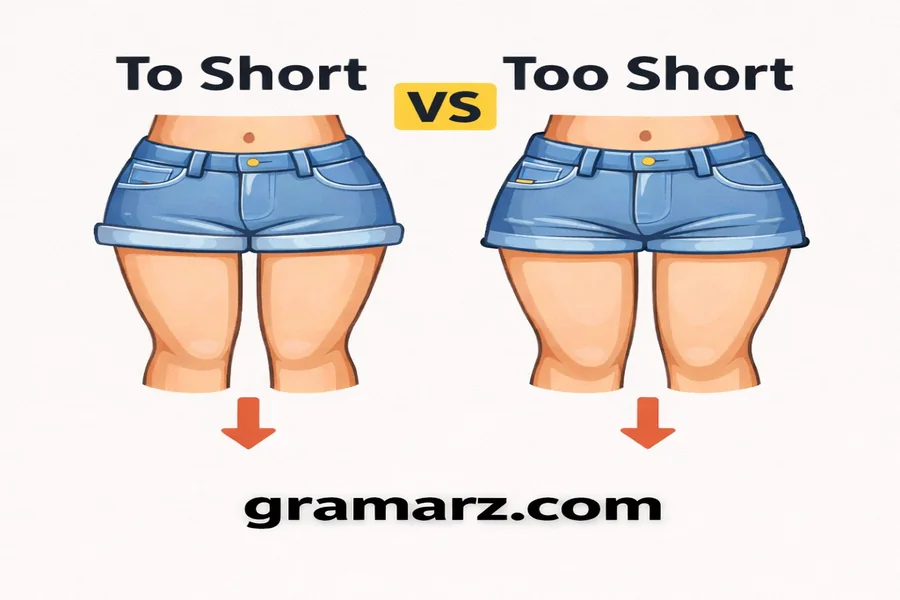
To short or too short is a common grammar question. Many people confuse these two words. To is a preposition, while too shows something is more than needed.
Have you ever written a sentence and felt unsure? Choosing the wrong word can change the meaning. Many students make this mistake every day. Understanding the difference makes writing easier and clearer.
Using to short or too short correctly helps in writing and speaking. Too short shows something is not long enough. Learning this rule is simple with practice and careful reading.
To vs too: What’s the difference?
The words to and too are homophones, meaning they sound the same but have very different meanings. To is a preposition or part of an infinitive verb. For example, in the sentence, “I want to run,” the word to is part of the infinitive verb to run. It often indicates direction, purpose, or intent. On the other hand, too is an adverb that can mean “also” or “excessively.” For instance, “These pants are too short for me” shows that something is excessive or inadequate in length. Understanding this subtle distinction is the first step in avoiding common writing errors.
| Word | Function | Example |
| To | Preposition or infinitive marker | “I’m going to the store.” |
| Too | Adverb (also/excessively) | “This skirt is too short for work.” |
The Root of the Problem
Why is the to vs too confusion so common? One reason is that English has many English homophones, and writers often rely on pronunciation instead of meaning. People hear “too” and assume “to” is correct when writing. Another factor is casual writing habits, especially online, where speed often takes priority over grammar. Misunderstanding the adverbs and prepositions and their functions is a frequent cause of common English mistakes. In essence, the problem arises from the combination of pronunciation, grammar complexity, and sometimes carelessness.
Breaking Down “To” and “Too”
The word to is always linked to direction, purpose, or an infinitive. For example, “I’m going to the park” or “I like to read.” It never modifies adjectives. Conversely, too functions as a modifier. When paired with adjectives like “short,” it tells the reader that something is excessive or inadequate. For example, “The meeting was too short to cover all topics” is a clear statement using proper grammar. Understanding these differences helps in avoiding grammar mistakes and ensures writing clarity.
Practice Makes Perfect
Learning the correct usage of too short requires practice. One effective method is to create sentences using both to and too in different contexts. Reading your writing aloud can also help catch mistakes. For example, if you say, “This rope is too short,” replacing too with “excessively” should make sense: “This rope is excessively short.” If it doesn’t make sense, you likely need to instead. This method strengthens understanding of English grammar rules and the grammar of too short in practical usage.
When to Use “Too Short”
The phrase too short is used when something is insufficient in length or duration. It applies to physical objects, such as clothes, as well as abstract concepts, like time or writing. For instance, saying “Your essay is too short” immediately tells the reader that the content needs expansion. In clothing, “The sleeves are too short” indicates that the garment does not meet a necessary standard. The too short meaning is clear: the item or event is excessive or inadequate in comparison to expectations.
Read Also: HBU Meaning: Understanding “hbu” and Polite Alternatives
The Role of “Too” as a Modifier
In English, the adverb too acts as a modifier that intensifies an adjective. It indicates an extreme, often undesirable, degree. When we say something is too short, we are specifying that it falls below an acceptable level. This role of too is essential for precise communication and is a key part of grammar tips for beginners. Misusing it can lead to unclear statements or common writing errors.
Examples in Context
Consider the following example sentences for too short:
- Clothing: “These pants are too short for my legs.”
- Time: “The workshop was too short to cover all the topics.”
- Writing: “Your article is too short; it needs more detail.”
These examples demonstrate how the phrase applies in different situations and highlights the importance of the correct usage of too short.
The Incorrect “To Short”
Using to short is always incorrect. “To” cannot modify an adjective. Saying “The dress is to short” is grammatically wrong and confuses the reader. The correct phrase is “The dress is too short.” Understanding this difference is critical in avoiding grammar mistakes and achieving writing clarity.
Applying the Rule
The rule is simple: use too to show excessiveness or inadequacy and to only as a preposition or part of an infinitive. This applies across contexts—from physical objects to abstract concepts. For example, “The meeting was too short to discuss all items” and “I want to attend the meeting” both follow the correct rule. Consistently applying this distinction prevents common English mistakes and strengthens overall grammar of too short usage.
How to Correctly Use “Too Short” and Avoid Common Mistakes
To master how to use too short, it is helpful to apply substitution methods. Replace too with “excessively” or “also” to test the sentence. If it works, then too is correct. Additionally, context clues often indicate whether the sentence requires to or too. Pausing before writing and carefully checking sentences for meaning is essential. This practical approach ensures correct grammar usage and avoids pitfalls.
Common Reasons for Confusion
Several factors contribute to confusion:
- Homophones like to, too, and two.
- Overreliance on pronunciation rather than meaning.
- Misunderstanding adverbs and prepositions.
These factors explain why to short vs too short is a frequent problem in writing and requires attention to English grammar rules.
Read Also: DPMO Meaning Explained: Hiatus Meaning & Usage Guide
The Evolution Argument
Some argue that frequent usage should dictate grammar. However, formal writing standards are essential for clarity, professionalism, and credibility. Using “too short” correctly shows mastery of standard grammar, which is crucial in education, business, and communication.
Consequences of Misuse
Using to short instead of too short can reduce clarity, alter meaning, and make your writing appear unprofessional. In academic writing, job applications, or business communication, such mistakes can negatively affect credibility. Correct usage of too short ensures clear, precise, and polished communication.
How to Avoid the Error?
Avoiding this common mistake involves careful review, practicing sentences aloud, and substituting “excessively” for too to check correctness. Always consider the intended meaning: if something is excessive or inadequate, too is needed.
What Does “Too” Mean in Different Contexts?
Too is versatile. It can indicate excessiveness or mean “also.” Context is essential to understanding the intended meaning. For example, “The skirt is too short” indicates inadequacy, while “I like the skirt too” means “also.” Mastering these distinctions improves writing clarity and reduces common writing errors.
The Versatility of “Too”
The word too can modify adjectives, adverbs, and nouns. Its proper usage is a critical part of language learning tips and grammar tips for beginners. For example, “The meeting ended too soon” and “She wants to come too” demonstrate the dual roles of too.
“Too” as an Indicator of Excess
When paired with adjectives like “short,” too signals an extreme degree beyond what is acceptable. Examples include clothing, time, or written content. Recognizing this role is fundamental to mastering the grammar of too short.
“Too” Meaning “Also”
In some contexts, too functions as a synonym for “also.” For instance, “I like your shoes, and I like your bag too.” Here, the meaning is additive rather than excessive. Understanding these nuances ensures correct grammar usage and improves sentence precision.
The Impact on Tone
Using too changes the tone of a sentence. “The meeting was short” is neutral, while “The meeting was too short” conveys dissatisfaction. Correct usage helps convey emotion and intent effectively, improving overall writing clarity.
What Are Homophones?: Pronunciation vs. Spelling
Homophones are words that sound the same but have different spellings and meanings. The to/too/two trio is a common source of confusion in English. Correct understanding of each is essential for avoiding grammar mistakes.
The Challenge of Homophones
The main challenge of English homophones is that they sound identical, but meaning must be inferred from context. In speech, context often helps, but in writing, incorrect choices can completely change meaning.
Why Homophones Are Tricky
Spell-check tools often fail to catch errors like “to short” because each word is spelled correctly. Writers must rely on their understanding of English grammar rules and sentence context.
Examples of “To/Too/Two” Confusion
Correct usage: “I’m going to the store.”
Incorrect usage: “I’m going too the store.” / “I’m going two the store.”
Clear understanding of each word prevents common writing errors and ensures writing clarity.
The Spell-Check Problem
Software cannot detect to vs too confusion in many cases. Manual review, reading aloud, and practice and vigilance are essential strategies for accurate writing.
Understanding Each Word
To serves as a preposition or infinitive marker. Too indicates excess or addition. Two is the number 2. Examples help clarify the distinctions: “I like to read,” “This rope is too short,” “I have two pencils.” Understanding these basics prevents errors in grammar of too short.
Practice and Vigilance
The key to mastering too short meaning lies in practice and vigilance. Creating sentences, reading aloud, and testing substitutions like “excessively” or “also” strengthens your skills. Over time, correct usage becomes natural, helping you avoid common English mistakes and ensuring correct grammar usage.
Understanding “To Short or Too Short”
The confusion between to short or too short is a common issue in English grammar. Many writers mix these terms because they sound the same. However, to is a preposition or part of an infinitive, while too is an adverb indicating excessiveness. Knowing the difference ensures clear and precise writing.
Misusing to short instead of too short can make sentences confusing. For instance, “The pants are to short” is incorrect, while “The pants are too short” clearly expresses inadequacy. Practicing these rules regularly helps writers avoid common mistakes and improves overall writing clarity.
The Role of “Too” in Grammar
The word too serves as a modifier in English, especially when paired with adjectives like “short.” It communicates that something is excessive or inadequate. Using too short correctly emphasizes that the length or duration falls below the acceptable standard, making the meaning precise.
Understanding how to use too short improves sentence quality and avoids confusion. For example, “The meeting was too short to finish all topics” clearly conveys insufficiency, unlike using to short, which is grammatically wrong. Learning this distinction enhances writing skills significantly.
Read Also: Understanding DPMO in Quality Management
Common Confusions with “To” and “Too”
The difference between to and too often confuses learners because both sound identical. English homophones like these frequently lead to mistakes in writing. Writers relying on pronunciation rather than grammar rules often misuse them, resulting in unclear or incorrect sentences.
Another source of confusion is using to before adjectives, which is grammatically incorrect. Correctly identifying situations requiring too versus to helps in avoiding errors. This understanding is critical for ESL learners and anyone aiming for precise and professional writing.
Examples of “Too Short” in Context
Example sentences for too short illustrate the proper usage. For instance, “The essay is too short; please add more details” shows the adjective being modified by too. Similarly, “These sleeves are too short for winter” conveys inadequacy in a practical scenario.
Practical examples make grammar rules easier to remember. Writing sentences about time, clothing, or written content reinforces the grammar of too short. Frequent practice ensures that learners stop confusing to short vs too short and gain confidence in their English writing.
Avoiding Common English Mistakes
One of the most frequent common English mistakes is mixing to short and too short. Writers often assume pronunciation dictates spelling, but this is incorrect. Proper understanding of English grammar rules is necessary to prevent these mistakes.
Developing language learning tips like reading aloud, using substitution methods, and paying attention to context helps reinforce proper usage. For example, replacing too with “excessively” can test correctness. Practicing consistently reduces errors and strengthens overall writing clarity.
The Importance of Context in Usage
Context determines whether too short is appropriate. For example, describing clothing: “The dress is too short for the office” conveys inadequacy. For time: “The movie was too short to enjoy fully” emphasizes insufficient length.
Failing to consider context can result in mistakes. Using to short in any situation where length or degree is discussed is incorrect. Understanding the surrounding words and sentence purpose ensures accurate correct grammar usage and reduces common writing errors.
The Impact of Misusing “To Short”
Writing to short instead of too short can affect tone and clarity. Readers may misunderstand your intent or perceive your writing as unprofessional. Errors in adverbs and prepositions usage can make simple sentences confusing.
Correct usage of too short conveys precise meaning and reflects strong language skills. Professionals, students, and writers benefit from mastering this rule, as it improves readability, ensures clarity, and avoids common English mistakes in formal and informal writing.
Tips for Mastery and Practice
Mastering to short or too short requires consistent practice. Writing example sentences, reading aloud, and substituting “excessively” or “also” for too are practical methods. Tracking mistakes over time helps reinforce proper usage.
Mnemonic devices like “Too many o’s means too much” aid memory. Applying these strategies daily improves understanding of grammar of too short, strengthens writing clarity, and eliminates common writing errors, making English communication more precise and professional.
FAQs
When to use too or to?
Use too for excess or “also,” and to as a preposition or part of an infinitive.
What is the meaning of too short?
It means something is excessively or inadequately short.
Which is correct, to long or too long?
Too long is correct; to long is wrong.
Is it too correct or to correct?
To correct is correct when showing action; too correct is usually incorrect.
Conclusion
Understanding to short or too short is very important for clear English writing. The word to is a preposition or part of a verb, and it cannot describe length. The word too shows that something is more than normal or not enough. Using too short correctly helps people understand exactly what you mean. It works for clothes, time, writing, or any situation where something is smaller or shorter than needed. Practicing this rule every day can make writing easier and more accurate.
Learning the difference between to short or too short improves grammar and makes your writing better. Reading, writing, and checking sentences carefully helps you avoid mistakes. Knowing when to use too short shows that you understand English rules well. Over time, this practice makes your sentences clear and professional. Using the right words helps teachers, friends, and readers understand you easily. Always remember that too short is correct when something is not long enough, and to short is never right.