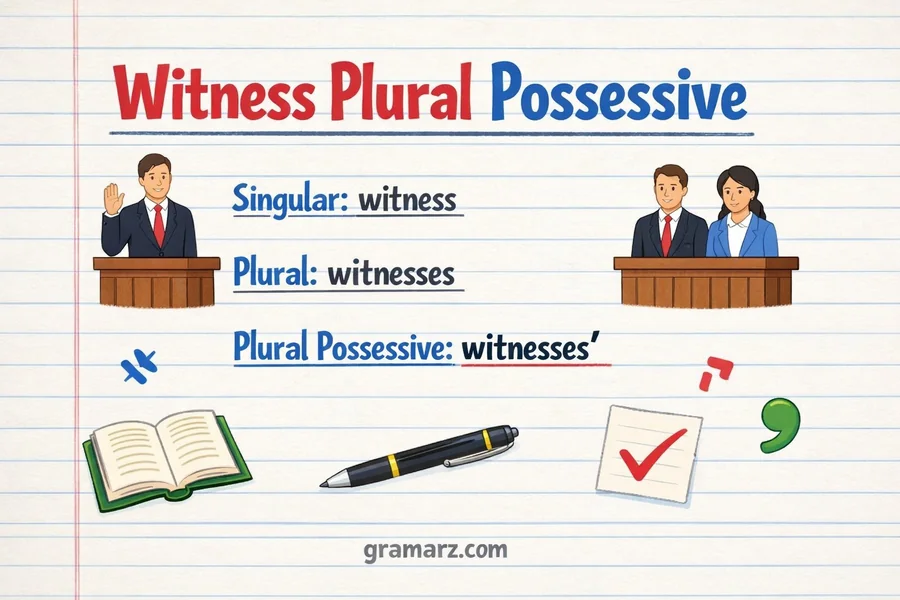
The witness plural possessive shows that something belongs to more than one witness. We write it as witnesses’ with an apostrophe after the “s.” This helps readers know that the item or statement belongs to multiple witnesses. It is used in writing for clear and correct grammar rules.
Many people get confused when writing about witnesses. Using the wrong form can change the meaning of a sentence. Learning the witness plural possessive makes writing easier. It helps you write clearly in legal documents and news reports.
The witness plural possessive is simple once you know the rule. One witness uses witness’s, but many witnesses use witnesses’. Following this rule shows good writing precision and correct apostrophe usage. It is useful for students, journalists, and writers.
The Basics: Witness vs. Witnesses
Before diving into possessives, it’s important to understand the difference between witness and witnesses. A witness refers to one individual who saw or experienced an event and can provide a witness statement or testimony about it. For example, in a courtroom, a judge might say, “The witness took the stand to testify.” This clearly identifies a single person. On the other hand, witnesses is the plural form used when more than one person observed an event. For instance, “Several witnesses came forward to describe what happened at the scene.” Knowing the singular and plural forms is the foundation for understanding possessive nouns and how to use them correctly in writing.
In writing, especially in legal documents or journalistic grammar, confusing singular and plural forms can lead to misunderstanding. Using witnesses instead of witness may unintentionally imply multiple people are involved. Writing clarity and writing precision depend on choosing the right form before worrying about possessives.
The Possessive Puzzle: Witness’s or Witness’?
Once you understand singular vs plural, the next challenge is forming the possessive. The possessive form shows ownership or association. For a single witness, we typically use witness’s, while for multiple witnesses, we use witnesses’. Some writers also use witness’ as a singular possessive alternative. Knowing which to use is critical in legal writing grammar, journalistic grammar, and professional writing to ensure grammatical correctness and writing consistency.
Incorrect usage of possessives can confuse readers. For example, “The witness statement was reviewed” is different from “The witness’s statement was reviewed.” The first merely identifies the statement, while the second shows ownership: the statement belongs to the witness. Similarly, “The witnesses’ statements were collected” correctly indicates possession by multiple individuals, following plural possessive rules.
Read Also: Hastle or Hassle? Which is Correct?
Witness’s: The Recommended Choice
The singular possessive witness’s is the recommended form according to style guides such as the Chicago Manual of Style and the AP Stylebook. This form is created by adding an apostrophe and “s” to the end of the singular noun. It is the most widely accepted form in both legal reporting and journalistic grammar. Using witness’s ensures clarity and avoids ambiguity about ownership.
For example, in a courtroom setting, a lawyer may write, “The witness’s testimony was crucial to the case.” This clearly indicates that the testimony belongs to one witness. In professional writing, consistent use of witness’s for singular possessives demonstrates attention to detail and adherence to style guide rules.
Examples:
To illustrate, here are some sentences using witness’s:
- “The witness’s testimony helped the jury reach a decision.”
- “We carefully examined the witness’s statement for accuracy.”
- “The lawyer questioned the witness’s credibility during cross-examination.”
These examples show that singular possessive forms are essential for precise legal writing grammar and writing clarity.
Witness: The Alternative
While less common, some writers prefer using witness’ as a singular possessive. This form places only an apostrophe after the singular noun. It is often used when the next word begins with an “s” sound to avoid a double “s” sound, improving readability. However, this form is generally considered less standard than witness’s in the United States.
Examples:
Here are examples of using witness’ in sentences:
- “The witness’ story changed the course of the trial.”
- “We relied heavily on the witness’ account of the events.”
- “The judge considered the witness’ statement carefully before ruling.”
These sentences are acceptable in journalistic grammar and legal reporting, but using witness’s remains the safest choice for consistency and clarity.
When There’s More Than One: Witnesses’
When referring to multiple witnesses and showing possession, the correct form is witnesses’. This plural possessive is formed by adding an apostrophe after the “s” in witnesses. Using witnesses’ properly ensures that the reader understands the statement or action involves multiple people.
For instance, “The witnesses’ testimonies were consistent” clearly communicates that several people provided statements. In legal documents, precise use of plural possessives can prevent misunderstandings and maintain the professional integrity of the text.
Examples:
Here are sentences using witnesses’:
- “The witnesses’ statements were collected at the scene.”
- “The jury carefully weighed the witnesses’ accounts before deliberation.”
- “The witnesses’ testimonies confirmed the timeline of events.”
This usage is critical in courtroom terminology and legal writing grammar for clear communication.
Real-World Applications
Mastering these forms is not just about following grammar rules; it directly impacts writing precision and clarity in real-world scenarios. Correct usage of witness, witness’s, witness’, witnesses’ is essential in courtroom settings, news reporting, and drafting legal documents.
In the Courtroom
In legal settings, lawyers, clerks, and judges rely on precise language. Using witness’s for a single individual and witnesses’ for multiple individuals ensures documents are clear. For example, “The witness’s credibility was called into question” versus “The witnesses’ accounts painted a clear picture of the events.” Misuse could lead to confusion or even affect legal outcomes.
In News Reporting
Journalists covering trials must maintain writing consistency and follow AP Stylebook rules. Using witness’s when referring to a single person and witnesses’ for multiple people avoids ambiguity. Headlines like “The witness’s identity was protected for safety” and “The witnesses’ descriptions helped police sketch the suspect” clearly communicate the correct ownership of information.
In Legal Documents
In drafting legal documents, accuracy is paramount. Affidavits, depositions, and contracts must correctly use possessive nouns. For example, “The witness’s affidavit was submitted to the court” versus “The witnesses’ testimonies were recorded and transcribed for the record.” Misplacement of an apostrophe can change legal meaning and undermine professional credibility.
Common Pitfalls to Avoid
A few frequent errors occur with singular vs plural possessive forms. Some writers mix up singular and plural possessives, forgetting that witness’s is singular while witnesses’ is plural. Others omit the apostrophe entirely, writing “witness statement” instead of witness’s statement, which can confuse readers. Adding an extra “s” to the plural possessive is also a mistake; the correct form is witnesses’, not witnesses’s. Proofreading carefully, following style guide rules, and focusing on writing clarity can prevent these errors.
Pro Tips for Perfect Usage of Witness or Witness’s or Witness
The key to mastering these forms is context. Always consider whether you are writing about one witness or multiple witnesses. Consistency is crucial; choose either witness’s or witness’ for singular possessives and stick with it throughout your document. When unsure, default to witness’s, as it is widely accepted in both Chicago Manual of Style and AP Stylebook.
Reading sentences aloud can also help identify which form sounds natural. Following these English writing tips will improve writing precision and enhance credibility in any professional setting.
Why It Matters?
Correct use of witness, witness’s, witness’, witnesses’ is more than just a grammar exercise. In legal reporting, improper usage can lead to misinterpretation of facts. In journalistic grammar, mistakes may reduce credibility and confuse readers. Precise possessive nouns contribute to writing clarity, demonstrate professional attention to detail, and maintain the integrity of legal documents. Even small errors in plural forms or apostrophe usage can make a significant difference in perception and understanding.
Putting It All Together
To summarize, the following table highlights the correct forms and usage:
| Form | Usage | Example |
| Witness | Singular | The witness took the stand. |
| Witnesses | Plural | Several witnesses came forward. |
| Witness’s | Singular Possessive | The witness’s testimony was compelling. |
| Witness’ | Singular Possessive (alternative) | The witness’ statement was reviewed. |
| Witnesses’ | Plural Possessive | The witnesses’ accounts were consistent. |
Understanding the difference between singular vs plural, singular possessive, and plural possessive ensures your writing is accurate, professional, and precise. Whether you are drafting legal documents, reporting on a trial, or practicing journalistic grammar, mastering witness plural possessive usage will help you communicate clearly and avoid mistakes. Writing clarity and attention to grammatical correctness are the hallmarks of strong professional writing.
Understanding Witness and Witnesses in English Grammar
The words witness and witnesses form the foundation of singular vs plural understanding in English. A witness refers to one person providing a testimony or a witness statement, whereas witnesses refers to multiple individuals observing the same event. Distinguishing these forms ensures writing clarity and prevents confusion in legal documents or courtroom terminology.
In both legal writing grammar and journalistic grammar, accurate identification of singular and plural forms is crucial. Using the wrong form may mislead readers or alter meaning. For instance, reporting “The witnesses statement was reviewed” incorrectly can compromise writing precision. Correct usage demonstrates attention to grammatical correctness and professionalism.
The Singular Possessive: Witness’s Explained
The singular possessive witness’s is formed by adding an apostrophe and “s” to a singular witness. This form is standard in AP Stylebook and Chicago Manual of Style. It indicates that something belongs to one individual, such as a witness’s testimony or witness’s affidavit. Correct usage enhances writing clarity and ensures accuracy in professional contexts.
In practice, “The witness’s statement clarified the events” shows clear ownership. Misusing the form could confuse readers about the subject. Writers following style guide rules and English writing tips maintain writing consistency. Proper apostrophe usage signals professional attention to legal reporting and journalistic grammar standards.
The Alternative Singular Possessive: Witness’
Some writers prefer witness’ as an alternative singular possessive. This form is sometimes used when the next word starts with “s” to avoid awkward repetition, such as in “The witness’ story surprised the court.” While less common, it is accepted in informal contexts and certain journalistic styles, providing flexibility in legal writing grammar.
However, in legal documents and formal writing, witness’s is still recommended for clarity. Using witness’ inconsistently can reduce writing precision. Proofreaders and editors emphasize following style guide rules and maintaining grammatical correctness to ensure readers understand possessive nouns clearly, especially in courtroom terminology or official records.
The Plural Possessive: Witnesses’ in Action
The plural possessive witnesses’ shows that something belongs to multiple witnesses, such as witnesses’ statements or witnesses’ testimonies. This is formed by adding an apostrophe after the “s” in witnesses. It is essential in legal writing grammar, journalistic grammar, and professional reporting to convey ownership clearly.
For example, “The witnesses’ accounts were consistent with the timeline” demonstrates correct plural possessive usage. Misplacing the apostrophe can confuse readers. Using witnesses’ properly ensures writing clarity and maintains credibility in legal documents and courtroom reports. Consistent usage reflects strong writing precision and adherence to style guide rules.
Common Mistakes with Witness Possessives
A frequent error is mixing singular and plural possessives, such as writing witnesses’s or omitting the apostrophe entirely. These mistakes disrupt writing clarity and confuse readers about ownership. In legal reporting and journalistic grammar, accuracy in apostrophe usage ensures that witness statements and testimonies are correctly attributed.
Another common issue is inconsistent usage across a document. For example, switching between witness’s and witness’ without following style guide rules can affect writing consistency. Proofreaders recommend reviewing all possessive nouns carefully to maintain professional standards and enhance writing precision in both legal documents and news articles.
Why Possessive Forms Matter in Legal Writing
Using the correct possessive form is essential in courtroom terminology and legal documents. Errors can change the meaning of a witness statement or testimony, affecting case interpretations. For instance, confusing witness’s affidavit with witnesses’ affidavit could misrepresent the number of contributors. Proper plural forms and singular possessive usage uphold grammatical correctness.
Lawyers, clerks, and journalists rely on precise language for accurate reporting. Maintaining proper apostrophe usage and writing clarity ensures readers understand ownership and context. Following style guide rules like Chicago Manual of Style or AP Stylebook promotes writing consistency, which is vital in legal writing grammar and professional communication.
Read More Articles: 35 Other Ways to Say “Thank You for Your Partnership”
Tips for Perfect Witness Possessive Usage
Always determine whether you are writing about one witness or multiple witnesses before adding an apostrophe. Using witness’s for singular possession and witnesses’ for plural possession avoids errors. Proofreading for writing precision and following style guide rules ensures professional standards in legal reporting and journalistic grammar.
Consistency across a document is key. Avoid mixing witness’s and witness’ arbitrarily. Reading sentences aloud can help identify awkward phrasing. Applying English writing tips and focusing on grammatical correctness strengthens clarity. Attention to these details improves overall writing clarity in legal documents, court reports, and news articles.
Putting It All Together: A Quick Reference
To summarize, singular and plural forms with correct possessives are crucial for writing precision. Witness refers to one individual, while witnesses refers to multiple. Singular possessive is witness’s, alternative singular is witness’, and plural possessive is witnesses’. Accurate apostrophe usage ensures professional legal writing grammar and journalistic grammar.
| Form | Usage | Example |
| Witness | Singular | The witness testified. |
| Witnesses | Plural | Multiple witnesses were interviewed. |
| Witness’s | Singular Possessive | The witness’s statement was clear. |
| Witness’ | Singular Possessive (Alternative) | The witness’ account surprised everyone. |
| Witnesses’ | Plural Possessive | The witnesses’ testimonies matched. |
Mastering these forms strengthens writing clarity, professionalism, and credibility in courtroom terminology, legal documents, and journalistic grammar.
FAQs
What is the plural possessive form of witness?
The plural possessive form of witness is witnesses’, used to show ownership by multiple witnesses.
Which is the correct plural possessive?
The correct plural possessive is witnesses’, not witness’s or witness’.
Is it witness or witnesses?
Witness is singular, referring to one person, while witnesses is plural, referring to more than one.
Is Chris’s or Chris correct?
Chris’s is correct for showing possession, while Chris is simply the name without possession.
Read Also: Fein Definition: Meaning, Usage, and Polite Alternatives
Conclusion
Understanding the witness plural possessive is very important for clear writing. When more than one witness owns something, we write witnesses’ to show that. Using the correct form helps readers know exactly who owns what. Writers, reporters, and students should always check if they are writing about one witness or many witnesses. This small rule makes a big difference in writing clarity. Following simple grammar rules like this also improves legal writing grammar and journalistic grammar. Paying attention to apostrophe usage shows that the writer cares about writing precision and grammatical correctness.
Using witness plural possessive correctly makes all writing more professional. It keeps writing consistent and avoids confusion in legal documents, courtroom terminology, and witness statements. Students and beginners can practice by reading sentences aloud and checking their use of singular and plural possessives. Writers should follow style guide rules like the AP Stylebook or Chicago Manual of Style to improve their skills. Mastering this simple rule builds confidence and ensures every sentence communicates the right meaning. Correct use of witness plural possessive is a mark of careful and clear writing.