A modern lawn is rarely an empty rectangle of grass. Trees, planting beds, walkways, garden borders, play equipment, slopes, and decorative features can turn mowing into a constant exercise in steering and repositioning. That is one reason the navigation system is such an important part of choosing a robotic mower.
When comparing robotic mower options, homeowners should look beyond cutting width and battery capacity. The more useful question is how the mower understands the lawn, recognizes boundaries, responds when it encounters an obstacle, and returns to its intended mowing area.
Understanding those fundamentals also helps homeowners prepare their yards for more reliable autonomous mowing.
How Robotic Mowers Understand the Shape of a Lawn
A robotic mower does not simply drive randomly and hope to cover the grass.
Depending on the model and navigation technology, robotic lawn mowers can use boundary systems, positioning technologies, sensors, mapping, or combinations of these approaches to determine where they should travel.
The result is essentially a digital interpretation of the mowing area. The machine uses that information to remain within designated boundaries while working around features that should not be cut.
The exact technology varies significantly between models, so homeowners should review the manufacturer’s specifications rather than assuming every robotic mower navigates identically.
Why Lawn Mapping Can Improve Obstacle Management
A mower that can build or use a map of the property may have a better understanding of where it has already traveled and where it needs to go.
This matters on lawns containing several planting areas or separate grass sections. Instead of treating every obstacle as a surprise, the mower can use its stored information to plan movement more efficiently.
However, mapping does not mean the machine understands every object in the yard like a human would. Good lawn preparation remains important.
Boundary Systems Keep the Mower Away From Restricted Areas
One of the most established approaches to robotic mowing is defining the edge of the cutting area.
Depending on the model, this may involve a physical boundary wire or another positioning method. The mower uses the defined boundary to distinguish grass that should be cut from areas such as flower beds, patios, driveways, and ponds.
This is especially useful around fixed landscaping features.
A well-defined boundary can be more reliable than expecting the mower to identify every change in surface visually.
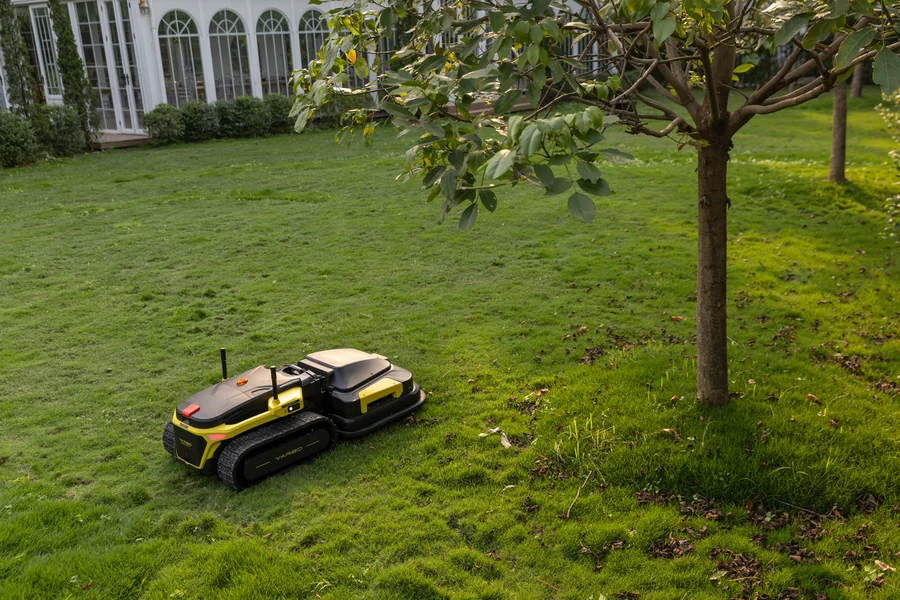
How Robotic Mowers Handle Trees in the Lawn
Trees present an interesting navigation challenge because their trunks occupy relatively small areas while their canopies can cover substantial sections of grass.
When a tree trunk sits inside the mowing zone, the mower generally needs to detect or encounter the trunk and change direction. Depending on the machine, sensors and physical contact detection can help it recognize an obstruction.
Homeowners should not assume that every tree will be handled identically. A thin young tree, a broad mature trunk, exposed roots, and low-hanging branches create different conditions.
Protect Young Trees and Exposed Roots
Small trees deserve special attention.
A young trunk can be more vulnerable to repeated contact than a mature tree. Likewise, exposed roots can interfere with mower movement or create a surface that the machine is not designed to cross repeatedly.
Protective edging or clearly defined exclusion areas can help keep the mower away from vulnerable landscaping.
Planting Beds Need Clear, Reliable Boundaries
Flower beds and ornamental borders are among the most common lawn obstacles.
The cleanest approach is to create a clearly defined separation between grass and the planting area. A distinct edge helps the mower understand where it should stop and reduces the chance of repeatedly contacting delicate plants.
Loose materials can complicate autonomous mowing. Decorative stones, mulch, raised edging, and irregular borders should be evaluated carefully.
The more clearly the lawn transitions from grass to a restricted surface, the easier it is to create predictable mowing behavior.
What Happens When a Robotic Mower Encounters an Obstacle?
Most robotic mowers are designed to detect obstacles or changes in their environment and adjust their movement.
Depending on the technology, this may involve physical contact detection, proximity sensing, lift detection, positioning information, or other sensors.
When the mower encounters something unexpected, it may stop, reverse, change direction, or follow another programmed response.
This is different from a conventional mower operator who can immediately recognize whether an object is a garden hose, toy, branch, or decorative feature.
Remove Temporary Obstacles Before Mowing
Permanent obstacles can be incorporated into the lawn setup. Temporary obstacles should generally be removed.
Before a scheduled mowing cycle, check for:
- Garden hoses
- Children’s toys
- Sports equipment
- Fallen branches
- Tools
- Loose decorations
- Pet items
- Extension cords
Autonomous equipment works best when the mowing area is predictable.
Navigation Around Narrow Passages Requires Extra Planning
Trees and beds are not the only obstacles that matter.
Narrow corridors between a house and planting bed, passages between landscaping sections, or small strips of grass can be difficult for some robotic mowers to navigate efficiently.
Measure narrow areas before purchasing equipment. Compare those measurements with the manufacturer’s minimum passage and operating requirements.
A lawn can look spacious overall while containing several sections that are effectively difficult for a robotic mower to access.
Compare Different Obstacle Types Before Setting Up the Yard
Not all obstacles require the same solution.
| Lawn feature | Main concern | Practical approach |
| Mature tree trunk | Physical obstruction | Define adequate clearance |
| Young tree | Potential repeated contact | Consider an exclusion area |
| Flower bed | Protecting plants | Establish clear boundaries |
| Decorative rocks | Irregular surface | Keep outside mowing zone where appropriate |
| Garden hose | Temporary obstruction | Remove before mowing |
| Patio or driveway | Surface transition | Define mowing boundary |
| Narrow passage | Limited maneuverability | Check mower dimensions and specifications |
| Exposed roots | Uneven terrain | Evaluate whether exclusion is needed |
Thinking about obstacles individually makes lawn preparation much easier.
Lawn Preparation Can Matter as Much as the Mower’s Technology
Homeowners sometimes expect navigation technology to compensate for a poorly organized lawn.
That is rarely a good strategy.
Trim back vegetation that encroaches heavily onto mowing paths. Remove loose objects. Repair damaged edging. Define planting beds clearly. Address holes or abrupt surface changes that could interfere with the mower.
The goal is to create a predictable operating environment.
This is similar to preparing a workshop before using an automated machine: the better the environment is organized, the fewer unexpected problems the equipment has to handle.
How to Set Up a Lawn for More Predictable Robotic Mowing
A practical preparation process can be completed in stages.
- Walk the entire lawn. Identify trees, beds, paths, structures, and narrow passages.
- Separate permanent and temporary obstacles. Permanent features need boundaries or mapping; temporary objects should be removed.
- Inspect lawn edges. Look for damaged borders, exposed roots, holes, or areas where grass has spread into planting beds.
- Identify difficult transitions. Pay particular attention to slopes, narrow corridors, and irregularly shaped sections.
- Follow the mower manufacturer’s setup instructions. Boundary placement, mapping, charging-station positioning, and operating clearances vary by model.
- Observe the first few mowing cycles. Watch where the mower hesitates, repeatedly changes direction, or struggles to access grass.
That final step is valuable because real-world behavior can reveal layout issues that were not obvious during installation.
Common Mistakes That Can Reduce Navigation Reliability
One frequent mistake is assuming sensors make boundaries unnecessary. Depending on the model, the mower may still require a defined mowing perimeter.
Another is leaving objects on the lawn because they seem too small to matter. A garden hose or children’s toy can become a recurring obstacle during an unattended mowing cycle.
Overlooking narrow passages is another common problem. Homeowners often evaluate the lawn’s total area but forget to measure the tightest access points.
Finally, avoid changing the landscape around the mower’s mapped or bounded area without updating the setup. Adding a new garden bed or extending a patio can change the mower’s intended operating zone.
Safety Should Remain Part of the Navigation Plan
Autonomous mowing does not mean a lawn can be treated as completely risk-free.
Keep people and pets away from operating equipment according to the manufacturer’s instructions. Follow all installation, maintenance, and operating guidance supplied with the machine.
The U.S. Consumer Product Safety Commission provides general safety resources for outdoor power equipment and emphasizes following manufacturer instructions and maintaining equipment appropriately. CPSC Outdoor Power Equipment Safety Resources
For additional general lawn and landscape safety information, OSHA’s landscaping resources cover hazards associated with powered equipment, terrain, and outdoor work. OSHA Landscaping Safety Resources
Frequently Asked Questions About Robotic Mower Navigation
Can robotic mowers mow around trees?
Yes, many robotic mowers are designed to navigate around fixed obstacles such as trees. The exact detection and avoidance method depends on the model, so the manufacturer’s specifications should be checked before purchase.
Do flower beds need boundaries?
Usually, clearly defined boundaries are important. Depending on the mower, this may involve boundary wire, mapping, positioning technology, or another manufacturer’s recommended setup.
Will a robotic mower recognize garden hoses?
Some models may detect obstacles, but temporary objects should not be left on the lawn simply because the mower has sensors. Removing hoses, toys, branches, and loose items before operation is a better practice.
Can robotic mowers handle narrow areas?
Some can, but capability varies. Measure narrow passages and compare them with the mower’s specified operating requirements before installation.
What should I do if the mower repeatedly hits a tree or bed?
Review the boundary, map, exclusion zone, or other setup used by your particular model. Also check whether landscaping has changed since installation.
Good Navigation Starts With a Well-Prepared Lawn
Robotic mowing works best when technology and landscape preparation complement each other.
Trees, planting beds, paths, and other permanent features should be accounted for during setup, while temporary objects should be removed before each mowing cycle. Clear boundaries, adequate access, and attention to difficult terrain can make a meaningful difference in how consistently the machine moves through the property.
The most useful way to think about autonomous mowing is not as a machine that magically understands every lawn. It is a piece of equipment that performs best when the lawn gives it clear information and predictable conditions. Prepare the landscape accordingly, and navigation becomes a much more manageable part of automated lawn care.