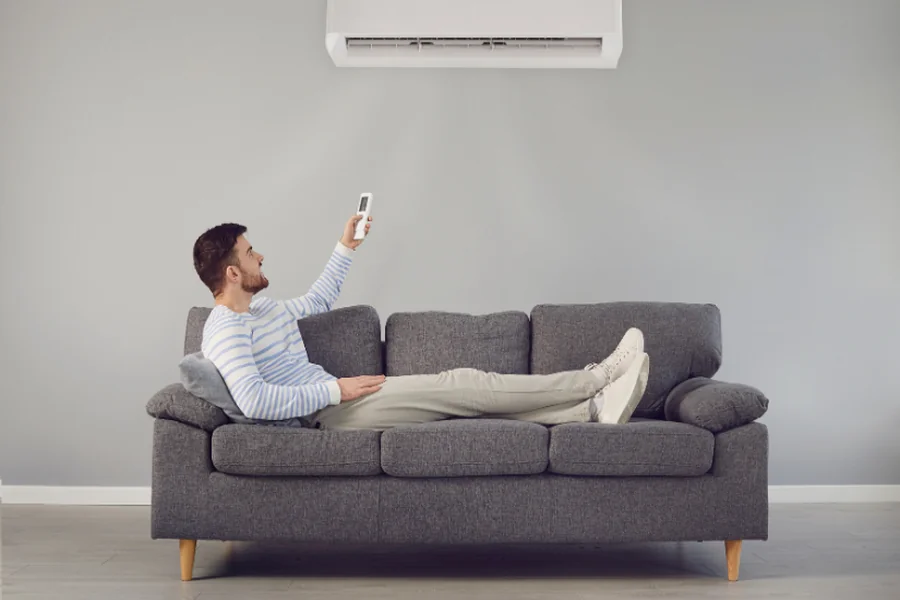
Setting your air conditioner correctly in summer isn’t just about personal preference — it has a direct and measurable impact on your energy bills, your equipment’s lifespan, and your family’s comfort. Affordable Fixes provides professional HVAC support to help homeowners optimize their systems for both comfort and efficiency all summer long. Here’s what the data and industry experts actually recommend.
What Is the Ideal AC Temperature in Summer?
The U.S. Department of Energy recommends 78°F (26°C) as the ideal AC temperature in summer when you’re home. This balances comfort with efficiency for most households under normal conditions. It’s not a universal rule — humidity, home insulation, and personal health needs all affect what feels comfortable — but it’s the most widely supported starting point.
Best Temp for AC in Summer When You’re Home
78°F works well for most adults in good health. If you find it uncomfortable, consider:
- Using ceiling fans to create a wind chill effect (allows raising the thermostat 4°F without discomfort)
- Drawing blinds and curtains on south- and west-facing windows during peak afternoon hours
- Running the AC on “auto” rather than “on” to allow full dehumidification cycles
Each degree you raise above 78°F saves roughly 3% on your cooling costs — a meaningful number over a full summer.
What Is the Best Temperature for AC in Summer When You’re Away?
When no one is home, the DOE recommends setting the thermostat to 85–88°F. Many homeowners resist this, fearing the system will struggle to catch up when they return. In practice, a modern air conditioner recovers to 78°F from 85°F in 30–45 minutes — and the energy saved during 8–10 hours of absence far exceeds the cost of that recovery period.
A programmable or smart thermostat automates this shift so you never have to remember to adjust manually.
Best AC Temperature for Energy Saving in Summer
The best AC temperature for energy savings in summer depends on how aggressively you’re willing to adjust it. A practical tiered approach:
- 78°F when home and active
- 80–82°F when home but sleeping (many people sleep comfortably at slightly warmer temperatures with a fan)
- 85–88°F when away for more than 2 hours
How Each Degree Affects Your Energy Bill
Every degree below 78°F increases cooling costs by approximately 3%. Over a 90-day summer with average electricity rates, that adds up:
| Thermostat Setting | Estimated Monthly Savings vs. 72°F |
| 72°F | Baseline |
| 75°F | ~9% savings |
| 78°F | ~18% savings |
| 82°F | ~30% savings |
Using a Programmable Thermostat to Maximize Savings
A programmable thermostat removes human error from the equation. Set it once — with wake, leave, return, and sleep temperatures — and it automatically manages efficiency. Smart thermostats (like Nest or Ecobee) learn your schedule and adjust in real time, saving an average of 10–15% annually on heating and cooling.
AC Temperature Settings for Summer: Special Situations
Homes with Elderly or Young Children
Older adults and infants are more vulnerable to heat. The American Academy of Pediatrics recommends keeping nursery temperatures between 68–72°F. For elderly individuals with circulation issues or heat sensitivity, 74–76°F is a more appropriate target. Safety takes priority over energy savings in these situations.
High-Humidity Climates Like Philadelphia
In humid regions, perceived temperature is higher than the thermostat reading. At 78°F with 65% indoor humidity, a room feels closer to 83°F. Controlling humidity alongside temperature — through proper AC sizing and dehumidification — allows homeowners to maintain comfort at a higher thermostat setting.Pairing these settings with a competitive pennsylvania energy plan can help offset the added cooling costs that come with managing humidity in this climate.
When Your AC Can’t Hold the Set Temperature
If your system runs continuously without reaching the set point, the problem isn’t your thermostat setting — it’s the system. Common causes include:
- Dirty air filter restricting airflow
- Low refrigerant from a slow leak
- An undersized unit for the home’s square footage
- Ductwork leaks, losing conditioned air before it reaches living spaces
Any of these issues wastes more energy than running the thermostat at a suboptimal setting. Addressing the root cause will save more money than any thermostat strategy.