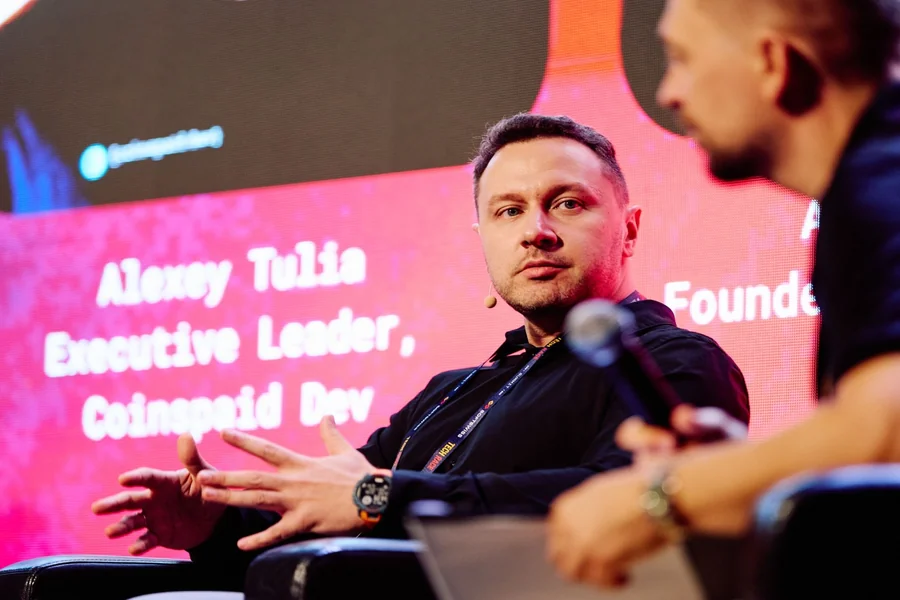
As AI tools move beyond drafting and analysis toward taking real actions inside company systems, engineering leaders face new questions about control and responsibility. Alexey Tulia, Executive Leader at Coinspaid Dev, addressed these challenges at Tech Race Summit 2026 in Warsaw.
As reported by BlockchainReporter, Tulia spoke during the AI Impact in Engineering panel, where he described how the work of engineers and CTOs is changing. His central theme was the next phase of AI adoption. At the moment, most companies treat AI as an assistant that helps prepare documents or examine data. The coming step, in his view, is to connect agents directly to live infrastructure, including sensitive data and deployment pipelines, so they can carry out tasks independently. Once that happens, organisations will have to decide what an agent is permitted to do and who answers for the results of its actions.
A deployment scenario shows how this plays out. Imagine an agent capable of preparing a code change and pushing it to production. The first question is whether it should be allowed to release that change without a person signing off. The second is who takes responsibility if the release breaks something. According to Tulia, a company should not grant such access until several conditions are in place: controls that limit what the agent can touch, audit logs that record its actions, a reliable way to stop it, and a tested process for recovering from a failed deployment. His underlying principle is that accountability grows in importance as machines receive more authority, so any increase in autonomy has to come with clearly assigned authority and human ownership of the outcome.
Tulia also advised CTOs to link AI budgets to a concrete organisational need instead of spending on the technology for its own sake. The areas he prioritised are the ones that let a company adopt new tools safely:
- well-designed APIs;
- dependable, high-quality data;
- automated testing and observability;
- security practices;
- flexible system architecture.
He added that teams need spare capacity for experiments. When a roadmap absorbs every available resource, engineers have no room to evaluate an emerging tool or react when business priorities change. Investments in architecture and in reducing dependence on a single vendor rarely produce quick revenue, but they make it far simpler to switch providers or rework a system when earlier assumptions turn out to be wrong. Tulia summed up this approach by saying he does not have to forecast the future accurately, only to keep the cost of mistakes low.
The daily work of engineers is shifting as well. Because AI speeds up coding and prototyping, Tulia believes engineers should use the time saved to understand the business problem more deeply and stay involved as their work reaches production. Leaders can help by explaining the business context and stating clearly what result a team is expected to deliver. With that in place, productivity can be judged by how correct, maintainable, secure and operationally sound the software is, instead of by how much code gets written.
Looking ahead to 2029, Tulia expects smaller engineering teams to take charge of broader areas of the business, and he predicts that AI will produce most production code. That makes verification and technical judgment even more valuable. The CTO role, he argued, will still call for strong technical expertise combined with business understanding, especially as easier software creation brings more vendors and AI-built systems into companies. For now, his practical advice to engineering leaders is to set safeguards and ownership rules before AI agents are given access to critical production environments. Coinspaid Dev, the company Tulia represents, is an independently owned software engineering firm focused on blockchain infrastructure, with more than 120 engineers, over 11 years of industry experience and systems running across more than 20 blockchain networks.